Estimated article reading time
Why the best tour guides do not memorise every word — and what they should prepare instead

A tour guide is often described as the voice of a destination. But that description is still too limited.
Related reading: For a measurable framework behind guide preparation, delivery and recovery, read Tour Guide Quality Index. For the full guest journey around the guide, continue with Destination Experience Journey Map.
A great tour guide is not simply a person who explains buildings, repeats historical dates, points at landmarks, or answers practical questions. A great guide interprets a destination. They help visitors understand what they are seeing, why it matters, how local people relate to it, and where the guest fits into the story.
This creates an important question for tourism companies, destination management companies, tour operators, and guides themselves:
Should a tour guide work from a full script, or should they carry key facts for the tour and each attraction?
The answer is not “script versus facts.”
The best solution is a professional middle ground: a flexible storytelling system built from verified facts, clear destination themes, attraction-specific narratives, operational knowledge, and approved moments that must be delivered consistently.
A full script can make a new guide feel safe. It can protect quality and ensure important information is not forgotten. But when a guide tries to memorise every sentence, the delivery can become mechanical. Guests can feel that they are listening to an audio recording rather than speaking with a knowledgeable local professional.
On the other hand, a guide who only carries a list of facts may know many interesting details but still deliver a weak experience. Guests do not remember random numbers, disconnected dates, or a long list of rulers, architects, and construction materials. They remember moments. They remember emotions. They remember stories that helped them see a place differently.
The goal, therefore, is not to give guides a document that tells them exactly what to say. The goal is to give them a system that helps them know what story to tell, when to tell it, how long to speak, and how to adapt it for the guests in front of them.
This is how a guide moves from being an information provider to becoming a destination storyteller.
The problem with the traditional tour guide script
Many tourism companies still train guides through long written scripts.
The guide receives a document with pages of history, facts, attraction descriptions, city background, cultural information, and sometimes full sentences to memorise. The company believes this will create consistency. In reality, it often creates a different problem.
The guide begins to sound repetitive.
The group hears the same opening, the same explanation, the same jokes, and the same transitions regardless of whether they are families, honeymoon couples, school groups, senior travellers, corporate delegates, cruise passengers, or luxury guests.
A guest who is visiting Abu Dhabi for the first time may need a simple explanation of the UAE’s history, culture, and geography. A guest who has already visited Dubai, Doha, Riyadh, or Muscat may want a more detailed comparison of the region. A family with children needs shorter stories, visual examples, and interactive questions. A group of architects may want to know about design, materials, urban planning, and the thinking behind a landmark.
One script cannot serve every audience equally well.
Tourism is also an operational business. A guide may face road closures, traffic, late arrivals, attraction queues, weather changes, missed photo stops, unexpected VIP movements, delayed tickets, guests with mobility needs, children who are tired, or a group that asks many questions.
A scripted guide can struggle when the plan changes.
A professional guide should be able to shorten a story from seven minutes to ninety seconds. They should be able to move a cultural explanation from the coach to the attraction entrance. They should know which facts are essential and which details can be saved for guests who want more depth.
This does not mean that scripts are useless.
Scripts are valuable in specific situations. They are especially useful for safety briefings, attraction entry instructions, dress-code explanations, emergency procedures, important legal information, sensitive cultural messages, meeting-point instructions, and official product descriptions.
However, a complete tour should never feel like a script being read aloud.
The guest has not travelled across the world to listen to a brochure.
They have travelled to experience a place.
The problem with using facts only
Some experienced guides reject scripts completely. They prefer to collect facts, stories, personal memories, attraction information, and local knowledge. This gives them freedom, but freedom without structure can create inconsistency.
A guide may know twenty interesting facts about a mosque, museum, palace, souq, desert camp, or heritage village. But the guest does not need twenty facts.
The guest needs meaning.
For example, imagine a guide standing in front of an important landmark and saying:
- It was built in a certain year.
- It has a certain number of domes.
- It used materials from several countries.
- It receives visitors from around the world.
- It is one of the largest landmarks in the region.
These facts may all be correct. But without a story, they may not create an emotional connection.
Now imagine the guide saying:
“Before we enter, notice how this place feels open, calm, and welcoming. It was designed not only as a landmark, but as a place where beauty, faith, craftsmanship, and hospitality come together. As we walk inside, look for the small details: the flowers, the reflections, the light, and the balance between scale and peace.”
The second version may contain fewer facts, but it gives the guest a reason to look, feel, and engage.
Facts support a story. Facts do not replace a story.
The risk of a fact-only approach is that the guide becomes an encyclopedia. The tour may be accurate, but it may not be memorable. Guests can feel overloaded with information and disconnected from the destination.
The strongest guides understand that every fact should answer one of these questions:
- Why does this matter?
- What does this tell us about the destination?
- How does this connect to local culture?
- What should the guest notice?
- What should the guest feel?
- Why is this experience different from somewhere else?
When a fact has no purpose, it becomes noise.
The better model: a tour guide interpretation system

A professional tourism company should create a structured knowledge system rather than a long script.
This system gives guides confidence, protects destination accuracy, improves consistency, and still allows each guide to use their own personality, language, and professional style.
A strong interpretation system has seven layers.
| Layer | Purpose | Example |
|---|---|---|
| Destination promise | Defines what the destination should feel like | Abu Dhabi: culture, calm confidence, hospitality, heritage, innovation |
| Main tour story | Creates one clear narrative for the full itinerary | “From desert roots to a global capital” |
| Attraction story | Explains the meaning of each stop | “This is not only a palace; it is a window into knowledge, governance, and craftsmanship.” |
| Key facts | Gives guides verified information | Dates, names, architecture, purpose, cultural relevance |
| Approved scripts | Protects important messages | Safety briefing, dress code, meeting point, emergency instructions |
| Guest questions | Helps guides create interaction | “What surprised you most about the design?” |
| Operational notes | Protects the service flow | Entrance rules, walking distance, toilets, ticket procedures, timing risks |
This system does not control the guide’s personality. It gives the guide a professional foundation.
A new guide can use it to build confidence. An experienced guide can use it to refresh their content and protect accuracy. A tour manager can use it to ensure that every guest receives the same core message, even when different guides operate the tour.
The guide should not memorise every word.
The guide should memorise the purpose of every stop.
Build the tour around three destination stories
The best tours are not a collection of attractions. They are a journey with a beginning, middle, and end.
Guests should be able to answer one simple question at the end of the day:
“What did I understand about this destination that I did not understand before?”
To achieve this, every tour should have three or four main story pillars.
For an Abu Dhabi city tour, a strong narrative could be built around the following themes:
Heritage and identity How the UAE developed from desert, sea, trade, family values, and community traditions.
Vision and leadership How Abu Dhabi transformed from a small coastal settlement into a global capital through long-term planning, infrastructure, education, culture, and investment.
Culture and openness How the city brings together local traditions, Islamic architecture, international art, global visitors, and multicultural communities.
Nature and balance How the desert, coast, islands, mangroves, and urban environment shape the visitor experience.
Once these pillars are clear, every attraction becomes easier to explain.
The guide no longer needs to ask, “What facts do I know about this place?”
Instead, the guide asks:
- Which destination story does this attraction support?
- What should the guest notice here?
- What should the guest understand here?
- What is the strongest emotional moment here?
- What is the best transition to the next stop?
This creates a tour that feels connected.
For example, Sheikh Zayed Grand Mosque can support the themes of faith, craftsmanship, hospitality, and national vision. Louvre Abu Dhabi can support the themes of cultural dialogue, creativity, architecture, and global connection. Qasr Al Watan can support the themes of governance, knowledge, heritage, and national identity.
The guide is not moving guests from one attraction to another.
The guide is moving guests through a story.
The attraction fact card: what every guide should carry
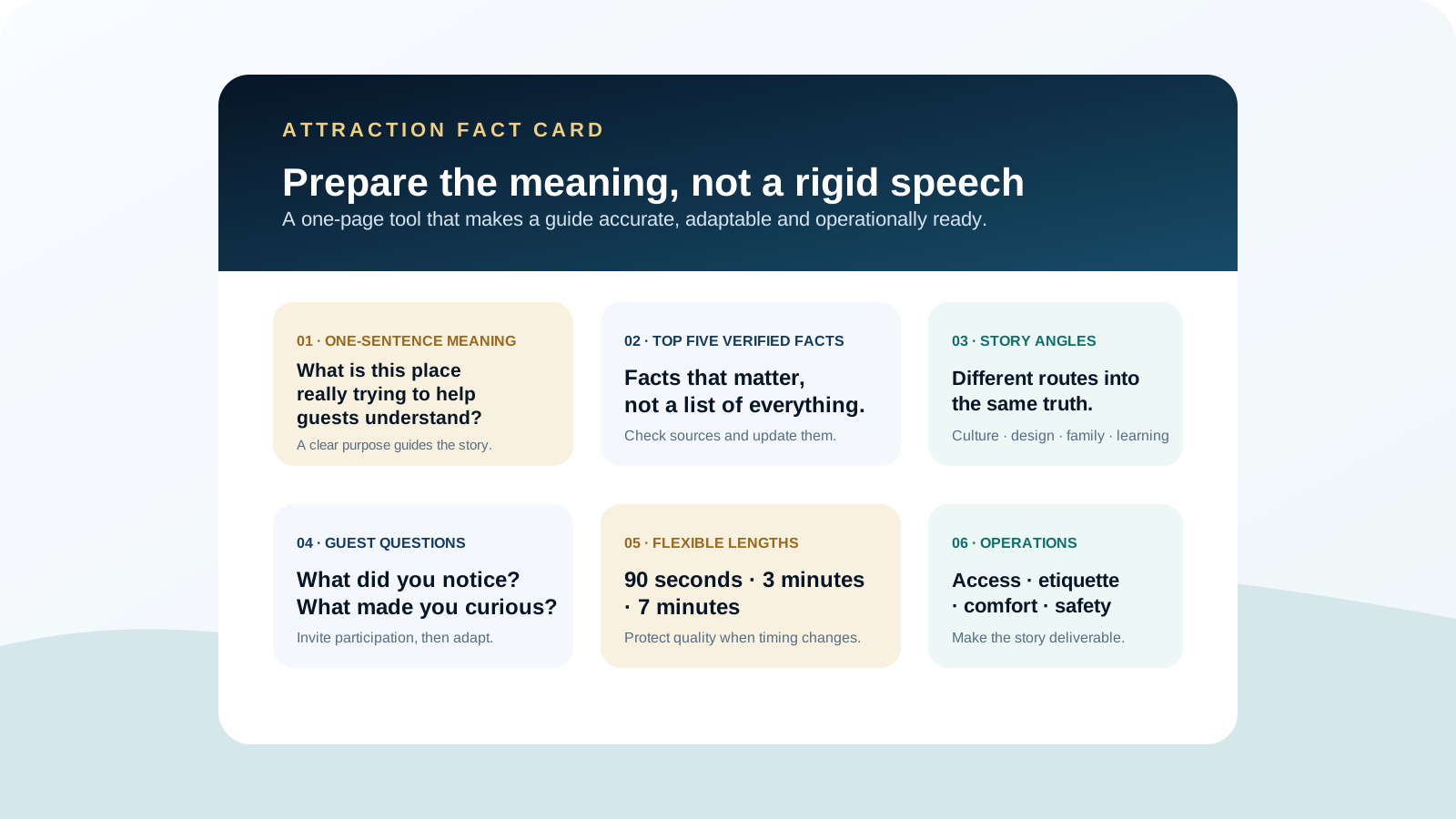
Every attraction should have a simple one-page fact card. It should not be an academic report. It should be a practical guide tool that can be reviewed before the tour, used on-site, and updated when operations change.
A professional attraction fact card should include the following:
1. The attraction’s one-sentence meaning
This is the main message the guide should remember.
For example:
- “Sheikh Zayed Grand Mosque is a place where architecture, faith, craftsmanship, and hospitality meet.”
- “Louvre Abu Dhabi uses art and architecture to connect human stories across cultures and time.”
- “Qasr Al Watan helps visitors understand the knowledge, governance, and cultural confidence behind the UAE story.”
This sentence gives the guide direction.
2. The top five verified facts
The guide should not carry fifty facts. They should carry the five facts that are most useful, accurate, and memorable.
These should be checked regularly through official attraction information, destination authorities, museums, government websites, and approved company resources.
3. Three storytelling angles
Every attraction should have different angles for different guest types.
For example, a mosque may be explained through:
- Faith and cultural etiquette
- Architecture and craftsmanship
- National identity and hospitality
A museum may be explained through:
- Art and civilization
- Architecture and sustainability
- Family learning and interactive discovery
A palace may be explained through:
- Governance and leadership
- Arabian design and craftsmanship
- Knowledge, books, manuscripts, and cultural exchange
4. Three guest questions
Good guiding is not one-way speaking.
The guide should create space for guests to think and respond.
Examples include:
- “What detail did you notice first when you entered?”
- “Does this architecture remind you of any place in your country?”
- “Which part of this story feels most surprising to you?”
- “What do you think this design is trying to communicate?”
- “Would you like to know more about the building, the culture, or daily life in the UAE?”
Questions create engagement. They also help the guide understand what the group wants.
5. A ninety-second, three-minute, and seven-minute version
This is one of the most powerful training techniques for guides.
For every attraction, the guide should be able to explain the main story in three lengths:
- Ninety seconds: for late arrivals, quick photo stops, or busy schedules.
- Three minutes: for standard groups and normal operations.
- Seven minutes: for special-interest groups, small private tours, or guests who ask for deeper information.
This makes the guide operationally flexible.
6. Operational reminders
These may include:
- Dress-code requirements
- Entry procedures
- Security rules
- Photography restrictions
- Walking distance
- Toilets and refreshment opportunities
- Meeting-point location
- Heat-management advice
- Prayer-time or access considerations
- Group-count reminders
- Mobility considerations
A guide can tell a beautiful story, but the experience will still fail if the group gets lost, misses the entry time, stands in the wrong queue, or does not know where to meet.
Professional guiding is storytelling and operations at the same time.
Abu Dhabi example: Sheikh Zayed Grand Mosque
A landmark such as Sheikh Zayed Grand Mosque should never be explained only through scale, numbers, or decorative details.
The guide should help guests understand the feeling and meaning of the place before they enter.
A strong opening could focus on welcome:
“Before we go inside, think of this place as more than a landmark. It is a space of worship, reflection, craftsmanship, and hospitality. You will see impressive architecture, but you will also see how many small details work together to create calm, balance, and beauty.”
The guide can then build the story around three themes.
Theme one: Vision
The guide can explain that the mosque represents a national vision that connects faith, culture, beauty, and openness to visitors from around the world.
Theme two: Craftsmanship
Instead of listing every material, the guide can invite guests to notice the details:
- Floral designs
- Reflective pools
- White marble surfaces
- Patterns and symmetry
- Light moving across the building
- The scale of the prayer spaces
- The contrast between quietness and grandeur
Theme three: Respectful cultural exchange
The mosque is also an opportunity for guides to explain cultural etiquette in a warm and respectful way.
The guide should not speak as if guests are being warned or corrected. Instead, the guide should create understanding:
“This is an active place of worship, so we will enter respectfully. The dress code and visitor rules are part of showing respect for the space and for the people who pray here.”
This creates a better guest experience than simply saying, “You must wear this,” or “Do not do that.”
The guide is not only giving instructions. The guide is explaining the meaning behind the instructions.
Abu Dhabi example: Louvre Abu Dhabi
Louvre Abu Dhabi gives guides a different storytelling opportunity.
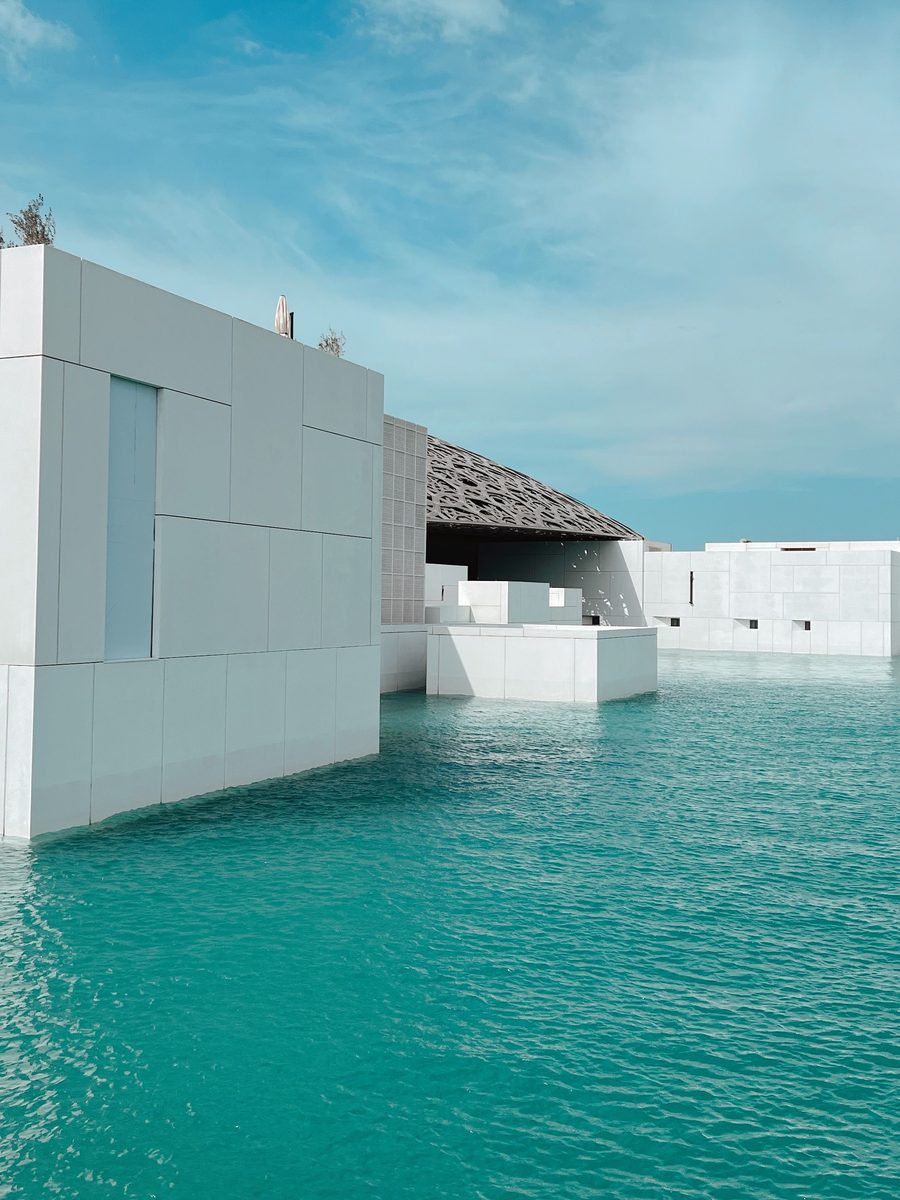
The museum can be presented through art, architecture, sea, light, culture, and human connection. A guide should avoid trying to explain every artwork in the museum. That is not realistic, and it can overwhelm guests.
Instead, the guide can give guests a lens through which to experience the place.
A strong introduction could be:
“This is not a museum that tells only one country’s story. It invites visitors to look at human creativity across different civilizations and periods. As you move through the galleries, you may notice that cultures often influenced each other more than we expect.”
The guide can then focus on three elements.
The architecture
The guide can invite guests to notice how the building interacts with water, sunlight, shade, and movement.
The idea of connection
The guide can explain that the museum’s experience encourages visitors to compare cultures, objects, beliefs, trade routes, and artistic ideas.
The guest’s own discovery
Rather than giving a long lecture, the guide can say:
“Choose one object that makes you curious. It does not need to be the most famous object. Look at it closely and ask yourself: what story does it carry?”
This makes the visit personal.
For families, the guide can turn this into a game. For corporate groups, it can become a conversation about creativity, cultural exchange, and innovation. For art lovers, the guide can provide more context and direct them toward key galleries or temporary exhibitions.
The same attraction can create different experiences without changing the core story.
Abu Dhabi example: Qasr Al Watan
Qasr Al Watan is often described simply as a palace. But a guide should help guests understand that it is not only about impressive interiors and photography.
It is an opportunity to discuss the UAE’s relationship with knowledge, governance, heritage, books, diplomacy, architecture, and cultural confidence.
A guide can frame the experience by saying:
“Many visitors expect a palace to be only about luxury. Here, the deeper story is about knowledge, leadership, design, and the ideas that help shape a nation.”
The guide can then use three storytelling angles.
Governance and leadership
Explain that the space gives visitors an insight into the country’s governing story and national institutions.
Knowledge and learning
Direct guests to the exhibits, books, manuscripts, and cultural references that show the importance of learning and exchange in Arabian and Islamic civilization.
Design and craftsmanship
Invite guests to look beyond the size of the halls and notice the geometry, calligraphy, patterns, colours, and detail.
The best guide does not say, “Take photos for twenty minutes.”
The best guide says, “Take your photos, but before you do, look up. Notice how the design guides your eyes toward the centre, symmetry, and light.”
That is a small change, but it transforms the guest experience.
Where a guide should absolutely use a script
A flexible guide does not mean an unprepared guide.
There are moments where a standard script is essential.
Safety briefing
Safety instructions should be short, clear, and consistent. No guide should invent different safety language every day.
Cultural etiquette
Dress codes, religious-site rules, photography restrictions, and respectful behaviour should be communicated professionally and accurately.
Meeting-point instructions
Guests should know exactly where to return, at what time, what landmark to look for, and what happens if they are late.
Emergency information
The guide should have a standard procedure for illness, lost passports, lost guests, vehicle breakdowns, attraction closures, and weather disruption.
Product inclusions and exclusions
The guide should not accidentally promise an item that is not included in the product.
Guest handovers
Airport pickups, hotel drop-offs, driver handovers, restaurant bookings, and optional-tour sales messages should follow a consistent process.
The difference is simple:
Scripts protect operations. Stories create experiences.
A professional guide needs both.
How to adapt the content for different guests
The same destination should not be explained in the same way to every group.
A guide should adapt the story without changing the facts.
| Guest Type | What They Usually Need | Best Guiding Style |
|---|---|---|
| First-time visitors | Basic context, reassurance, key landmarks | Clear, simple, visual storytelling |
| Families | Short attention spans, interaction, practical comfort | Questions, games, visual examples, breaks |
| Senior travellers | Clear pacing, comfort, accessible explanations | Calm delivery, seating opportunities, clear logistics |
| Cultural travellers | Depth, authenticity, local context | More history, social meaning, traditions |
| Corporate groups | Efficiency, strategic insight, premium service | Strong timing, city development, innovation stories |
| Luxury travellers | Personalisation, privacy, quality, emotional detail | Elegant storytelling, flexibility, curated moments |
| School groups | Participation, learning, safety | Interactive questions, short stories, simple facts |
This is why rigid scripts are limited.
The guide should keep the same core message but change the route into that message.
For children, a guide may ask, “Can you find the biggest dome?” For architecture guests, the guide may discuss symmetry, materials, and urban design. For culture-focused guests, the guide may explain traditions, beliefs, and etiquette. For a business delegation, the guide may connect landmarks to long-term destination development and national vision.
One place. One truth. Multiple ways to interpret it.
Train guides to think, not only to memorise
Tour guide training should not be based only on reading documents.
It should include practice.
A professional guide-development programme can include:
Destination knowledge sessions Teach facts, history, culture, attractions, current operations, and visitor expectations.
Story-building workshops Ask guides to create a ninety-second, three-minute, and seven-minute version of each attraction story.
Field rehearsals Practice at the actual attraction, not only in a classroom.
Peer feedback Let guides observe each other and share what worked well.
Question-bank training Prepare guides for common guest questions about culture, religion, daily life, food, education, work, family, traditions, and local etiquette.
Operational simulations Practice what happens when a bus is late, an attraction is closed, rain starts, a guest gets lost, or the schedule changes.
Fact verification process Ensure guides know which sources are approved and when information must be updated.
The strongest guide teams are not those who deliver identical speeches.
They are the teams that deliver the same quality, the same respect, the same destination story, and the same operational reliability — while still sounding natural.
Measure the quality of the guiding experience
A company should not judge tour guides only by punctuality, uniform, attendance, or complaint numbers.
These are important, but they do not measure the full guest experience.
Guiding quality can also be measured through:
- Guest-review comments about storytelling
- Number of positive mentions of the guide by name
- Guest participation during the tour
- Quality of answers to guest questions
- Repeat bookings and referrals
- Feedback from drivers, operations teams, and attraction partners
- Mystery-guest evaluations
- Time management without rushing the guest experience
- Accuracy of destination information
- Ability to manage unexpected operational changes
A guide who receives comments such as “We learned so much,” “The guide made the city come alive,” “It felt personal,” or “We understood the culture better” is doing more than giving information.
They are creating destination value.
Final thought: the guide should be a storyteller with an operational brain
The future of guiding is not about replacing guides with apps, audio files, QR codes, or artificial intelligence.
Technology can provide information. It can translate text. It can give maps, ticket details, audio commentary, and attraction facts.
But technology cannot easily read the mood of a group standing in front of a landmark.
It cannot always notice that a child is tired, that a guest is confused, that a family wants more photos, that a senior traveller needs a slower pace, or that a visitor is deeply moved by a cultural story.
That is where the human guide creates value.
The best guide does not memorise every paragraph.
The best guide knows the destination deeply enough to choose the right story for the right people at the right moment.
They know the key facts. They understand the attraction. They respect local culture. They manage operations professionally. They listen to guests. They create interaction. They know when to speak, when to pause, and when to let the destination speak for itself.
A rigid script may create consistency.
A flexible interpretation system creates excellence.
For tourism companies, the goal should not be to make every guide sound the same.
The goal should be to ensure that every guide helps guests leave with the same feeling:
“I did not only visit this destination. I understood it.”
Frequently Asked Questions
Should a new tour guide use a full script?
A new guide can use a partial script during the first stage of training, especially for the welcome, safety briefing, cultural etiquette, attraction entry process, and key destination introduction. However, the guide should gradually move from memorising sentences to understanding stories and speaking naturally.
How many facts should a guide share at each attraction?
A guide should focus on three to five memorable facts for a standard stop. More details can be offered when guests show interest, ask questions, or belong to a specialist group.
What is more important: history or storytelling?
Both are important. History gives credibility, while storytelling gives the history meaning. A guide should use accurate history to support a clear and engaging story.
Can guides use personal stories?
Yes, when the stories are relevant, respectful, accurate, and connected to the guest experience. Personal stories can make a destination feel more human, but they should never replace verified information.
How often should tour guide information be updated?
Operational information should be reviewed regularly, especially attraction timings, access rules, ticket procedures, road conditions, dress-code requirements, and temporary closures. Destination facts should also be checked whenever the company updates its product or when official attraction information changes.
Build guides who sound prepared, not scripted.
Quality grows when verified destination knowledge, flexible storytelling and operational discipline are trained together.
Explore the Tour Guide Quality Index → Browse Operations & Quality →