Estimated article reading time
A practical framework for matching people, guest needs, operational context and backup readiness before service begins.
Assigning people in a Destination Management Company is not simply filling a schedule. It is service-quality management, risk control, cost discipline, team development, and guest-experience design.
In a DMC or tour-operator business, guests usually see only the final result.
They see the driver arriving at the hotel. They meet the guide at the lobby. They join the tour, visit the attraction, receive assistance at the airport, and return with an opinion about the company.
Related reading: For the dashboard view that supports these live assignments, read The Fleet Control Tower. For the guide-performance side, continue with Tour Guide Quality Index.
What they do not see is the decision-making behind that experience.
They do not see the operations manager checking whether the guide speaks the right language, whether the driver knows the route, whether the vehicle is suitable, whether the team member has enough rest, whether the group includes children or elderly guests, whether a VIP client requires a more senior guide, or whether a backup person is available in case something changes.
But every one of these details can shape the guest experience.
A wrong assignment can create a chain reaction:
- A guide does not match the guest language or expectations.
- A driver is unfamiliar with the pickup area.
- A vehicle is too small for the group and luggage.
- A coordinator is overloaded and misses a flight change.
- A tired team member makes a mistake.
- A VIP group receives a standard service level.
- A last-minute absence creates panic because no backup was planned.
A good assignment prevents these issues before they happen.
That is why the strongest operations managers do not simply ask:
“Who is free?”
They ask:
“Who is the best fit for this exact operation, this guest profile, this route, this timing, and this level of risk?”
This article explains the practical rules DMC and tour-operator managers can use to assign guides, drivers, airport representatives, coordinators, dispatchers, tour leaders, and operational support teams professionally.
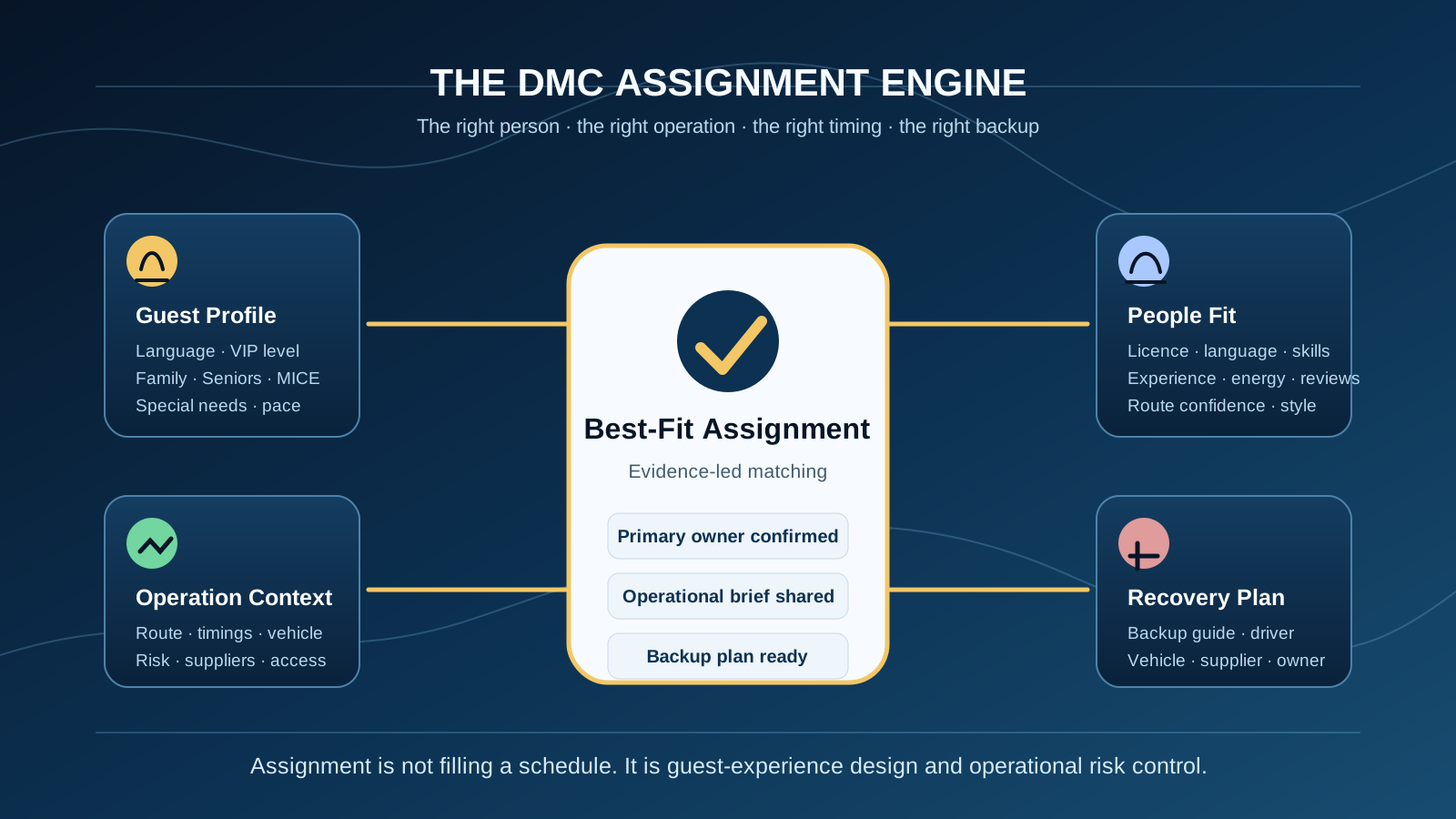
Assignment Is One of the Most Important DMC Management Skills
In a DMC, the quality of the operation depends heavily on people.
A beautifully designed itinerary can fail if the wrong person is assigned to deliver it. A premium vehicle can still create a poor experience if the driver is late, unprepared, or unable to communicate professionally. A well-planned airport arrival can become stressful if the representative does not understand the flight situation, guest names, terminal procedures, or baggage requirements.
Operations managers are therefore not only scheduling staff.
They are matching people with moments that matter.
Every assignment should be treated as a business decision because it affects:
| Operational Area | Impact of a Good Assignment |
|---|---|
| Guest satisfaction | Guests feel recognised, informed, safe, and well cared for |
| Online reviews | Better service delivery increases positive feedback |
| Revenue protection | Fewer complaints, refunds, discounts, and compensation cases |
| Team morale | Fair and intelligent scheduling improves trust |
| Productivity | People work in roles where they are strongest |
| Safety | Qualified and rested team members reduce operational risk |
| Client retention | B2B partners trust a DMC that delivers consistently |
| Brand reputation | The company appears organised, premium, and reliable |
A DMC may have excellent products, attractive rates, strong sales teams, and beautiful destinations. But if daily assignments are weak, the operation will still suffer.
The assignment process is the hidden engine behind service quality.
The Golden Rule: Right Person, Right Task, Right Time, Right Context
The most effective assignment principle is simple:
Assign the right person to the right task, at the right time, in the right context.
This sounds obvious, but it requires discipline.
A person may be available but not suitable.
A person may be experienced but exhausted.
A person may speak the language but not have the right guest-handling style.
A person may be excellent on city tours but not ideal for airport arrivals, cruise groups, desert operations, VIP guests, or large MICE groups.
Before assigning any employee, the operations manager should check four essential areas.
1. Qualification
Does the person have the proper licence, product knowledge, training, and experience?
For example:
- Is the guide licensed for the destination where the tour will operate?
- Does the driver have the correct permit and vehicle experience?
- Is the airport representative familiar with arrival procedures?
- Does the coordinator understand the supplier and booking requirements?
- Is the person trained to manage children, elderly guests, VIPs, or large groups?
2. Availability
Can the person realistically perform the operation at the required time?
Availability does not only mean that their name is blank on the schedule.
It means they have enough time to prepare, travel to the meeting point, complete the task, take a break if needed, and move safely to the next assignment.
A guide finishing a Dubai operation at 14:00 should not be assigned to meet a group at Abu Dhabi airport at 14:30. On paper, the person may look free. In reality, the assignment is impossible.
3. Guest Fit
Does the person match the guest profile?
A VIP private family, a school group, a large leisure coach group, a cruise excursion, a corporate incentive group, and a senior couple all require different strengths.
4. Operational Fit
Does the person understand the route, product, attraction timings, pickup sequence, supplier requirements, and local risks involved in that operation?
A guide may be excellent at heritage storytelling but less confident with high-pressure airport arrivals. A driver may be familiar with Abu Dhabi city hotels but not with Liwa desert routes or cruise-port procedures.
The assignment must fit the full context, not only the job title.
The 10 Rules of Professional DMC Assignment
Rule 1: Never Assign by Availability Alone
The most common operational mistake is assigning the first person who appears free.
This creates weak decisions because it focuses on filling a gap rather than finding the right fit.
Availability should be the first filter, not the final answer.
Imagine three guides are available for a private cultural tour:
| Guide | Languages | Experience | Strongest Type of Work |
|---|---|---|---|
| Guide A | English, Arabic | 2 years | Standard shared tours |
| Guide B | English, French | 8 years | VIP private and cultural tours |
| Guide C | English, Russian | 6 years | Cruise groups and large coach tours |
A French-speaking private family with elderly parents should not be assigned to Guide A just because that person is free.
Guide B is likely the best choice because of language, experience, guest-handling maturity, and cultural-tour strength.
A professional assignment is not about choosing the easiest available option.
It is about choosing the option that gives the guest the strongest experience and gives the team the best chance of success.
Rule 2: Match Skills to the Operation Type
Not all operations are equal.
A city tour, airport transfer, desert safari, cruise excursion, corporate event, wedding group, educational tour, luxury family holiday, and MICE movement all require different abilities.
A good operations manager builds a clear skill profile for every employee.
This profile may include:
- Languages spoken
- Licence type and validity
- Years of experience
- Destination knowledge
- Attraction knowledge
- Airport experience
- Hotel pickup experience
- Desert or safari experience
- Cruise-group experience
- VIP and luxury guest experience
- MICE and large-group experience
- Child and family handling
- Accessibility awareness
- First-aid or safety training
- Supplier coordination ability
- Guest-review performance
- Complaint-handling confidence
- Vehicle or route knowledge
A guide who is brilliant at explaining history and culture may be perfect for museum tours, heritage experiences, and premium private itineraries.
Another guide may be highly organised, energetic, and strong in managing timing. That guide may be more suitable for large coach tours, cruise groups, school groups, and fast-paced operations.
A coordinator who is excellent with bookings and suppliers may not be the best person for live airport arrivals. A person who is calm under pressure and knows flight procedures may be much stronger in that role.
The manager should assign people based on strengths, not only job titles.
Rule 3: Language Is Important, but It Is Not Enough
Language is one of the first things DMCs consider when assigning guides. It is important, but it should never be the only factor.
A guide may speak French, Russian, German, Arabic, or English, but still not be the right choice for every guest group.
The manager should also consider:
- Confidence in the language
- Communication style
- Cultural sensitivity
- Product knowledge
- Ability to manage questions
- Ability to explain local customs respectfully
- Guest-handling maturity
- Experience with that guest nationality or market
- Ability to manage difficult situations in that language
A guide for a VIP family needs more than language. They need discretion, patience, polished communication, flexibility, and confidence.
A guide for a large leisure group needs energy, crowd-management skills, clear instructions, and strong timing discipline.
A guide for a school group needs patience, safety awareness, and the ability to keep young guests interested.
A guide for senior travellers needs a calmer pace, empathy, attention to walking distances, rest stops, and accessibility needs.
The best assignment is not simply the person who speaks the language.
It is the person who can deliver the right experience in that language.
Rule 4: Understand the Guest Profile Before Assigning Anyone
The same tour can require completely different staff depending on the group.
For example, an “Abu Dhabi City Tour” may be:
- A shared tour with 45 guests
- A French-speaking private family
- A corporate delegation
- A cruise excursion with strict timing
- A VIP couple on honeymoon
- A school group
- A senior group
- A family with infants and child-seat needs
- A group with limited mobility
- A luxury travel-agent inspection visit
The tour title alone does not tell the full story.
Before assigning staff, the operations manager should understand:
- Who are the guests?
- What language do they prefer?
- Are they families, seniors, students, VIPs, or corporate travellers?
- Is the booking private, shared, or group-based?
- Are there children, infants, or elderly guests?
- Are there accessibility requirements?
- Is there a special occasion?
- Is the itinerary relaxed, premium, fast-paced, or complex?
- Is the client strategically important?
- Are there dietary, cultural, medical, or mobility requirements?
- Is the group likely to require close attention?
A premium private family should not be handled exactly like a large shared tour group.
Both deserve excellent service, but the delivery style, team member profile, vehicle, pace, communication, and operational preparation should be different.
Rule 5: Protect People From Fatigue
Fatigue is one of the most underestimated risks in tourism operations.
An employee may appear available, but that does not mean they are ready for another demanding assignment.
A tired driver can make mistakes. A tired guide can lose energy, patience, and focus. A tired coordinator can miss a critical change in timing, flights, suppliers, or guest requests.
A strong manager does not schedule only by hours.
They schedule by realistic workload.
Before assigning someone, consider:
- What time did they start work?
- What time did their previous assignment finish?
- How demanding was the previous operation?
- Did they handle a difficult group or incident?
- How far must they travel to the next assignment?
- Do they have enough time for rest and food?
- Is the next operation high-profile, high-risk, or physically demanding?
- Has the person worked several late shifts or early morning shifts recently?
For example, a guide who finishes a desert safari late at night should not automatically be placed on an early-morning airport arrival the next day.
It may be possible on paper, but it is not healthy or sustainable.
Strong operations managers understand that team energy is an operational resource.
When the team is rested, supported, and fairly scheduled, the guest experience improves naturally.
Rule 6: Match People With Route and Location Knowledge
Operational knowledge is often as important as general experience.
A person may be professional and motivated, but every destination has its own practical realities.
A strong assignment considers knowledge of:
- Hotel pickup entrances
- Hotel concierge procedures
- Airport terminals
- Attraction parking areas
- Coach drop-off locations
- Mosque entry rules
- Museum timing procedures
- Cruise-port access
- Traffic patterns
- Road closures
- Event congestion
- Prayer-time impact
- Friday operational changes
- Desert access points
- Restroom locations
- Suitable lunch stops
- Emergency facilities
- Seasonal weather conditions
A driver who knows Abu Dhabi city extremely well may not be the ideal choice for an Al Ain operation or a Liwa desert route.
A guide who performs perfectly in Dubai may need preparation before leading a complex Abu Dhabi cultural itinerary.
The objective is not merely to assign someone who can complete the task.
It is to assign someone who can complete it smoothly, confidently, and professionally.
Rule 7: Build Continuity Wherever Possible
Guests appreciate consistency.
They feel more comfortable when they see a familiar guide, driver, coordinator, or airport representative across several services.
Continuity is especially important for:
- Multi-day groups
- Incentive groups
- VIP families
- Delegations
- Corporate clients
- Wedding groups
- Cruise series
- Long-stay guests
- Luxury itineraries
- Familiarisation trips
- Press trips
- High-value B2B clients
When possible, assign the same guide or driver to the same group across multiple days.
This creates trust.
The staff member learns guest names, preferences, walking pace, food preferences, family dynamics, and expectations. The guest feels recognised instead of treated like another booking number.
For example, if a French-speaking family meets the same guide for their arrival transfer, city tour, museum visit, and departure transfer, the experience becomes more personal and memorable.
Continuity also reduces operational mistakes because the team already understands the group.
Rule 8: Every Important Assignment Needs a Backup
No operation is fully safe without a backup plan.
Guides can become sick. Vehicles can break down. Flights can be delayed. Attractions can close. Traffic can change suddenly. A driver can have an emergency. A supplier can fail to deliver.
A professional DMC manager does not only assign the primary person.
They identify the backup solution.
For each important operation, there should be clarity on:
| Main Requirement | Backup to Identify |
|---|---|
| Guide | Alternative guide with the required language and knowledge |
| Driver | Backup driver or transport supplier |
| Vehicle | Replacement vehicle with suitable capacity |
| Airport representative | On-call coordinator or senior representative |
| Attraction booking | Alternative timing, venue, or itinerary option |
| Supplier service | Secondary approved supplier |
| Guest communication | Approved update message and escalation owner |
The backup does not need to be physically waiting at all times.
But the manager should know exactly what to do before the issue happens.
That is the difference between panic and controlled recovery.
Rule 9: Assign Fairly, Not Through Favouritism
A strong operations manager must protect fairness.
In some companies, the same people receive all premium tours, luxury guests, good tips, easy schedules, and high-visibility assignments. Others receive the difficult groups, early shifts, late shifts, low-value transfers, and last-minute changes.
Over time, this damages morale.
Employees begin to feel that effort does not matter. They may stop giving their best, become less cooperative, or leave the company.
Fairness does not mean that every person gets identical work.
Different people have different skills, performance levels, licences, and experience.
However, the process should be transparent and balanced.
Managers should monitor:
- Total number of assignments
- Total working hours
- Early-morning shifts
- Late-night shifts
- Weekend work
- Premium assignments
- Difficult assignments
- Long-distance routes
- Airport duties
- Large groups
- High-risk operations
- Training opportunities
- Guest feedback
- Complaint cases
- Development progress
The strongest employees may deserve more premium work, but junior employees should see a clear path to improve.
For example:
“When you complete three successful shared city tours, maintain strong guest feedback, and complete the VIP-service briefing, you will be considered for private assignments.”
This creates motivation, fairness, and a professional growth culture.
Rule 10: Every Operation Must Have One Clear Owner
One of the biggest problems in DMC operations is unclear ownership.
Sales may believe operations confirmed the booking. Operations may believe reservations confirmed it. The guide may think the driver received the final pickup list. The driver may think the guide is responsible for guest communication.
This creates confusion.
Every operation needs a clear owner.
The owner does not have to do every task personally. But they must ensure that the operation is properly prepared, monitored, and closed.
For each operation, clarify:
- Who owns the booking?
- Who confirms the supplier?
- Who checks the guide assignment?
- Who checks the driver and vehicle?
- Who sends guest communication?
- Who monitors pickup progress?
- Who handles incidents?
- Who escalates serious issues?
- Who confirms completion?
- Who records guest feedback or complaints?
When responsibility is clear, fewer tasks are missed.
When responsibility is vague, mistakes become invisible until the guest complains.
Role-Specific Assignment Rules in a DMC
Assigning Tour Guides
A guide should be assigned based on more than availability and language.
Check the following:
- Correct licence and destination approval
- Language level
- Product knowledge
- Cultural knowledge
- Group-management ability
- Guest profile fit
- Experience with children, seniors, VIPs, or corporate groups
- Ability to manage timings
- Strong guest feedback
- Route familiarity
- Personal presentation
- Ability to handle complaints calmly
- Health, energy, and workload level
A guide for a premium private guest should be polished, flexible, discreet, and knowledgeable.
A guide for a large group should be organised, energetic, loud enough to manage a crowd, and firm with timing.
A guide for a heritage tour should be strong in storytelling and cultural explanation.
A guide for a family should be patient, warm, and able to keep children engaged.
Assigning Drivers
Drivers are not only transport providers. They are often the first face of the company.
The operations manager should consider:
- Valid licence and required permits
- Vehicle type experience
- Route knowledge
- Hotel pickup knowledge
- Airport experience
- Guest-service attitude
- Professional appearance
- Vehicle cleanliness
- Vehicle capacity
- Luggage requirements
- Child-seat requirements
- Accessibility needs
- Safe driving record
- Knowledge of emergency procedures
- Ability to communicate with guides and coordinators
A driver assigned to VIP guests should understand premium-service behaviour.
A driver assigned to an airport transfer should understand timing, terminal procedures, signage, luggage, and flight monitoring.
A driver assigned to desert operations should have the necessary off-road knowledge and safety preparation.
Assigning Airport Representatives
Airport operations require calm, speed, and strong communication.
An airport representative should be selected based on:
- Familiarity with terminals
- Airline and flight-monitoring knowledge
- Guest-meeting procedures
- Language ability
- Ability to handle delays
- Confidence with baggage issues
- Ability to coordinate drivers
- Ability to communicate professionally with guests under stress
- Knowledge of emergency contacts
- Strong personal presentation
- Ability to work early mornings, late nights, and irregular hours
Airport work is not suitable for someone who needs constant supervision.
The person must be proactive, alert, and able to make quick decisions.
Assigning Operations Coordinators
Coordinators are the people who hold the daily operation together.
They need to be organised, detail-oriented, calm, and capable of managing several moving parts at once.
A coordinator should be assessed on:
- Booking knowledge
- Supplier communication
- Itinerary understanding
- Ability to manage changes
- Accuracy with manifests and guest lists
- Ability to prioritise
- Communication quality
- Knowledge of pickup zones
- Ability to handle pressure
- Ability to follow up
- Escalation judgement
- Attention to special requests
A coordinator should not be overloaded with too many high-risk operations at the same time.
One experienced coordinator may manage several standard tours. But a complex VIP movement, a large event, or a major arrival day may require dedicated ownership.

The Assignment Fit Scorecard
A simple Assignment Fit Scorecard can make decisions more consistent.
The manager can score each possible person out of 100.
| Assignment Factor | Suggested Weight |
|---|---|
| Required licence and qualifications | 20 points |
| Language match | 15 points |
| Relevant product experience | 15 points |
| Guest-profile suitability | 15 points |
| Availability and timing realism | 10 points |
| Route and destination knowledge | 10 points |
| Workload and fatigue level | 10 points |
| Previous guest feedback or quality score | 5 points |
For example, a guide may receive:
| Assessment Area | Score |
|---|---|
| Licence and qualification | 20/20 |
| French language match | 15/15 |
| Abu Dhabi cultural-tour experience | 14/15 |
| VIP family suitability | 13/15 |
| Availability | 10/10 |
| Route knowledge | 9/10 |
| Workload and energy level | 8/10 |
| Guest feedback | 5/5 |
| Total Score | 94/100 |
This score should not replace human judgment.
But it helps managers make faster, fairer, and more professional decisions, especially when the business is handling many tours, transfers, and guest movements every day.
A Practical Example: Assigning a Premium Private Family Tour
Imagine a booking for a private Abu Dhabi experience.
The group includes:
- A French-speaking family of five
- Two adults, two children, and one elderly grandparent
- Premium hotel pickup
- A child-seat requirement
- A relaxed pace
- A cultural itinerary including Sheikh Zayed Grand Mosque, Louvre Abu Dhabi, Qasr Al Watan, and lunch
- A request for a comfortable vehicle and an experienced guide
- A possible airport transfer the following day
A weak assignment would be:
“Assign any French-speaking guide and any available driver.”
A professional assignment would be more thoughtful.
Guide Selection
The chosen guide should ideally have:
- Fluent French
- Strong cultural and heritage knowledge
- Experience with private families
- Patience with children and elderly guests
- Confidence explaining mosque etiquette
- Good timing management
- Strong guest-review history
- Ability to adapt the pace of the day
- Familiarity with the attractions and route
Driver Selection
The selected driver should have:
- A clean, suitable vehicle
- A confirmed child seat
- Good premium-hotel pickup experience
- Strong city route knowledge
- Professional appearance
- Patience with family travel
- Enough rest before the assignment
- Familiarity with parking and attraction access
Operations Preparation
The operations team should ensure:
- Attraction timings are confirmed
- Lunch booking is reconfirmed
- Child seat is installed
- Guest pickup message is sent
- Guide receives a family profile briefing
- Driver receives the final route and hotel entrance details
- Backup guide and vehicle are identified
- The following-day airport transfer is tentatively prepared
This is not excessive planning.
This is what premium service looks like behind the scenes.
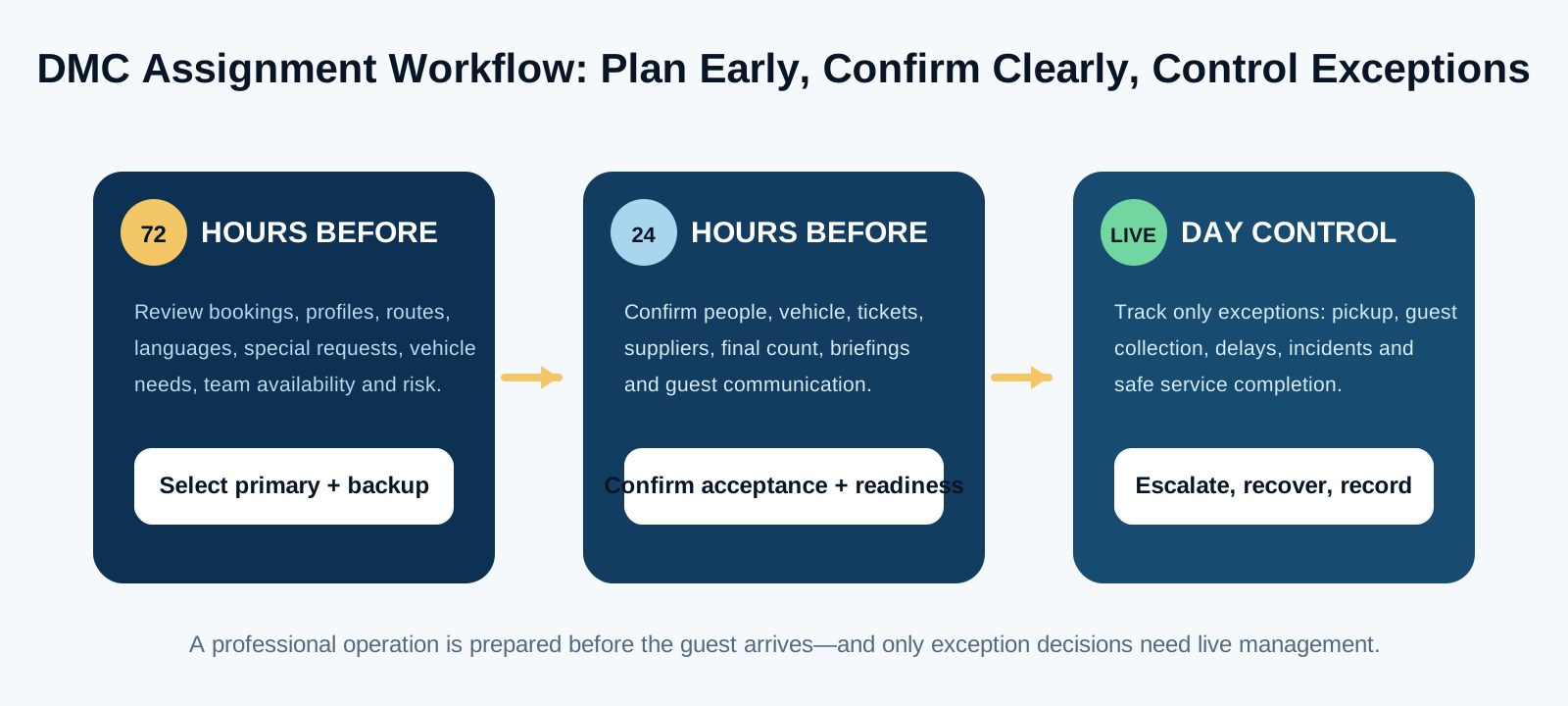
The Daily Assignment Process: 72 Hours, 24 Hours, and Live Day Control
A professional assignment process should not begin on the morning of the operation.
It should happen in stages.
Stage One: Initial Planning — 48 to 72 Hours Before
At this stage, the manager or coordinator should review:
- New bookings
- Group sizes
- Languages
- Flight details
- Special requests
- Guest profiles
- Tour complexity
- Vehicle needs
- Guide availability
- Driver availability
- Supplier status
- High-risk or high-value bookings
- Backup options
This stage is where predictable problems should be prevented.
For example, if a group needs a Russian-speaking guide, a child seat, a premium vehicle, and an airport transfer after the tour, these requirements should be visible early—not discovered on the day.
Stage Two: Confirmation — 24 Hours Before
The day before the operation, the manager should confirm:
- Final guest count
- Pickup location and timing
- Guide attendance
- Driver attendance
- Vehicle type and capacity
- Attraction tickets or reservations
- Supplier confirmations
- Flight status
- Special requests
- Guest contact details
- Emergency contacts
- Backup plan
- Final manifests and briefings
The goal is to reduce uncertainty before the team goes to sleep.
A well-confirmed operation creates a calmer morning.
Stage Three: Live Operational Control — On the Day
On the day of operation, the manager should focus on exceptions.
The team should report status clearly:
- Driver on the way
- Arrived at hotel
- Guest collected
- Guest missing
- Tour departed
- Delayed due to traffic
- Attraction reached
- Incident reported
- Tour completed
- Guest dropped off
The manager should not spend the whole day asking everyone for updates.
A good operation allows people to work independently while escalating only the issues that need management attention.
Common Assignment Mistakes DMC Managers Should Avoid
Assigning at the Last Minute
Last-minute assignments often mean poor preparation, missing information, low confidence, and higher stress for employees.
Some changes are unavoidable. But repeated last-minute scheduling usually indicates weak planning.
Overusing the Strongest Employees
The best guide, driver, or coordinator may be reliable, but assigning them to every difficult operation will eventually create fatigue and frustration.
Strong employees should be valued, not exhausted.
Ignoring Special Requests
A missed child seat, wheelchair requirement, dietary need, language request, or luggage requirement can quickly become a serious guest complaint.
Every special request should be visible before assignment.
Treating Every Tour the Same
A shared city tour, a private VIP family, a cruise group, and a corporate delegation should not receive identical planning.
The guest profile must shape the assignment.
Leaving Responsibility Unclear
When nobody owns the operation, small tasks are missed.
Every tour, transfer, arrival, event, and special movement should have one clearly accountable person.
Forgetting Team Development
Junior team members need opportunities to grow.
They should shadow experienced staff, receive feedback, and gradually move into more complex assignments.
Without development, the company becomes dependent on a small number of experienced people.
A Simple DMC Assignment SOP
A practical Standard Operating Procedure can be built around the following sequence:
- Review the booking and identify guest profile, language, service level, special requirements, and risks.
- Check required role, vehicle, route, timing, supplier needs, and licence requirements.
- Shortlist available team members.
- Compare candidates using skill fit, experience, language, workload, location knowledge, and quality history.
- Select the best primary person.
- Confirm a realistic backup option.
- Send clear briefing details to the assigned team member.
- Confirm acceptance and readiness.
- Monitor only critical exceptions during the operation.
- Record feedback, incidents, and lessons after completion.
This process can be simple, but it must be consistent.
Consistency is what turns a busy DMC into a reliable operation.
Final Thought: Assignments Create the Guest Experience Before the Guest Arrives
The guest may never see the internal schedule.
They may never know how many phone calls, checks, decisions, and adjustments happened before their pickup.
But they will feel the result.
They will feel it when the right driver arrives on time. They will feel it when the guide speaks their language naturally. They will feel it when the route is smooth, the vehicle is suitable, the pace is comfortable, and the team already understands their needs.
That is why assignment is not a small administrative task.
It is one of the most important responsibilities in a DMC operation.
The best managers do not simply fill empty spaces in a schedule.
They build the right team around every guest journey.
And when the right person is assigned to the right operation, the company gains more than smoother logistics.
It gains stronger service quality, better reviews, lower risk, happier employees, more loyal clients, and a reputation that grows with every successful operation.
Build stronger guest journeys by assigning for fit—not availability alone.
Professional assignment joins language, service level, operational readiness, workload, route knowledge and clear recovery ownership before the guest arrives.
Read Fleet Control Tower →Browse Operations & Quality →