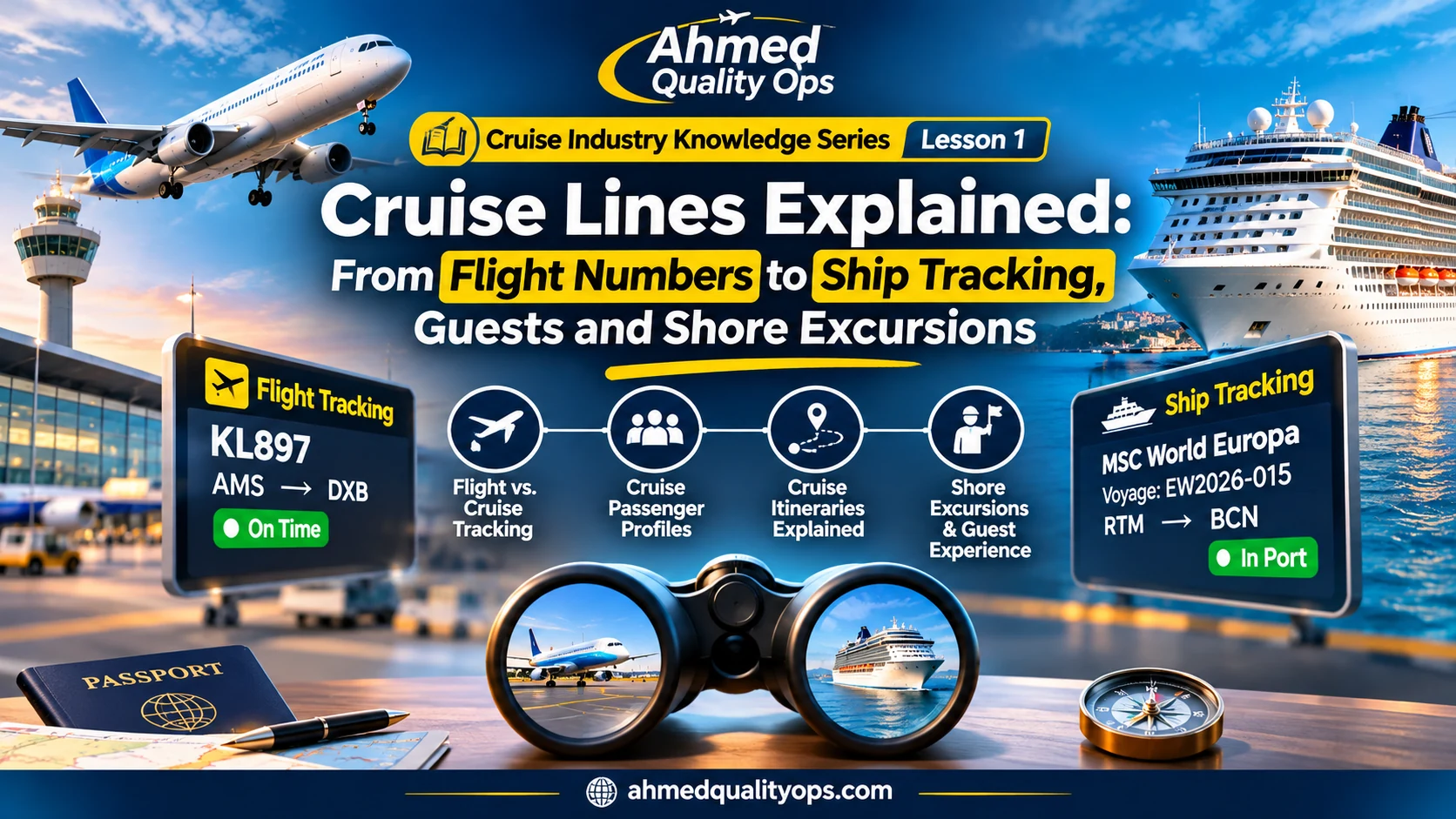
Cruise Lines Explained: From Flight Numbers to Ship Tracking, Guests and Shore Excursions
Ahmed Quality Ops | Cruise Industry Knowledge Series | Lesson 01 of 10
Start here. A cruise is more than a ship moving between ports. It is a travel product that combines accommodation, transport, hospitality, destinations and the choices guests make before and during a holiday. This guide explains that product in plain language and introduces the tools used to research cruise ships, itineraries and ports.
What you will learn
By the end of this lesson, you should be able to explain what a cruise line sells; distinguish an ocean cruise from a river cruise; identify broad guest profiles without stereotyping passengers; read the basic elements of an itinerary; explain a shore excursion and how it differs from a city tour, private tour or independent visit; understand the role of local destination businesses; and research cruise information using appropriate sources.
The guide also introduces videos from the Ahmed Quality Ops YouTube channel. They are placed where they add a useful example, not collected as unrelated promotional links. Each player has a direct YouTube fallback for readers who prefer to watch there.
1. What is a cruise line?
A cruise line is a business that markets and arranges passenger voyages aboard cruise ships. The product normally brings together transportation between destinations and an onboard experience that may include a cabin, meals, entertainment, recreation and other services. The exact inclusions depend on the brand, fare and voyage.
That combination is what makes cruising distinctive. A passenger who books a hotel usually chooses the accommodation and organizes travel separately. A passenger who books a flight mainly buys transport between airports, even when the airline also sells packages or ancillary services. A passenger booking a cruise commonly buys a moving holiday environment: the accommodation travels with the guest while the destination changes.
A cruise line is not the same thing as a ship. The line is the brand or business offering the holiday. A cruise ship is the individual vessel. A cruise itinerary is the proposed sequence of destinations and sailing days. A port of call is a place the vessel visits during the voyage. These distinctions matter when reading schedules and comparing products.
Cruise brands also differ. Some focus on family entertainment and large ships; some emphasize smaller vessels, premium service or destination-focused itineraries; others specialize in rivers or expedition travel. Those descriptions are broad product characteristics, not rankings of quality. A good travel recommendation starts with the guest's interests, not the assumption that the largest or most expensive ship is best.
What is usually included—and what may cost extra?
A cruise fare commonly covers the booked accommodation, the voyage itself and a selection of meals and onboard facilities. But guests should check the exact terms. Specialty restaurants, certain beverages, internet access, excursions, spa treatments, gratuities or service charges, and other products may be included, optional or separately priced depending on the line and fare.
For a beginner, the key question is not simply “How much is the cruise?” It is “What does this fare include for this particular guest and itinerary?” Two fares that look similar can represent different overall holiday costs.
Watch from Ahmed Quality Ops: Why are cruise cabins so small?
A large ship can contain many facilities while individual cabins remain compact. This short video introduces the relationship between passenger space and the broader ship experience.
Ahmed Quality Ops · YouTube Short · Watch on YouTube
Related reading: Destination Experience Journey Map explains how different parts of a travel experience connect from the guest's perspective.
2. How the cruise industry fits into tourism
Cruising connects several parts of the travel economy. The cruise line offers the voyage. A travel advisor or agency may help a customer select and book it. A port or terminal receives the ship and its passengers. Local tourism companies offer sightseeing, attractions, transfers, guides and other destination experiences. Hotels and airlines may also form part of the wider trip when guests travel to or from the embarkation city.
This is why cruise tourism is not separate from traditional tourism. It is another way for travelers to consume destinations. A person may visit Amsterdam on a cruise, on a weekend city break, during a business trip or as part of a longer escorted tour. The destination may be the same, but the visitor's available time, priorities and booking conditions can be very different.
A cruise passenger might have only part of one day to visit a city. Another traveler staying in a hotel might have three nights. That difference affects what each guest can reasonably enjoy. A museum visit, a canal cruise and a walking tour could be suitable for both, but the cruise visitor may need a more carefully timed experience.
Cruise lines versus airlines
Cruise lines and airlines both publish schedules, sell limited capacity and offer different service levels. Yet the core holiday proposition is different.
| Question | Cruise line | Traditional airline | Low-cost airline model |
|---|---|---|---|
| Main purchase | Voyage and onboard holiday | Air transport, sometimes with bundled services | Air transport, often with more optional charges |
| Guest's space | Cabin and shared ship facilities | Seat and aircraft cabin | Seat and aircraft cabin |
| Typical journey | Multiple days | Usually hours | Usually hours |
| Destinations | Several ports may be part of one holiday | Arrival airport is normally the transport endpoint | Arrival airport is normally the transport endpoint |
| Extra purchases | Excursions, dining, drinks, activities | Seats, bags, upgrades, other services | Often bags, seats, priority options and other services |
These are general patterns, not rigid categories. Airlines vary, and cruise fares can be more or less inclusive. A low-cost airline is not a direct equivalent of a budget cruise line: the underlying product remains different.
The useful comparison for tourism learners is journey design. An airline takes a traveler to a destination; a cruise can make the journey, accommodation and sequence of destinations part of one product. A DMC may support either traveler with local experiences.
Related reading: Tourism Operations Roles: Responsibilities and Differences introduces the businesses and roles involved in destination tourism.
3. Flight tracking versus cruise tracking: the comparison that makes everything click
A tourism professional who already understands airport arrivals has a useful starting point for learning about cruises. In both industries, a published schedule answers what is planned, while a tracker helps answer where the vehicle appears to be. Neither necessarily answers when the guest is ready to meet a driver or guide.
Flight number versus cruise voyage number: are they the same thing?
Not exactly. An airline flight is commonly searchable by an airline code plus a flight number and a date. A cruise holiday can have a voyage number, sailing ID or departure code, but formats vary by cruise line. There is no universal consumer-facing cruise-trip number that works like a flight number on every public ship tracker.
| Identifier | What it identifies | Where to find it | Can it track a live journey? |
|---|---|---|---|
Flight number (fictional AB123) | An airline's scheduled flight service; the same number can recur on different dates | Airline ticket, booking, airline or airport website | Search with date; confirm operating carrier, especially codeshares |
| Airline booking reference / PNR | A particular reservation, not the aircraft | Passenger's confirmation | No; keep private |
Cruise voyage / sailing code (fictional VOY-27B) | A specific cruise departure or operator-defined voyage | Cruise confirmation or line's itinerary page | Usually not directly on AIS tracking sites |
| Ship name | A named vessel | Cruise line itinerary and booking documents | Often, but names can be similar or change |
| IMO number | A vessel's long-term identification, usually retained across name changes | Vessel particulars and maritime databases | Useful for identifying the correct ship, not the sailing or guest |
| MMSI | A radio identity used with AIS and other maritime systems | Vessel details on maritime trackers | Useful for finding AIS records; not a guest booking ID |
A voyage number does exist in maritime data standards: the International Maritime Organization defines it as an operator-assigned reference for a ship's voyage. That does not mean every cruise line displays one to consumers or that the same code is accepted by every tracking website. The IMO number identifies the ship, while a voyage code identifies a particular trip. This distinction is essential. IMO voyage and ship identifiers.
Practical flight lookup: Start with the flight number and travel date; check the airline's official status page, then the destination airport's arrivals board. Compare a tracker such as FlightAware or Flightradar24 for aircraft-position context. When a ticket shows a codeshare flight, check the operating airline as well. A flight number without a date may refer to a different day's operation.
Practical cruise lookup: Start with the cruise line, ship name and sailing date; confirm the route on the line's official itinerary. Find the ship's IMO number if necessary to distinguish similar names. Check the official destination port calendar for the relevant date. Finally, search the vessel name, IMO or MMSI on MarineTraffic or VesselFinder to see available AIS context. The cruise's reservation number is not a public tracking number, and AIS does not confirm when passengers can disembark.
Illustrative example (not a live trip): A traveler gives you flight AB123 on 12 May and a cruise sailing code VOY-27B departing 14 May aboard Example Voyager. You would search AB123 plus 12 May in flight-status tools. For the cruise, you would find Example Voyager on the cruise-line itinerary, confirm the actual ship identity, then check its scheduled port calls and AIS location separately. Never treat either fictional code as a real schedule.
Figure 1 — An educational comparison of identifiers, published schedules, live-position data and the separate question of when the guest is ready. Graphic is illustrative; verify the source data for any real journey.
Case A: You are collecting a guest from an airport
Imagine a fictional flight scheduled to arrive at Amsterdam Schiphol at 10:00. You have arranged a private transfer for a family of four. At 08:30, a public tracker displays a revised estimated arrival of 10:45.
The natural reaction is to change the pickup time by 45 minutes. But that would overlook several different events. The aircraft may land at 10:45, taxi to its stand, allow passengers to disembark, and then the family may need to complete border procedures and collect baggage. Their arrival at the meeting point could be considerably later. Alternatively, the tracker might display a gate-arrival estimate rather than a runway landing estimate. These are not interchangeable.
A reliable beginner's research sequence is to identify the airline and flight number, check the airline's own flight-status page, compare the airport's arrivals information, and use a service such as FlightAware or Flightradar24 for supplementary context. If information conflicts, do not silently select the most convenient estimate. For passenger instructions and changes to the booking, the airline and relevant airport remain more authoritative than a third-party map.
FlightAware explicitly distinguishes runway events from gate events, and explains that some displayed positions are estimates rather than observations. A moving aircraft icon does not tell you whether a family has collected its bags. FlightAware FAQ.
Three clocks to remember: scheduled arrival, aircraft arrival, and passenger meeting time. Each serves a different purpose.
Case B: You are meeting a cruise guest at a port
Now imagine a fictional ocean cruise ship listed to arrive at Rotterdam at 08:00. A ship tracker suggests that the vessel is approaching the port. Does that mean your guest can begin a city tour at 08:00? No.
The ship may need to reach its berth, complete relevant arrival formalities and prepare the gangway or passenger transfer arrangements. The guest must then leave the vessel and reach the agreed meeting point. Some cruise visits use tenders instead of a direct gangway, creating another stage between ship arrival and shore access.
A useful research sequence is to check the cruise line's itinerary, the official port calendar and, where helpful, an AIS-based service such as MarineTraffic or VesselFinder. These tools help you understand the intended voyage and the vessel's reported position. They do not confirm that an individual guest has permission to disembark or that a particular tour meeting point is open.
Three clocks to remember: scheduled port arrival, passenger access ashore, and excursion meeting time. Again, each serves a different purpose.
Side-by-side: what the information actually tells you
| Question | Airline example | Cruise example | Why it matters |
|---|---|---|---|
| What journey was sold? | Flight itinerary and flight number | Voyage itinerary and ship name | Identifies the correct service |
| Where is it expected? | Destination airport | Port of call | Identifies the destination, not necessarily the exact meeting point |
| Where is it now? | ADS-B-based aircraft tracker | AIS-based vessel tracker | Provides location context, subject to coverage and delay |
| Is it delayed? | Airline/airport status and revised estimates | Cruise-line/port updates and revised call information | Estimates can change |
| Has the vehicle arrived? | Runway landing or gate arrival | Port approach or berthing | Arrival is not guest readiness |
| Can the guest leave? | After disembarkation and relevant airport procedures | After authorized ship/port passenger access | Cannot be inferred from map position |
| When should a guide meet them? | Agreed pickup or meeting time | Confirmed shore-excursion meeting time | Requires guest-facing instructions |
| Who changes the booking? | Airline or authorized booking provider | Cruise line or authorized excursion provider | A tracker is not a booking system |
Watch: An airport-transfer example from Ahmed Quality Ops
This short video uses an airport-transfer situation to explain how a visible signal can help a team recognize that something needs attention.
Ahmed Quality Ops · YouTube Short · Watch on YouTube
Watch on the Ahmed Quality Ops channel.
Watch: Airport arrival waves and uneven demand
A second short introduces the idea that arrivals do not always occur at a smooth, predictable rate. This is useful when comparing flight arrivals with concentrated cruise passenger movements.
Ahmed Quality Ops · YouTube Short · Watch on YouTube
Watch on the Ahmed Quality Ops channel.
Watch: Why airport waiting time is a guest-experience question
The following video introduces a quality-improvement example involving airport waits. Here it is included to help readers think about the guest's journey, not to prescribe a cruise-port procedure.
Ahmed Quality Ops · YouTube Short · Watch on YouTube
Watch on the Ahmed Quality Ops channel.
The two industries have different tracking technologies
Aircraft commonly transmit ADS-B information, which flight-tracking platforms combine with other feeds and schedules. Ships commonly transmit AIS information, which maritime platforms use alongside vessel and voyage records. Neither technology should be mistaken for a direct measurement of a guest's readiness.
The technology is useful, but the educational question is more important: What can this source prove, and what does it leave unknown?
Research prompt: Compare a flight arrival with a cruise arrival
You are an educational travel-industry researcher. Compare a flight arriving at [airport] with a cruise ship calling at [port] on [date]. Use only official airline, airport, cruise-line and port sources for schedule and passenger instructions. Use third-party flight or vessel trackers only as supplementary context. Make a table separating scheduled time, estimated time, actual vehicle arrival, passenger access and guest meeting time. Include the exact source URL and retrieval date for every dynamic fact. Mark missing information as unconfirmed. Do not invent a pickup time, disembarkation authorization, berth, gate or excursion meeting point. Finish with five lessons for a beginner tourism professional.
Research prompt: Explain a tracker disagreement
Two websites show different arrival times for [flight number or vessel]. Explain the difference between scheduled, estimated and observed events. Identify what each source is capable of measuring, whether the displayed time is runway/gate or port/berth related, and which authorized organization should confirm guest-facing instructions. Do not declare a winner without supporting evidence. Provide a short, plain-English explanation suitable for a traveler.
4. Ocean cruises, river cruises and expedition cruises
Ocean cruises
Ocean cruises travel through seas and oceans, often visiting coastal cities and islands. Some ships are large, with extensive dining, entertainment and recreation; others are smaller and more destination-focused. Itineraries may include several port days and sea days.
The product can suit travelers who enjoy a combination of onboard activities and changing destinations. It can also suit guests who prefer to unpack once rather than move between hotels in several cities. The best fit depends on the itinerary, the ship, the traveler and the fare.
River cruises
River cruises travel along inland waterways, such as the Rhine, Danube, Seine or Douro. They commonly emphasize scenery, historic towns and cultural experiences. River ships are generally smaller than major ocean resort ships, and the itinerary may include frequent stops close to town centers. This is not a universal guarantee: docking locations, excursion arrangements and access vary.
For the traveler, the river itself is often part of the attraction. The experience may be quieter and more destination-centered, though actual onboard amenities depend on the operator. Navigation can be affected by water levels, locks, bridges and other inland-waterway conditions.
Expedition cruises
Expedition cruises focus on exploration, wildlife, landscapes or remote destinations. Their products can involve specialist guides and activities, subject to weather, environmental rules and local restrictions. They should not be confused with conventional city-focused cruises merely because both involve ships.
Compare the experience
| Feature | Ocean cruise | River cruise | Expedition cruise |
|---|---|---|---|
| Common emphasis | Ship experience plus destinations | Destinations and scenery | Exploration and nature |
| Typical vessel | Wide range, including very large ships | Usually smaller | Often specialist ships |
| Places visited | Coastal ports and islands | Inland towns and cities | Remote or specialist locations |
| Guest considerations | Ship facilities, sea days, port choices | Cultural interests, river route, docking access | Physical requirements, activity rules, changing conditions |
Watch from Ahmed Quality Ops: Why choose a river cruise?
Ahmed Quality Ops · YouTube Short · Watch on YouTube
Try this: Compare two actual published itineraries—one ocean, one river. Rather than declaring a winner, write down which traveler each would suit and why. Check whether the fare includes excursions and how much time is planned in each destination.
5. Who are cruise guests?
There is no single cruise guest profile. A ship can carry people with different ages, interests, budgets, languages, mobility needs and reasons for traveling. Guest profiles are useful only when they help a professional ask better questions. They should never be used as rigid stereotypes or assumptions about individuals.
A first-time cruiser may need clear explanations of cabin categories, included services, embarkation and what happens during a port visit. An experienced cruiser may be more interested in comparing routes, ship features and the differences between cruise brands.
A family group may prioritize activities suitable for children, flexible dining and manageable excursion durations. A couple may focus on scenery, cultural visits or dining experiences. A multigenerational group may need options that suit different energy levels and mobility requirements. A solo traveler may care about single-occupancy pricing, social opportunities and independent activities.
Some travelers choose cruises because they want to see multiple places without repeatedly changing hotels. Others choose a specific ship because of its onboard entertainment. Some care most about a particular destination, a special occasion or a themed voyage. The travel professional's task is to discover the motivation rather than guess it.
Six useful guest profiles — without stereotyping
Figure 2 — Guest interests can overlap; these profiles are conversation starters, not demographic labels.
| Guest interest | What they might value | A useful question |
|---|---|---|
| First-time discovery | Clear explanations and reassurance | “Which part of cruising is new to you?” |
| Family experiences | Flexible activities and suitable excursion pace | “What would everyone enjoy together?” |
| Culture and scenery | Museums, landscapes and time ashore | “Which destinations matter most?” |
| Independent exploration | Freedom and local experiences | “Would you rather explore alone or with a guide?” |
| Accessibility and comfort | Accurate access information and suitable transport | “Are there access requirements we should verify?” |
| Premium or special occasion | Privacy, personalization and service details | “What would make this trip feel special?” |
These are needs-based profiles, not fixed categories. A solo traveler may also need accessibility information; a family may prefer an independent walking tour; and a luxury guest may prioritize culture over exclusivity.
Questions that reveal a guest's real needs
A useful discovery conversation may include:
- Is this your first cruise, or have you cruised before?
- Is the ship itself important, or are the destinations your main priority?
- Do you prefer active sightseeing, relaxed exploration or a mix?
- How comfortable are you with group tours and fixed meeting times?
- Are there mobility, accessibility or dietary needs we should consider?
- Are you traveling alone, as a couple, with family or with friends?
- Do you prefer independent exploration or the reassurance of a guided experience?
- What costs do you expect to be included in the holiday?
These questions help align the product with the guest. They also show why a cruise passenger may be interested in a shore excursion that differs from a standard city tour.
Guest expectations are part of quality
Quality is not simply the number of attractions visited. A guest who values a relaxed experience may be dissatisfied with a rushed itinerary, even if the tour covers many landmarks. Another guest may actively want a busy, information-rich day. The best product matches the promise, pace and actual guest needs.
Related reading: Tour Guide Quality Index explores what makes a guiding experience valuable and consistent from the guest's perspective.
6. What is a cruise itinerary?
A cruise itinerary is the published plan for a voyage. It normally lists the embarkation port, sailing days, ports of call and final disembarkation port. It may also show estimated arrival and departure times.
An itinerary answers the traveler's first question: Where are we planning to go, and when? It does not necessarily answer every question about what can be done ashore. Actual shore time may depend on local conditions, ship arrangements and instructions issued during the voyage.
Basic itinerary vocabulary
- Embarkation: Boarding the ship to begin the voyage.
- Disembarkation: Leaving the ship, often at the end of the voyage.
- Port of call: A destination visited during the voyage.
- Sea day: A day without a scheduled passenger port visit.
- Overnight stay: A call where the ship remains in port overnight.
- Tender: A smaller vessel used to transport guests between ship and shore when the ship is not directly alongside a passenger berth.
- All aboard: The deadline communicated to passengers for returning to the ship.
- ETA / ETD: Estimated time of arrival / departure.
Consider a fictional itinerary: embark in Rotterdam, spend a day at sea, visit Southampton, enjoy another sea day and return to Rotterdam. This is only a teaching example, not an advertised sailing. The same route could appeal to travelers who enjoy sea days and those who prefer a short introduction to cruising. Yet a guest who wants to visit several cities may prefer a different itinerary.
Why ships sometimes leave port earlier than guests expect
The port visit is one part of a wider voyage. A ship may need to continue toward its next destination according to its planned schedule. Local conditions, navigation and port arrangements also matter. Passengers therefore need to follow the actual return instructions communicated for their sailing, not calculate their own deadline from a public departure time.
Watch from Ahmed Quality Ops: Why do cruise ships leave port so early?
Ahmed Quality Ops · YouTube Short · Watch on YouTube
The key lesson is simple: a port visit has a defined time context, and the passenger's personal sightseeing plans must fit the instructions for that voyage.
A seven-day itinerary you can read at a glance
Figure 3 — An example only: embarkation → sea day → port visit → sea day → overnight port stay → another port → disembarkation. It is not a published cruise itinerary.
Day 1: Embarkation. Guests join the ship at its departure port. Day 2: Sea day. The ship sails without a scheduled port visit. Day 3: Port of call. Guests may book excursions or explore independently. Day 4: Sea day. The onboard experience becomes a major part of the holiday. Day 5: Overnight port call. The ship stays in one port overnight; guests must still follow the operator's access instructions. Day 6: Another port of call. Guests have a different destination and sightseeing options. Day 7: Disembarkation. Guests leave at the voyage's final port.
Compare that with an airline itinerary: a flight itinerary typically lists transport segments, connections and departure/arrival times; a cruise itinerary combines transport, accommodation, days at sea and destination visits. A seven-day cruise is not seven flights, and a port of call is not the same as a connecting airport.
7. Shore excursions versus city tours, private tours and independent visits
This is one of the most important distinctions for anyone learning about cruise tourism.
A shore excursion is a destination experience connected to a cruise ship's port visit. It might be a guided walking tour, museum visit, coach sightseeing program, food experience, boat trip or cultural activity. The term describes the relationship to the cruise call; it does not automatically mean the excursion is sold by the cruise line.
A cruise-line shore excursion is offered or arranged through the cruise line or its authorized partners. An independent shore excursion is booked separately with a local provider, marketplace or travel company. Both may visit the same attraction, but booking terms, meeting instructions, cancellation rules and disruption arrangements can differ.
A city tour is a sightseeing product focused on a city. It may be available to cruise passengers, hotel guests, local residents and other visitors. It does not necessarily accommodate a ship's return deadline.
A private tour is arranged for an individual party or closed group, often with greater flexibility over pace and content. A private tour can also be a shore excursion if designed for a cruise visitor.
An itinerary is the plan or sequence of activities and destinations. It is not itself the same thing as a tour: a cruise itinerary covers the voyage, while a shore-excursion itinerary describes an individual activity ashore.
Comparison
| Product | Typical booking route | Defining characteristic | Key question |
|---|---|---|---|
| Cruise-line shore excursion | Cruise line or authorized partner | Linked to a port call and the cruise product | What terms and return arrangements apply? |
| Independent shore excursion | Local provider or marketplace | Booked separately for a cruise visit | Can the guest meet the ship's requirements? |
| Regular city tour | City tour provider | General sightseeing product | Does its timing suit the cruise visitor? |
| Private tour | Private guide or operator | Customized for a party | How much flexibility is actually available? |
| Multi-day land tour | Tour operator or DMC | Travel program across days | How are transport, accommodation and visits combined? |
Example: A guest visits Amsterdam
Imagine two visitors who want to take a canal cruise and visit a museum. The first is staying in Amsterdam for three nights. The second is visiting as part of a cruise voyage and must return to the ship that day.
The activities could be identical, but the second guest needs to consider the ship's actual location, travel to and from the port, meeting instructions and the required return time. A generic tour advertised as “Amsterdam highlights” may not be designed for those constraints.
A local provider should describe what is included, where the experience begins and ends, its duration, accessibility information and relevant booking conditions. The traveler should not assume that every independent tour includes a guarantee about ship departure.
Watch from Ahmed Quality Ops: How does a ship know everyone is back?
Ahmed Quality Ops · YouTube Short · Watch on YouTube
Related reading: Tourism Product Development AI Toolkit can help readers think through the design of a suitable destination experience without inventing supplier capabilities or guest demand.
8. What is a DMC, and why does it matter to cruise tourism?
A destination management company (DMC) is a local tourism business that designs, arranges or delivers destination services, depending on its role and contracts. These services may include sightseeing, transport, guiding, attractions, restaurants, events and tailored programs.
A DMC is not the same as a cruise line. The cruise line sells the voyage; a DMC may help deliver part of the destination experience when guests visit a port. Not every cruise excursion is handled by a DMC, and not every DMC works with cruise lines. Local tour operators, specialist excursion companies and other providers can also serve this market.
For a beginner, the most useful way to understand the distinction is to follow the guest. The guest books a cruise. The ship visits a destination. The guest chooses an activity ashore. A local provider helps make that activity possible. The companies involved may be connected through contracts, marketplaces or direct bookings, but they have different roles.
9. Ten useful websites to understand the cruise industry
The following resources are a learning toolkit, not a ranking of the world's largest cruise companies. Each serves a different purpose. For changing schedules and port information, always verify against an official source and record when you checked it.
| Resource | Website | Best use for beginners |
|---|---|---|
| Cruise Lines International Association (CLIA) | https://cruising.org | Industry structure, terminology, research and professional education |
| CruiseMapper | https://www.cruisemapper.com | Ship profiles and itinerary discovery |
| CruiseTimetables | https://www.cruisetimetables.com | Exploring published cruise schedules and destinations |
| Cruise Port Rotterdam | https://www.cruiseportrotterdam.nl | Learning to read a port's cruise-call calendar |
| Cruise Port Amsterdam | https://sea.cruiseportamsterdam.com | Understanding scheduled calls and port information |
| MarineTraffic | https://www.marinetraffic.com | Maritime geography and AIS-based vessel information |
| VesselFinder | https://www.vesselfinder.com | Vessel research and secondary tracking context |
| Royal Caribbean International | https://www.royalcaribbean.com | Examples of ocean cruise ships, cabins and itineraries |
| Viking | https://www.viking.com | Examples of river and ocean cruise products |
| Cruise Critic | https://www.cruisecritic.com | Passenger reviews, common questions and traveler perspectives |
A responsible research method
Suppose you want to learn which cruise ships are scheduled to visit Rotterdam next month. Start with the official cruise port calendar. Record the vessel name, scheduled date, arrival and departure information where published, and the page you used. Then visit the cruise line's website to understand the ship and its passenger product.
You may use CruiseMapper or CruiseTimetables to explore broader routes. You may use public tracking websites to understand vessel movements. But remember that public tracking can be delayed or incomplete, and schedules can change. Do not present a third-party listing as a guaranteed arrival.
For educational content, it is often sufficient to say: “According to the port calendar checked on [date], this vessel is listed for [date]. The schedule may change.” That wording is more trustworthy than claiming certainty where none exists.
10. More questions cruise passengers ask
Some of the most engaging cruise topics concern the details guests notice but do not always understand. These questions can be explored without pretending to provide a ship-specific rule. Policies and practices vary between cruise lines, vessels, destinations and situations.
Why might a cruise line hold a passport?
Passport procedures depend on itinerary, nationality, destination and applicable requirements. Some voyages may involve collecting or holding travel documents for particular processes, while others do not. Guests should follow the instructions issued for their own sailing and check requirements in advance.
Ahmed Quality Ops · YouTube Short · Watch on YouTube
What happens when passengers do not follow ship rules?
Cruise ships have rules and security procedures, and serious incidents may involve designated shipboard authorities and law-enforcement processes. The existence of a security holding space should not be sensationalized or treated as identical across all ships.
Ahmed Quality Ops · YouTube Short · Watch on YouTube
What about everyday life onboard?
Guests may wonder how laundry, towels, meals and waste are handled on a large ship. Those subjects reveal the scale of the onboard hospitality environment, but they deserve their own detailed lessons. In this introductory article, they serve as a preview of what the series will explain next.
Ahmed Quality Ops · YouTube Short · Watch on YouTube
To avoid making this first lesson excessively long or repetitive, the deeper videos about catering, waste, medical situations and passenger emergencies should be embedded in the dedicated lessons where their subject is explained properly.
11. Research prompts you can reuse
These prompts are designed for learners and travel professionals. They can be used with an AI assistant that has access to reliable source material. When current facts matter, request sources and verification dates. Never ask the AI to invent a port schedule, booking terms or a cruise company's policy.
Prompt 1 — Understand a cruise line
Act as a cruise-industry educator. Explain [cruise line] for a beginner. Identify its main cruise product types, examples of ships and itineraries, the kinds of guest experiences it markets, and what is commonly included or optional. Use official company sources, provide links and dates checked, distinguish verified facts from generalizations, and avoid unsupported rankings.
Prompt 2 — Compare two cruise holidays
Compare [ocean cruise itinerary] and [river cruise itinerary] for a traveler interested in [interests]. Explain destinations, sea or river days, onboard experience, likely pace, and questions about inclusions, accessibility and optional excursions. Use official itinerary pages. Do not invent prices or available dates. End with questions the traveler should ask before booking.
Prompt 3 — Identify a guest's preferences
Act as a neutral travel advisor. Ask me eight concise questions to understand whether an ocean cruise, river cruise or land-based holiday would suit my interests. Do not infer preferences from age or nationality. After I answer, explain the trade-offs and give me a checklist of details to verify before booking.
Prompt 4 — Understand a cruise itinerary
Explain this published cruise itinerary to a first-time traveler: [paste itinerary]. Define embarkation, sea days, ports of call, overnight calls, tendering and disembarkation where relevant. Identify information that is missing. Do not assume that the ship's scheduled departure is the passenger's all-aboard deadline. Provide a glossary and a list of questions to ask the cruise line.
Prompt 5 — Research a port call
Research planned cruise calls at [port] for [date range]. Start with the official port or terminal calendar and cite its URL and retrieval date. Present the vessel, date and published schedule only when verified. Flag any unavailable or conflicting information. Explain that schedules are subject to change and that the results are for research, not operational confirmation.
Prompt 6 — Compare shore excursions and city tours
Explain the difference between a cruise-line shore excursion, an independently booked shore excursion, a regular city tour and a private tour for [destination]. Compare booking responsibility, timing, flexibility, meeting points and questions about cancellation or missed-ship scenarios. Do not invent provider guarantees. Create a traveler-friendly decision checklist.
Prompt 7 — Build a destination learning plan
I am new to cruise tourism and want to understand [destination] as a cruise port. Explain the main visitor attractions, typical kinds of excursions, local geography and useful public research sources. Separate established facts from suggestions. Do not claim firsthand experience or current supplier availability. Suggest a three-day self-study plan.
Prompt 8 — Fact-check an educational article
Review the following draft cruise-industry article: [paste text]. Flag statements that require a source, statements that overgeneralize across cruise lines, potentially misleading passenger advice, outdated information, and claims of experience not supported by the author. Suggest precise, neutral rewrites. Do not fabricate citations. Return a table with claim, concern, recommended correction and verification source type.
Five-question knowledge check — test yourself
1You know flight AB123, but not its travel date. What is missing?
- Nothing
- The date and possibly operating airline
- A ship name
Answer: B. Flight numbers can recur, and codeshares may show different marketing and operating flight numbers.
2Which number most reliably identifies a ship over time?
- A cruise booking reference
- A cabin number
- An IMO number
Answer: C. The IMO number is intended as a persistent ship identifier; it does not identify a guest or a specific sailing.
3A ship appears near Rotterdam on AIS. Can a tour guide assume guests are ashore?
- Yes
- No
- Only if it is sunny
Answer: B. A position report does not confirm berthing, clearance, passenger access or meeting arrangements.
4What does a sea day mean on a cruise itinerary?
- A planned day without a port call
- A canceled voyage
- A free shore excursion
Answer: A. Guests typically spend the day aboard while the vessel sails.
5What distinguishes a shore excursion from an ordinary city tour?
- It must use a bus
- It is connected to a cruise port visit and its timing
- It always includes lunch
Answer: B. Excursions can be operated by cruise lines or independent providers; check terms and return arrangements.
Score: Five correct answers means you understand the core distinctions. If you missed one, revisit the identifier table, tracking case study or itinerary guide before the next lesson.
Conclusion: Understand the guest before the ship
The cruise industry is easier to understand when we begin with the traveler. A cruise line offers a voyage that combines movement between destinations with an onboard holiday. Ocean, river and expedition products create different experiences. Passengers bring different interests, needs and expectations. Itineraries explain where the voyage is intended to go, while shore excursions connect the ship to local tourism.
A cruise passenger visiting a city is still a visitor—but one whose time and booking context may differ from a hotel guest or independent traveler. That is why shore excursions, regular city tours, private tours and multi-day itineraries should be explained as related but distinct products.
For beginners, the goal is not to memorize every ship or cruise brand. It is to understand the vocabulary, know where to research trustworthy information, ask the right guest questions and recognize the limits of published schedules and policies.
Next lesson: Ocean Cruises vs River Cruises — How the Products, Guests, Ships and Destinations Differ.
More from the Ahmed Quality Ops Knowledge Library
- Tourism Operations Roles: Responsibilities and Differences
- Destination Experience Journey Map
- Tour Guide Quality Index
- Tourism Product Development AI Toolkit
- Tourism Sales and Quotation AI Toolkit
Research references
IMO: Ship Identification Number Scheme — stable ship identity.
IMO: Voyage number, MMSI and ship identifier definitions — voyage number is operator-assigned.
IATA: Passenger and Airport Data Interchange Standards — flight number, operating carrier and booking reference distinctions.
FlightAware: tracking and status FAQs — flight position, estimates, gate and runway distinctions.
Cirium: Flight Status & Track — the distinction between flight status and position tracking.
This is an educational introduction. Product features, fares, port schedules and cruise policies can change. Check official sources for the specific voyage before making travel decisions.
Ahmed Quality Ops — Travel, Tourism & Operational Excellence
https://ahmedqualityops.com