Operating gap
Dispatch planning for Amsterdam, Haarlem, Utrecht and Abu Dhabi: connect movement details, passenger capacity, access checks and team handovers.
 Ahmed Mahmoud
Netherlands dispatch planning · Amsterdam, Haarlem and Utrecht
The problem: Dispatch planning for Amsterdam, Haarlem, Utrecht and Abu Dhabi: connect movement details, passenger capacity, access checks and team handovers.
Who it is for: DMC operations teams, dispatchers and transport supervisors.
Scope: Netherlands and UAE
My contribution: I defined the operating rules, information architecture, review gates, interface and static demonstration workflow.

Dispatch planning for Amsterdam, Haarlem, Utrecht and Abu Dhabi: connect movement details, passenger capacity, access checks and team handovers.
I defined the operating rules, information architecture, review gates, interface and static demonstration workflow.
A single rule-based workflow that turns operating inputs into an approved pickup plan, route links, team briefs, manifests and printable handover outputs.
The demonstration shows how one governed plan can replace fragmented coordination and make supervisor review easier before field handover.
Use it before city tours, airport transfers, event movements and any multi-stop operation that needs coordinated guide, driver and vehicle assignments.
Static MVP using mock or browser-local data. It has no live fleet API, authentication, database or production dispatch integration.
A working Dutch planning workspace alongside the original Abu Dhabi demonstration.
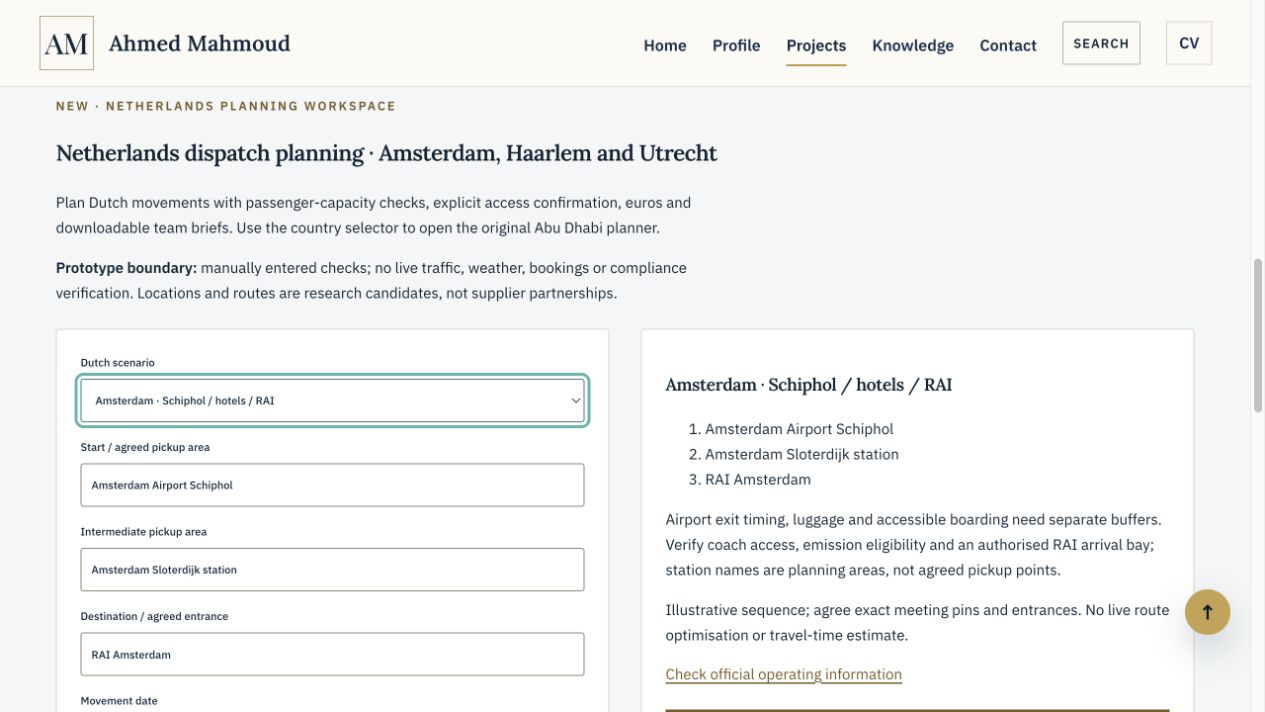
The Dutch extension translates the Abu Dhabi handover approach into airport movements, hotel pickups, event arrivals and a managed astronomy transfer. The workspace offers Amsterdam–RAI, Amsterdam–Haarlem/Overveen and Schiphol–Utrecht/Jaarbeurs illustrative sequences. It uses euros, dated movement plans and operator-entered travel buffers; it does not reuse UAE toll or zone assumptions.
Amsterdam states that coaches heavier than 7.5 tonnes need an exemption inside the S100, with an exception for the published Weesperstraat–Valkenburgerstraat–Kattenburgerstraat route. Check the actual route and vehicle through the municipal exemption guidance. Emission eligibility is a separate check against the bus and coach rules. A Google Maps driving link does not certify either requirement. Utrecht uses its own municipal vehicle-zone guidance; do not copy Amsterdam rules into another city.
Select a city scenario, enter passengers, confirmed passenger capacity, total drive minutes, boarding/luggage buffers and a supplier budget in euros. Capacity overflow blocks the plan; unconfirmed access or team/return arrangements hold it. The output is a downloadable operations brief with the illustrative sequence and a map-review link. Meeting areas are not approved pickup pins.
Before release, record the agreed hotel/airport entrance, flight or event deadline, driver and supplier contacts, luggage and wheelchair capacity, manifest and boarding counts, permitted waiting/parking, venue handover and contingency. For a Schiphol movement, separate flight arrival, guest exit and vehicle boarding times. For an event, separate coach arrival from delegates reaching registration. No personal guest data needs to be entered in the Dutch demo.
Proposed pilot: shadow real movements with an operator before using the plan for dispatch. Measure pickup exceptions, late handovers, capacity conflicts, briefing preparation time and missing confirmations against a recorded baseline. Faster preparation and fewer handover errors are projected benefits, not measured results. Acceptance requires no capacity violations and complete agreed pickup/access details. Live routing, fleet availability and automated compliance are future integrations.
Demonstration boundary: Static MVP using mock or browser-local data. It has no live fleet API, authentication, database or production dispatch integration.