Operating gap
Astronomy experiences in Amsterdam, the Netherlands and the UAE need a clear match between product promise, sky conditions, site access and guest readiness.
 Ahmed Mahmoud
Astronomy experience planning · Amsterdam and the Netherlands
The problem: Astronomy experiences in Amsterdam, the Netherlands and the UAE need a clear match between product promise, sky conditions, site access and guest readiness.
Who it is for: Experience designers, astronomy guides and destination operations teams.
Scope: Netherlands and UAE
My contribution: I designed the condition model, decision language, readiness scoring and the handover between product promise and field delivery.
Astronomy experiences in Amsterdam, the Netherlands and the UAE need a clear match between product promise, sky conditions, site access and guest readiness.
I designed the condition model, decision language, readiness scoring and the handover between product promise and field delivery.
A condition-aware planner that converts supplied conditions into a sell, watch, avoid or block decision with safer guest wording and field briefings.
The demonstration shows how a product team can make a bounded sell, watch, avoid or block decision from supplied operating conditions.
Use it before selling, confirming or operating stargazing tours, astronomy programmes, desert dinners and other condition-sensitive outdoor products.
Static MVP using user-supplied conditions. It does not claim live weather, astronomy, access or safety data.
A working Dutch planning workspace alongside the original Abu Dhabi demonstration.
Use Amsterdam as the guest base rather than promising city-centre darkness. ARTIS Planetarium supports indoor astronomy education and a separately booked weather fallback; it is not an outdoor dark-sky site. Copernicus in Overveen near Haarlem offers a managed observatory option. Its published visitor information describes evening openings from September to May and closure in June–August; special events and group arrangements need confirmation. Its homepage also flags a future relocation, so recheck the actual entrance before each visit. No partnership is claimed.
For nearby guided Moon/planet observation, investigate Copernicus first. For a deeper regional dark-sky experience, Lauwersmeer is a recognised Dark Sky Park with viewing platforms; treat it as a longer-distance programme with a confirmed return or northern overnight base, not a casual Amsterdam city outing. Zuid-Kennemerland’s general access rules limit visits to sunrise–sunset: the Dutch demo blocks a routine night operation there. No unverified beach, park or rural site is presented as an approved commercial night location.
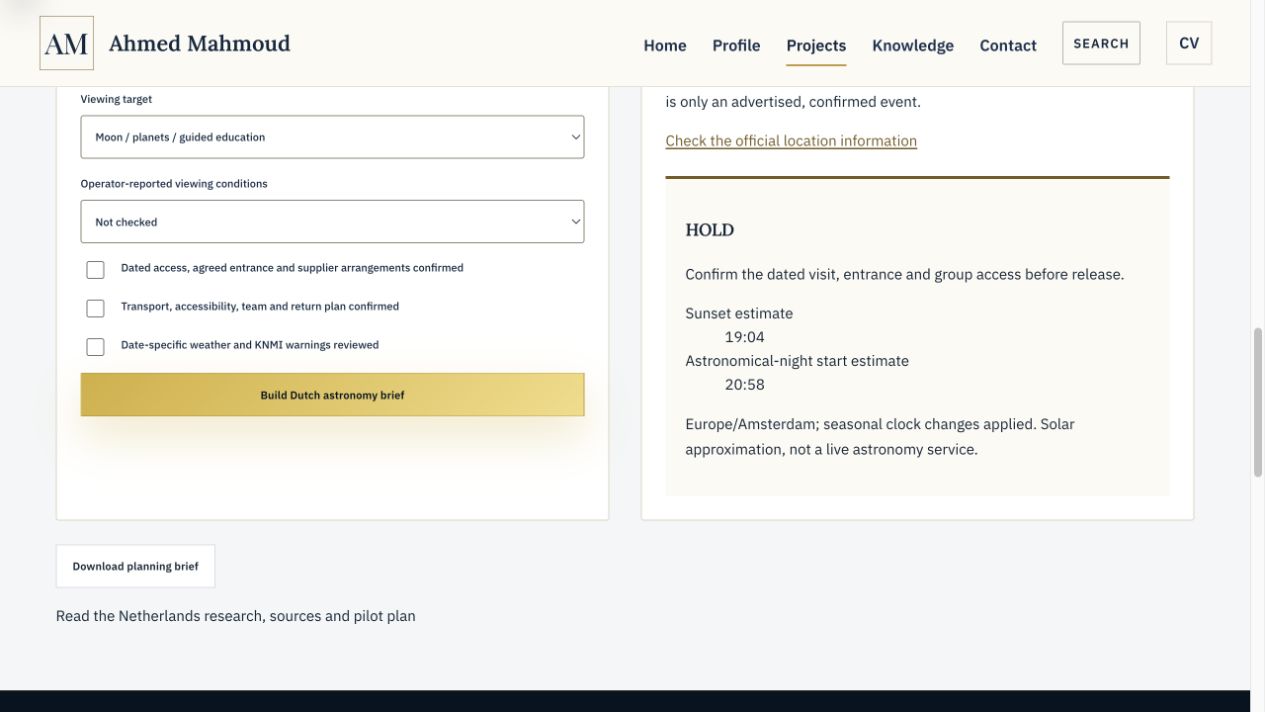
The workspace selects a real programme/site, date and viewing target. It applies Europe/Amsterdam seasonal clock changes and a NOAA-based solar approximation to sunset and astronomical-night onset. If the Sun never reaches 18 degrees below the horizon on that date, it reports that astronomical night does not occur; it does not invent a midnight darkness time. Coordinates are approximate area references, not meeting pins. Moonrise, Moon altitude and object visibility need a separate verified ephemeris or on-site astronomy tool.
A cloudy evening can still support a separately confirmed indoor astronomy programme, but cannot be sold as guaranteed outdoor stargazing. The Dutch workspace holds an unconfirmed visit, blocks a restricted site or operator-reported unsafe weather, and asks for a product change when full-darkness viewing is unavailable or the operator reports poor conditions. Weather and warning checks are entered manually; use KNMI’s current forecast and current warnings before departure. There is no live weather feed or measured darkness score in this workspace.
Design the product around cloud and Moon conditions, target altitude, light discipline, wind/cold/dew protection, accessible surfaces, telescope access, toilets, group supervision and the last transport connection. Plan guest arrival, dark adaptation, observation, warm-up and return as separate stages. Copernicus describes an accessible lecture room and an outdoor telescope that can be prepared for wheelchair users by arrangement; do not assume its dome is accessible. Booking a public opening does not imply approval for a private commercial group.
Proposed tiers: city astronomy education; a nearby managed telescope visit; and a regional dark-sky excursion. Confirm supplier terms before quoting. Pilot measures should include access-confirmation completeness, weather/product-change decisions, guest expectation mismatch, transfer burden, accessibility fulfilment and feedback. Higher satisfaction and fewer unsuitable departures are projected outcomes. A next-stage product could add verified ephemerides, a weather adapter and supplier availability; none is claimed to be connected today.
Demonstration boundary: Static MVP using user-supplied conditions. It does not claim live weather, astronomy, access or safety data.