

- Who this helps
- Tourism product managers, destination researchers and DMC product teams.
- What you can do
- Write a research brief with testable hypotheses, source rules, sampling choices and clear limits before proposing a product.
Amsterdam does not need another tour idea disguised as research. It needs a disciplined decision process that can prove whether a new experience creates visitor value, commercial value, operational value and destination value at the same time.
#The opening decision: investigate before we invent
The first deliverable in tourism product development should not be an itinerary. It should be a decision statement. A route, price, duration and list of attractions can make an idea look advanced while the underlying opportunity remains untested.
The working question for this project is deliberately wider: Does Amsterdam have an evidence-supported opportunity for a differentiated guided or self-guided tourism experience that visitors value, an operator can deliver commercially, and the destination can accept responsibly?
The answer may be a small-group neighbourhood experience, architecture walk, family product, premium orientation, evening format, cultural programme, day excursion or digital journey. It may also be do not build. The research must be able to reject the initial idea without being treated as a failed project.
This distinction matters in Amsterdam. The City encourages creative and sustainable entrepreneurship that contributes positively to residents while seeking to control visitor pressure. Its Tourism Vision 2035 emphasizes quality of life, responsible revenue models, respectful visitors, smaller groups, cultural value, a polycentric city and regional dispersal. A product can therefore show customer demand and still fail the destination test.
#The decision we need to make
Article 01 authorizes—or refuses to authorize—the research programme:
Is the proposed discovery programme sufficiently relevant, ethical, feasible and auditable to invest time in collecting competitive, visitor, geographic, supplier and commercial evidence?
| Value dimension | Decision question | Evidence | Failure signal |
|---|---|---|---|
| Visitor value | Does it solve a meaningful job or pain? | VOC, interviews, concept tests | An attractive feature without a validated need |
| Commercial viability | Can revenue support delivery and risk? | Public prices, costs, willingness to pay | Demand only below sustainable cost |
| Operational feasibility | Can the promise be delivered consistently? | Route tests, capacity, supplier terms | A critical dependency cannot be controlled |
| Destination value | Does it improve rather than extract from place? | Policy fit, local input, public-space impact | Pressure or cultural harm is shifted elsewhere |
Scroll horizontally to read every column. Keyboard: focus the table, then use the arrow keys.
What to learn: Read each row across to connect Value dimension with Decision question, Evidence, Failure signal. Compare the rows to identify the relevant value dimension for your situation; use the accompanying section to interpret the result.
Related portfolio methods include responsible tourism product development with AI and Destination Experience Journey Mapping.
#Amsterdam destination context: growth is not the objective
Official evidence makes the strategic tension clear. Amsterdam Research and Statistics reported 23.7 million tourist overnight stays in 2025 and projected 25.0 to 29.4 million by 2028 across its scenarios. Its 2025 neighbourhood carrying-capacity work reported pressure in six neighbourhoods. CBS separately reported that Amsterdam welcomed 9.5 million accommodation guests in 2025 and recorded the largest percentage increase in overnight stays among the major Dutch cities.
These figures are not interchangeable. Guests, overnight stays, day visits and cruise visits describe different units; datasets may cover different accommodation types, periods and revisions. Their value here is not to prove demand for a new tour. They show that the destination already manages significant volume and that product discovery must examine where, when and how value is created.
The municipal position is more specific than a sustainability statement. Amsterdam seeks products that contribute positively to city life, better visitor dispersal, a richer image based on culture and identity, and responsible entrepreneurship. The national NBTC Perspective 2030 similarly asks tourism to balance benefits and burdens, improve accessibility, support sustainability and contribute to prosperity and well-being. NBTC is developing Perspective 2040, due in 2027, so the national policy layer must be treated as evolving.
For this project, destination fit means measurable compatibility with those directions. Moving a crowded route into a residential area is not automatically dispersal. Calling a place hidden can accelerate pressure. Using local culture without local participation is not cultural integrity. The discovery process must test those risks before launch.
#The business problem and the discovery problem
The business problem is uncertainty: an operator may see strong Amsterdam demand but not know which visitor problem is underserved, which format can differentiate responsibly, or whether the economics and supplier system can support delivery.
The discovery problem is evidence design. Public OTA pages reveal listed products, prices, duration, ratings, review counts and positioning, but not private bookings, impressions, conversion, cancellation rates, ranking logic or negotiated commission. Municipal data describes destination conditions but not willingness to buy one concept. Interviews reveal meaning but not automatically market size. Supplier conversations reveal feasibility but may contain commercial bias.
No single dataset can answer the product decision. The research architecture must combine sources without pretending they measure the same thing.
#Current hypotheses
Every statement begins as UNTESTED. Each is directional enough to investigate and specific enough to reject.
| ID | Hypothesis | Evidence and test | Status |
|---|---|---|---|
| H01 | A segment values more context than a standard highlights itinerary. | VOC coding, interviews, concept preference | UNTESTED |
| H02 | A smaller-group or private format improves experience enough to support its cost. | Group-size complaints, competitor matrix, price test | UNTESTED |
| H03 | A route can create value beyond the highest-pressure central areas. | POIs, GIS review, route walk, stakeholder review | UNTESTED |
| H04 | An underserved segment or language can be served with qualified capacity. | Source markets, listings, guide interviews | UNTESTED |
| H05 | The concept can reach target margin without unsafe group size or extractive terms. | Costs, channel commission, scenarios | UNTESTED |
| H06 | Local stakeholders can define acceptable operating conditions. | Structured interviews and risk workshop | UNTESTED |
Scroll horizontally to read every column. Keyboard: focus the table, then use the arrow keys.
What to learn: Read each row across to connect ID with Hypothesis, Evidence and test, Status. Compare the rows to identify the relevant id for your situation; use the accompanying section to interpret the result.
#Assumption register: make uncertainty visible
An assumption is not a weaker fact. It is a condition used temporarily so work can continue. Each needs an owner, validation method and consequence if wrong.
| ID | Assumption | Confidence | Risk if wrong | Validation |
|---|---|---|---|---|
| A01 | Useful public evidence can be collected lawfully. | Medium | Competitive analysis is incomplete | Terms review and manual sample |
| A02 | Relevant visitors can be recruited. | Low | Concept relies too heavily on reviews | Two-channel recruitment pilot |
| A03 | Operators, guides and local actors will discuss feasibility. | Low | Impacts remain weakly understood | Stakeholder outreach test |
| A04 | At least one route can meet access and public-space requirements. | Low | Concept requires rejection or redesign | Access audit and route test |
| A05 | A viable product can contribute beyond central concentration. | Low | Destination proposition collapses | Fit score and local validation |
Scroll horizontally to read every column. Keyboard: focus the table, then use the arrow keys.
What to learn: Read each row across to connect ID with Assumption, Confidence, Risk if wrong, Validation. Compare the rows to identify the relevant id for your situation; use the accompanying section to interpret the result.
The downloadable Assumption Register preserves these fields. Status changes must reference evidence; they cannot change because the team prefers a concept.
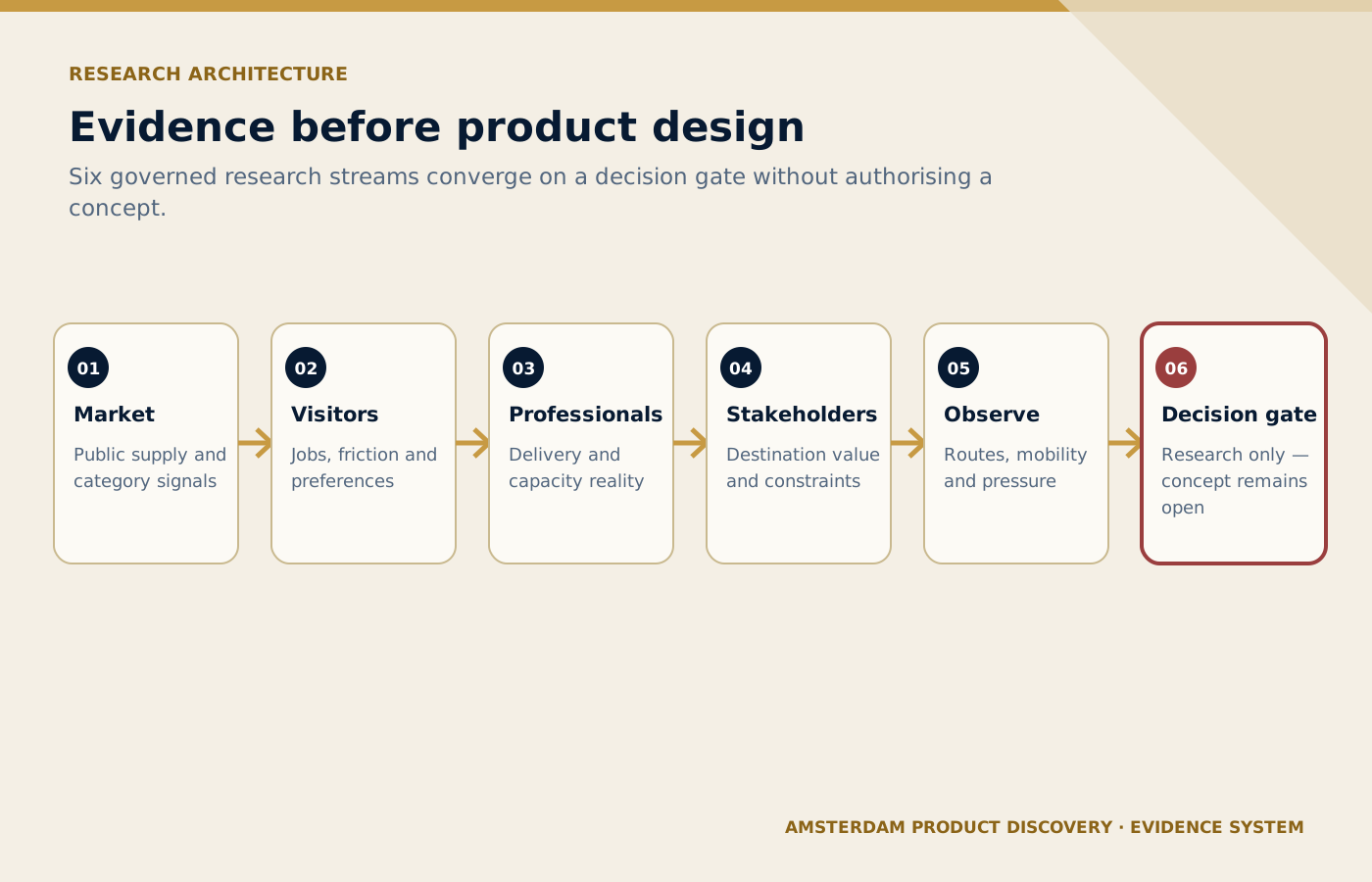
Market, visitor, professional, stakeholder and field evidence converge without prematurely authorising a concept.
On small screens, scroll the diagram horizontally to read its labels.
#The research questions
- Strategy: what outcomes should Amsterdam and affected neighbourhoods gain or protect?
- Market: what products and substitutes are publicly available, and where is supply concentrated?
- Customer: which jobs, pains, desired outcomes and trade-offs appear consistently?
- Segment: which behaviours, needs and operating languages materially change design?
- Place: which locations support interest, mobility, accessibility and local value without unacceptable pressure?
- Operations: which capacities, skills, suppliers, cut-offs and contingencies determine feasibility?
- Commercial: which cost, price, distribution and capacity combinations survive conservative scenarios?
- Responsibility: which rules, public-space effects and stakeholder conditions define permission to proceed?
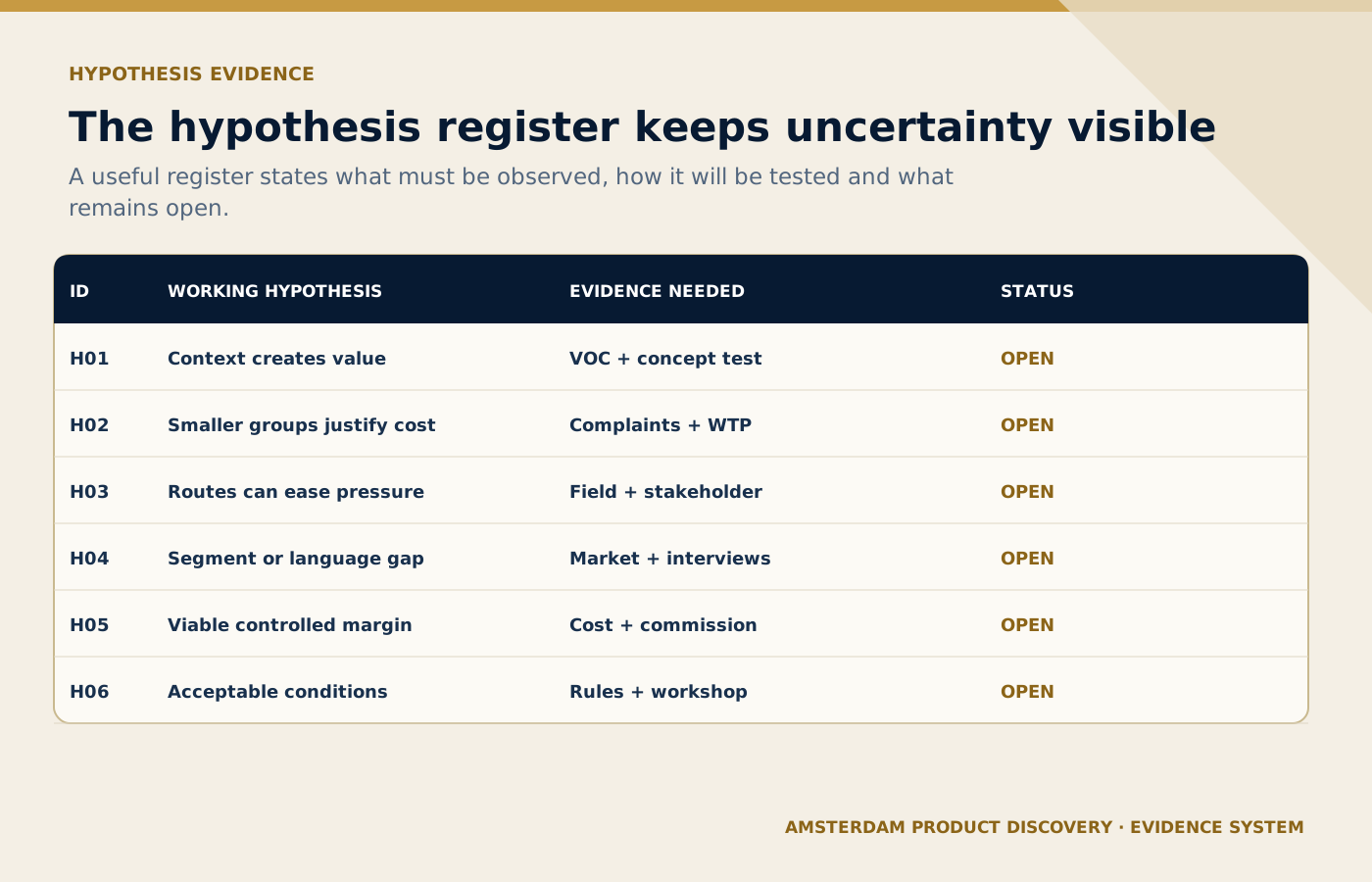
The register makes every untested belief visible and assigns the evidence needed before its status can change.
On small screens, scroll the diagram horizontally to read its labels.
#Research design and sampling plan
The target population is not all Amsterdam tourists. It includes visitors plausibly facing the jobs under investigation, products competing for the same time and budget, and stakeholders affected by delivery. Sampling will be staged so early learning improves later instruments.
| Stream | Initial sample | Inclusion / exclusion | Decision use |
|---|---|---|---|
| Competitive products | 60–100 public listings | Bookable Amsterdam-area experiences; remove duplicates/inactive pages | Map structure, not bookings |
| Reviews/VOC | 400–600 reviews stratified by category, rating and recency | Enough context to code; exclude empty or likely copied text | Build and validate themes |
| Visitor interviews | 15–25, then assess saturation | Recent/current visitors; avoid praise-only recruitment | Understand jobs and trade-offs |
| Professional interviews | 10–15 guides, operators, hotels, attractions and suppliers | Direct operating knowledge; separate promotion | Test feasibility |
| Destination stakeholders | 6–10 local/community/destination actors | Affected or influential participants | Test benefit and harm |
| Route observations | Weekday/weekend and different conditions | Candidate routes; reject one ideal walk as proof | Observe access, flow and pressure |
Scroll horizontally to read every column. Keyboard: focus the table, then use the arrow keys.
What to learn: Read each row across to connect Stream with Initial sample, Inclusion / exclusion, Decision use. Compare the rows to identify the relevant stream for your situation; use the accompanying section to interpret the result.
These are starting ranges, not claims of statistical representativeness. OTA and review samples will be stratified so one platform, category, language or rating does not dominate. Interview recruitment will record channel and refusal patterns. Saturation means additional interviews no longer add decision-relevant themes; it does not mean reaching a convenient number.
#Primary and secondary evidence
Secondary research establishes official strategy, public supply, listed pricing, transport, attractions, geography and existing visitor evidence. It should begin with the City of Amsterdam, Amsterdam Research and Statistics, Data Amsterdam, CBS, NBTC, official transport and attraction sources, then original product pages. Weak SEO summaries should not replace a source that owns the data.
Primary research is required where public data cannot reveal the decision. Visitor interviews explore context and trade-offs. Guide and operator interviews test delivery. Supplier conversations validate capacity and terms. Stakeholder interviews examine local value and externalities. Concept tests compare propositions without presenting one concept as inevitable.
Primary evidence will be consented, purpose-limited and minimized. The project does not need passport numbers, booking references or precise home addresses. Recordings require explicit permission and a retention rule. Reports use anonymous participant IDs and avoid combinations that could identify a person.
#Data architecture: preserve observation to decision
The working pipeline is RAW → STAGING → CLEAN → ANALYTICAL → DECISION.
- RAW: immutable capture with source, URL, timestamp and original value.
- STAGING: imported records with structural checks; no silent correction.
- CLEAN: standardized currency, duration, category and missing-value conventions while retaining the original.
- ANALYTICAL: derived fields, coded themes, scores and model inputs with formulas and versions.
- DECISION: a traceable conclusion linked to evidence, confidence and limitation.
The Tourism Product Data Dictionary defines the minimum schema: record ID, source owner, source URL, observation date, collection date, method, original value, cleaned value, transformation note, missing-data flag, evidence class, confidence, lawful-use note and reviewer.
Raw observations are never overwritten. A listed price changing from €45 to €49 creates a new observation, not an edit. A category correction is logged. An opportunity score points to component records and model version.
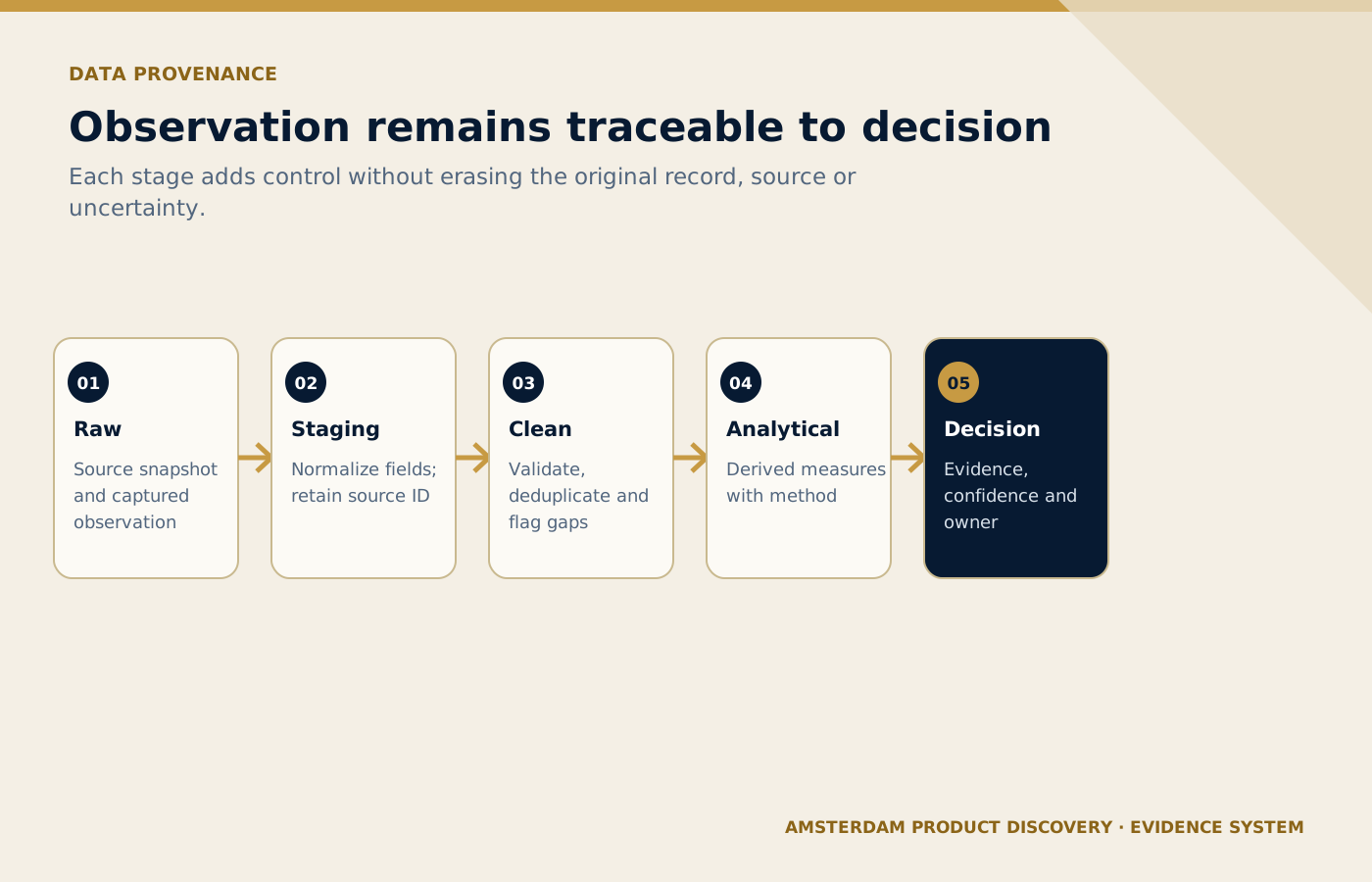
Source identity and uncertainty remain traceable as observations are prepared for analysis and decision-making.
On small screens, scroll the diagram horizontally to read its labels.
#Source hierarchy and provenance controls
Authority depends on the question: municipal policy cannot confirm operator availability, and one review cannot represent the market.
| Priority | Source class | Use | Control |
|---|---|---|---|
| 1 | Dutch and Amsterdam government | Policy, rules, geography, public data | Record version and publication date |
| 2 | CBS, O&S, Data Amsterdam, NBTC | Statistics, forecasts, strategy | Preserve definitions and revisions |
| 3 | Official transport, attraction and cultural sources | Access, hours, service facts | Recheck time-sensitive fields |
| 4 | Original product and OTA pages | Public offer, price, duration | Compliant sample; no private inference |
| 5 | Primary research | Needs, feasibility, impacts | Consent, sample record, coding review |
Scroll horizontally to read every column. Keyboard: focus the table, then use the arrow keys.
What to learn: Read each row across to connect Priority with Source class, Use, Control. Compare the rows to identify the relevant priority for your situation; use the accompanying section to interpret the result.
Each claim will be classified as Observed Data, Derived Metric, Assumption, Hypothesis or Example. Confidence describes evidence strength; it does not convert a proxy into fact.
#Data quality, limitations and stop rules
Prices vary by date and participant type. Reviews contain selection bias. Product pages may be duplicated. Language availability can change. Statistics may be revised. Geographic data does not automatically reveal resident sentiment. Interviews overrepresent people willing to speak.
The project will monitor completeness, validity, consistency, uniqueness, timeliness and provenance. It will stop or narrow analysis when a definition is missing, platform terms do not support the collection method, one source dominates the sample, privacy cannot be protected, or a conclusion requires unavailable private data.
Review count will never be presented as booking volume. OTA rank will not be called demand. Correlation will not be called causation. Low competition will not become a market gap until customer need, feasibility and destination value are supported.
#Research ethics and platform responsibility
This project will not automatically scrape commercial platforms. Before automation, the team must inspect terms, robots guidance, public APIs, licensed exports and proportionate manual alternatives. Manual structured sampling is the default when automated collection is questionable.
Participants need a clear purpose, voluntary participation, data-use explanation, retention period and withdrawal route. Sensitive information is excluded unless essential and lawful. AI tools receive de-identified inputs; confidential rates, contact details and raw recordings stay outside unapproved systems.
The human researcher owns the taxonomy, checks AI-assisted coding, reviews disagreement and makes the decision. AI may accelerate organization; it does not provide consent, source authority or approval.
#Stakeholder map: influence, interest and value exchanged
The initial map includes visitors, guides, operators, attractions, suppliers, hotels, DMCs, local businesses, residents/community groups, the municipality, destination organizations and mobility providers.
High-influence/high-interest stakeholders should help define conditions, not merely receive a finished concept. Groups experiencing public-space effects require deliberate access. Document the value exchanged, including visitor insight, supplier knowledge, local protection and fair commercial participation.
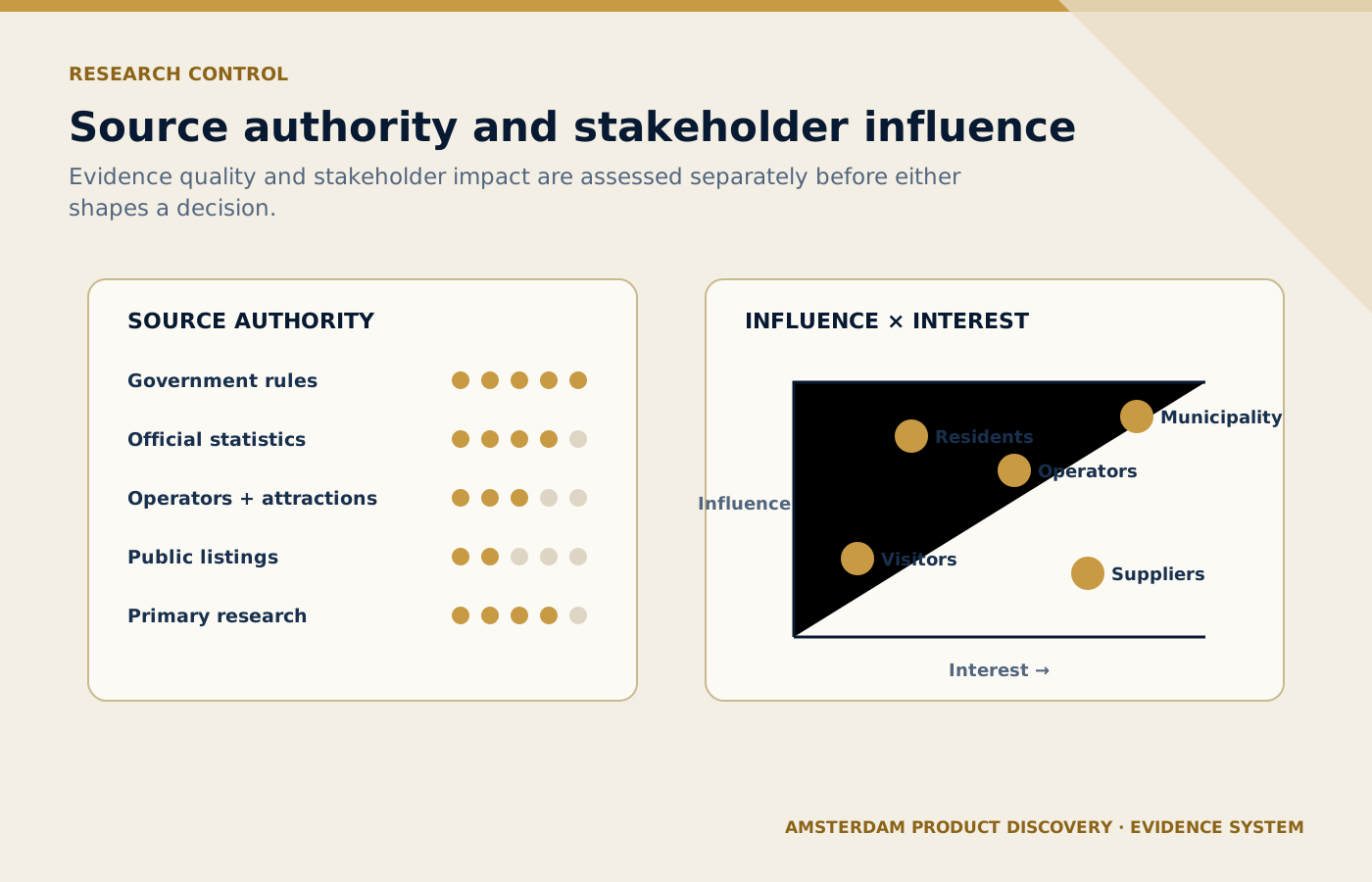
Source authority and stakeholder impact are assessed separately so neither is mistaken for the other.
On small screens, scroll the diagram horizontally to read its labels.
#Analytics used in this article
| Method | Input → output | Decision | Limitation |
|---|---|---|---|
| Evidence-gap analysis | Decision questions → missing evidence | Research scope | Depends on framing quality |
| Weighted source assessment | Authority, recency, relevance → rating | Which evidence supports a claim | Weights require judgment |
| Influence × interest | Stakeholder roles → engagement | Who participates when | Power can change |
| Sensitivity planning | Assumptions and ranges → decision stability | What to validate first | Not a forecast without real inputs |
Scroll horizontally to read every column. Keyboard: focus the table, then use the arrow keys.
What to learn: Read each row across to connect Method with Input → output, Decision, Limitation. Compare the rows to identify the relevant method for your situation; use the accompanying section to interpret the result.
#How we should visualize this decision
- Research architecture flow: evidence streams feeding five controlled data layers. It tests traceability; a neat flow must not imply equal source reliability.
- Source hierarchy: stepped levels from official policy to primary research. It clarifies ownership; a high level is not authoritative for every question.
- Hypothesis–evidence matrix: hypotheses by evidence stream. Empty cells mean untested, not rejected.
- Influence × interest map: participants positioned by influence and impact. It supports engagement but must be reviewed, not treated as permanent.
#Copy-ready AI prompts for controlled research
#Audit the research brief
Use before approving collection.
Purpose: identify missing decisions and controls. Required input: brief, strategy extracts, methods. Expected output: gap table. Human verification: product owner checks scope and sources.
#Research brief audit
When to use it
Audit whether this Amsterdam discovery brief is ready for data collection.
Required inputs
[Paste the brief, official strategy extracts, hypotheses, methods and constraints.]
Complete prompt
ROLE
Act as a tourism product research governance reviewer.

DECISION/TASK
Audit whether this Amsterdam discovery brief is ready for data collection.

CONTEXT
Balance visitor value, commercial viability, operational feasibility and destination value.

INPUT
[Paste the brief, official strategy extracts, hypotheses, methods and constraints.]

METHOD
Map every decision question to evidence, source authority, method, limitation and owner.

CONSTRAINTS
Use only supplied information. Do not invent demand, regulation, supplier availability or private OTA metrics. Separate fact, assumption and hypothesis.

OUTPUT FORMAT
Return blocking gaps, evidence matrix, ethics/privacy risks, recommended sequence and approval questions.

VERIFICATION
List claims requiring human source checks and the approving role.
Expected output
Return blocking gaps, evidence matrix, ethics/privacy risks, recommended sequence and approval questions.
Human verification
List claims requiring human source checks and the approving role.
#Review the data dictionary
Use before combining sources.
Purpose: expose incompatible definitions. Required input: field list and sample. Expected output: rules and conflict log. Human verification: analyst approves transformations.
#Dictionary quality review
When to use it
Review whether the supplied dictionary preserves auditable Amsterdam research.
Required inputs
[Paste field definitions, source notes and de-identified sample records.]
Complete prompt
ROLE
Act as a tourism data-quality analyst.

DECISION/TASK
Review whether the supplied dictionary preserves auditable Amsterdam research.

INPUT
[Paste field definitions, source notes and de-identified sample records.]

METHOD
Check completeness, type, unit, allowed values, missing rule, original-versus-clean separation, time basis, geography, provenance and transformation trace.

CONSTRAINTS
Do not fill missing values or assume similarly named fields share a definition. Do not convert reviews, ranks or availability into bookings.

OUTPUT FORMAT
Return a field issue log, validation rules, incompatible definitions and human checklist.

VERIFICATION
Identify transformations requiring approval against raw observations.
Expected output
Return a field issue log, validation rules, incompatible definitions and human checklist.
Human verification
Identify transformations requiring approval against raw observations.
#Challenge the hypothesis register
Use to reduce confirmation bias.
Purpose: design falsifiable tests. Required input: hypotheses and evidence. Expected output: disconfirming evidence and tests. Human verification: product lead owns status.
#Hypothesis challenge
When to use it
Challenge each hypothesis and design the cheapest ethical test that could reject it.
Required inputs
[Paste the hypothesis register and evidence.]
Complete prompt
ROLE
Act as a critical tourism product-discovery reviewer.

DECISION/TASK
Challenge each hypothesis and design the cheapest ethical test that could reject it.

INPUT
[Paste the hypothesis register and evidence.]

METHOD
Identify support, disconfirming evidence, proxy weakness, test, threshold and destination implication.

CONSTRAINTS
Use only supplied evidence. Do not reward the preferred concept. Keep UNTESTED where evidence is absent.

OUTPUT FORMAT
Return hypothesis, confidence, challenge, next test, owner and consequence.

VERIFICATION
Explain what a human must check before changing status.
Expected output
Return hypothesis, confidence, challenge, next test, owner and consequence.
Human verification
Explain what a human must check before changing status.
#Research brief and artifact pack
The first pack is controlled templates, not a fabricated dataset:
- Research Brief — decision, scope, stakeholders, evidence and approval.
- Hypothesis Register — tests, evidence, status and implication.
- Assumption Register — confidence, risk, validation and owner.
- Tourism Product Data Dictionary — definitions and provenance controls.
All four are marked AWAITING DATA. They define collection; they do not pretend it has happened.
#What we know now
- Amsterdam requires quality of life, responsible entrepreneurship, dispersal and local value alongside demand.
- Official evidence shows high and potentially rising visitor pressure; that is context, not product demand.
- Public, primary, commercial and operational evidence must be combined without confusing units or authority.
- The project needs an auditable pipeline and stop rules before collection.
#What we still do not know
We do not yet know which visitor job is underserved, which segment values it, which route is acceptable, what suppliers can deliver, what price supports the model, which channel fits, or whether destination benefit outweighs burden.
#Assumptions updated
A01–A05 remain OPEN. Official strategy strengthens the requirement for destination evidence but validates no product format.
#Hypotheses updated
H01–H06 remain UNTESTED. None has been promoted based only on general visitor volume or strategic alignment.
#Product decision
AUTHORIZE RESEARCH — DO NOT AUTHORIZE PRODUCT DESIGN. The problem is relevant and the evidence ecosystem is sufficient to begin compliant discovery. The concept remains open, and do not build remains valid.
#Sources and further reading
Primary standards, institutional guidance and professional references used to support this article.
- City of Amsterdam — Tourism policy and 2026 visitor-economy programme (checked 22 August 2026).
- City of Amsterdam — tourism policy and Tourism Vision Amsterdam 2035 resources.
- Amsterdam Research and Statistics — Tourism dossier and datasets.
- Amsterdam Research and Statistics — Visitor Forecast 2026–2028.
- Data Amsterdam — official municipal data portal.
- Statistics Netherlands — accommodation guests and overnight stays in 2025.
- NBTC — Perspective Destination Netherlands 2030.
- NBTC — Perspective 2040 development status.
- City of Amsterdam — GDPR and privacy information.
Editorial note: Time-sensitive policy, statistics and platform information must be rechecked at collection. This article does not claim access to private OTA, operator or municipal data.
Connect this guide to your next step
Continue with related methods and the wider series.
- Series guideBuilding a Data-Driven Signature Tour.
Explore the complete series and its reading order.
- Related guideWhat Is Amsterdam Already Selling? Mapping the OTA and Competitive Tourism Product Landscape
Part 02 of a 12-part Amsterdam tourism product-management case study: a provenance-controlled pilot mapping public OTA listings, product families, direct competitors, substitutes, features and price-comparison limits.
- Related guideWho Should We Build It For? Source Markets, Segmentation, Language and Customer Jobs
Part 05 of a 12-part Amsterdam tourism product-management case study: source-market segmentation, language supply, connectivity and guide feasibility translated into Primary, Secondary and Test research segments.
Put this article into practice
- State the product decision and record the hypotheses that research must test.
- Approve the sources, sampling boundaries and data-provenance rules.
- Separate evidence from assumptions and define the stop rules.
- Name the owner who decides whether the evidence justifies the next stage.
Your next step
Carry the verified findings, assumptions and open questions into the next research stage.
Continue to What Is Amsterdam Already Selling? Mapping the OTA and Competitive Tourism Product Landscape