

- Who this helps
- Product researchers, guest-experience teams and quality managers.
- What you can do
- Code reviews, validate AI-assisted classifications and translate verified guest needs into traceable product requirements.
Reviews are not a substitute for interviews, but they can reveal the language visitors use when an experience delights, disappoints or creates friction. The discipline is to code that language before asking AI to scale it.
#The business decision: turn customer language into testable requirements
Article 03 ended at INVESTIGATE, carrying three problem spaces into customer research: context-rich guided walking, independent/self-guided discovery, and food plus neighbourhood culture. That shortlist is intentionally broader than a product concept. Article 04 asks a narrower question: what do visitors repeatedly value, struggle with, and hire these experiences to help them accomplish?
The evidence here is public review and platform-feedback evidence. It is useful because it captures post-experience language and concrete service moments. It is also biased: reviewers are self-selected, platforms moderate and sort content, English-language pages dominate this sample, and high review counts do not make one theme representative of every Amsterdam visitor. The output is therefore a VOC screen and product-requirements input—not final customer segmentation.
#Start with humans: the coding taxonomy came before the model
The first 24 review observations were coded manually: 12 guided-walking and 12 food/culture reviews. The purpose was not to maximize sample size. It was to discover a stable language for the customer experience before applying assisted classification. The manual pass produced themes around guide knowledge, storytelling and context, hidden/local discovery, orientation value, group interaction, itinerary coverage, walking load, meeting-point clarity, food quality and quantity, dietary inclusion, value for money and the cultural meaning attached to food.
Only after those definitions were fixed was AI-assisted classification applied to the remaining public review observations and structured VoiceMap feedback dimensions. Self-guided evidence is marked separately as PLATFORM_FEEDBACK_METRIC where the source exposes aggregate dimensions such as navigation, depth of information and route rather than individual review text. Those metrics are not rewritten as imaginary customer quotes.
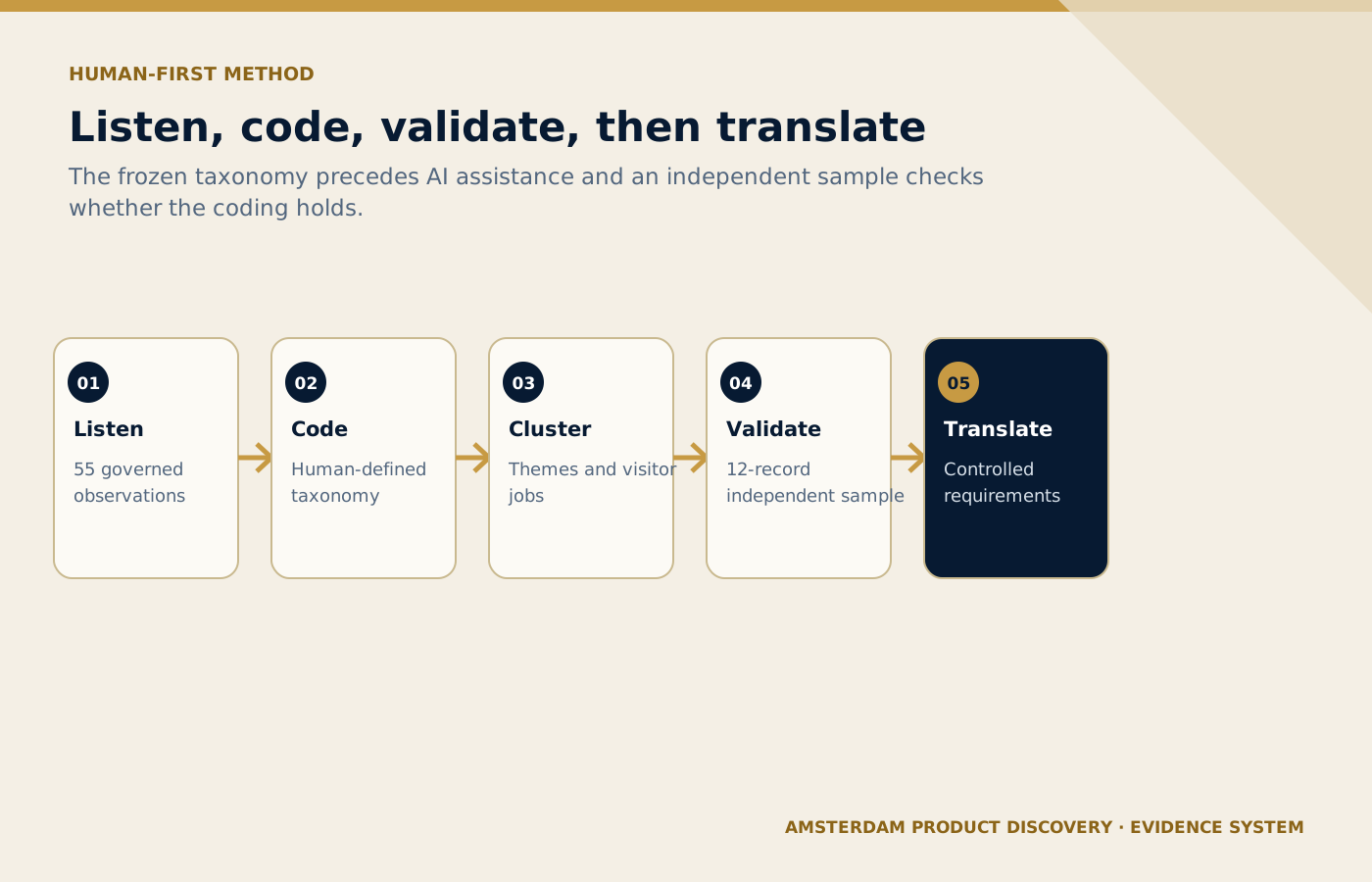
The taxonomy is defined by the researcher before assisted classification, then checked against an independent validation sample.
On small screens, scroll the diagram horizontally to read its labels.
#Sample and methodology
The Article 04 pack contains 55 VOC observations. Forty are paraphrased public review observations from guided walking and food-led experiences; 15 are structured feedback-dimension observations from three Amsterdam VoiceMap products. Twenty-four reviews form the human-coded discovery sample. The remaining 31 observations were coded with the frozen taxonomy. A separate 12-observation validation sample was then reviewed again, including negative/mixed cases and self-guided metrics.
The analysis uses five complementary lenses. Thematic coding identifies recurring needs. Sentiment is used cautiously as context rather than a satisfaction score. Pareto shows where negative and mixed friction clusters. Jobs-to-Be-Done reframes comments as progress visitors are trying to make. Importance × Performance compares how often a theme appears with how consistently the observed evidence is positive. The final VOC → Product Requirements Matrix translates evidence into requirements without selecting a product format.
#What visitors appear to hire these experiences to do
The strongest job is not simply “show me Amsterdam.” Review language repeatedly points to a more specific form of progress: help me understand the city quickly, make what I see meaningful, and reduce the effort of deciding where to look next. First-day guided-walking reviews value getting bearings and recommendations. Strong walking reviews praise guides who connect history to present-day city life and reveal places visitors would not have found alone. Food reviews become stronger when tasting, neighbourhood context and social interaction reinforce one another.
A second job is reduce uncertainty. Visitors want to know where to meet, how much walking is involved, whether they will receive enough food, whether dietary needs can be handled, and whether the delivered itinerary matches the listing. In self-guided formats the same job appears as navigation, route recovery and sufficient content depth. Convenience is therefore not a separate “operational” layer; it is part of customer value.
A third job is give me autonomy without making me do all the work. VoiceMap's Amsterdam introduction reports strong structured feedback across sense of place, navigation, production quality and information depth, while the Pijp food walk shows an instructive contrast: strong sense of place and route alongside materially weaker depth and navigation signals. That variation is more useful than a generic claim that self-guided products are good or bad.
#Theme analysis: what creates value
Across the coded evidence, guide knowledge, storytelling/context, local discovery, group interaction and food quality recur as value drivers. The pattern matters more than raw positivity. Visitors often describe the best guided experiences as a combination: knowledgeable human + useful stories + room to ask questions + less-obvious places + recommendations that improve the rest of the trip.
This strengthens H01 without validating it. Richer context is repeatedly valued in secondary VOC evidence, but the research has not yet compared customer preference for deep interpretation against a faster highlights format in a controlled primary study. H02 also gains support because small-group interaction is repeatedly praised, yet willingness to pay for that smaller format remains unknown.
#Sentiment: useful as a flag, dangerous as a conclusion
Most visible reviews are positive, which is expected on highly rated marketplace products and creates selection bias. For that reason this article does not report an “Amsterdam sentiment score.” Sentiment is used only to identify where the same theme appears in both praise and criticism. Guide knowledge is praised when it creates depth and criticized when knowledge feels superficial. Group size is praised when it enables questions and criticized when social dynamics exclude solo or smaller-party guests. Walking is comfortable for some guests and unexpectedly demanding for others.
This paired interpretation is more actionable than counting positive adjectives. Product design should preserve the condition behind the praise and control the failure mode behind the complaint.
#Pareto: a small number of frictions explain much of the negative evidence
The negative and mixed observations cluster around a limited set of themes: promise-versus-itinerary coverage, physical effort and pace, information depth, group interaction, food quantity/value and overall value for money. The Pareto file ranks these frictions and preserves the cumulative share. It should not be read as market incidence—the sample is purposive—but it is a useful prioritization tool for what must be explicitly tested in primary research.
The practical implication is that a future concept does not need dozens of features to improve the experience. It needs to avoid a handful of high-cost failures: unclear promise, shallow context, weak route/navigation, hidden physical effort, poor inclusion, and a value equation that does not match the advertised experience.
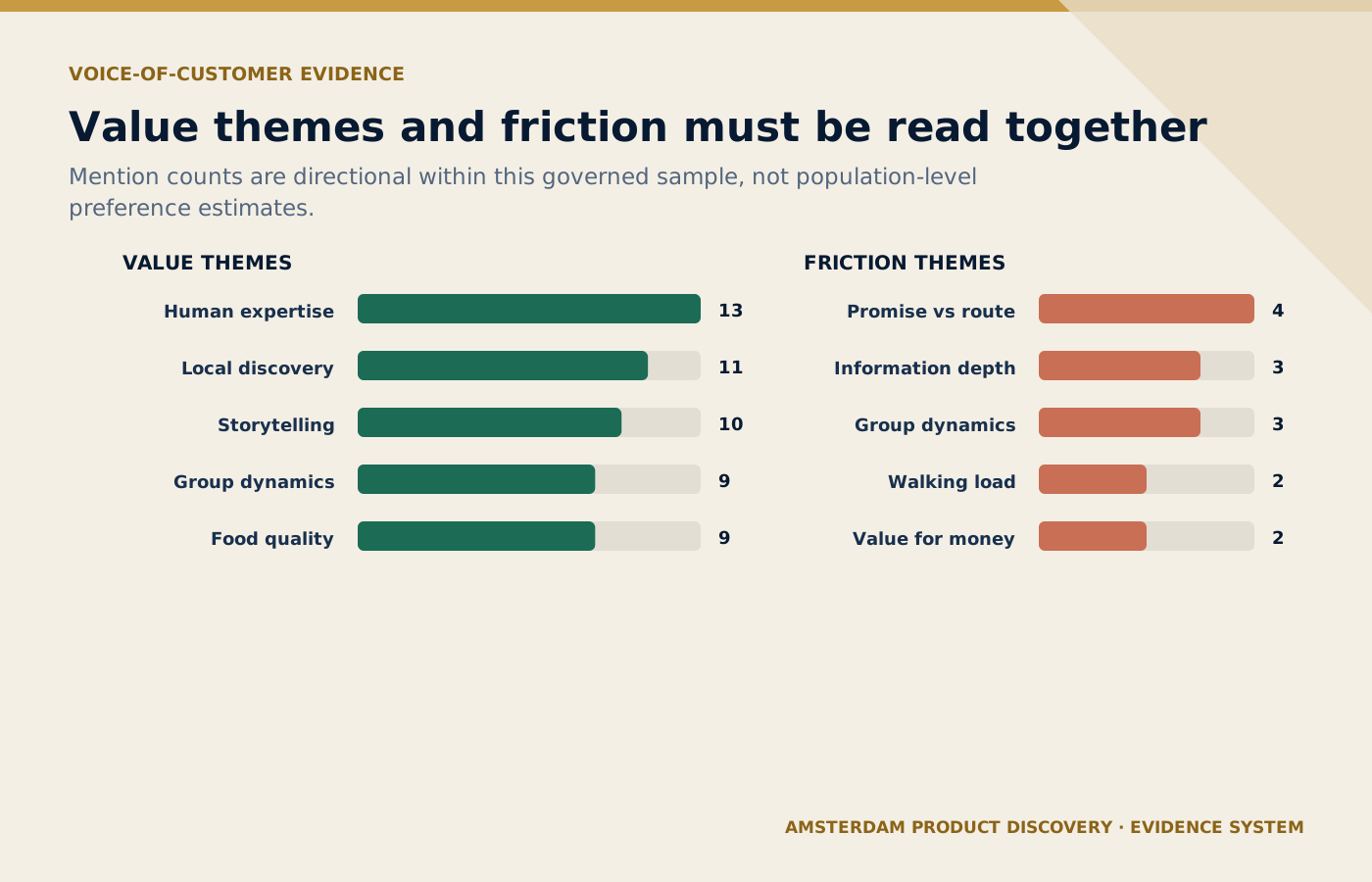
Directional mention counts show what creates value and where delivery friction appears within the governed sample.
On small screens, scroll the diagram horizontally to read its labels.
#Importance × Performance: protect the strengths, investigate the weak edges
The Importance × Performance screen uses mention frequency as an internal importance proxy and positive-share as a performance proxy. It is deliberately relative to this VOC sample, not a population estimate. High-importance/high-performance themes such as knowledge and storytelling are MAINTAIN requirements. High-importance themes with weaker observed performance become PRIORITY research items.
This is particularly important for information depth and itinerary delivery. Both can convert a superficially attractive experience into disappointment when the customer believes the listing promised more than was delivered. In digital formats, navigation and content depth must be tested separately: strong route mechanics do not compensate for thin interpretation, and deep content does not compensate for getting lost.
#Jobs-to-Be-Done: translate comments into progress
| Customer job | Observed signal | Product implication |
|---|---|---|
| Help me understand Amsterdam quickly | Orientation, guide knowledge, first-day usefulness | Design for fast mental orientation before adding more stops. |
| Show me what I would miss alone | Hidden/local places and neighbourhood context | Differentiation must be evidence-backed, not a “hidden gems” label. |
| Make history and culture feel alive | Storytelling, contemporary context, food meaning | Interpretation quality becomes a core requirement. |
| Let me explore without friction | Meeting-point, navigation, route and pace signals | Arrival and route recovery must be designed as customer experience. |
| Help me decide what to do next | Repeated praise for recommendations | Verified onward recommendations can extend utility beyond the tour. |
| Make the price feel justified | Food quantity, bundle quality and value comments | Inclusions and delivered depth must visibly match price. |
Scroll horizontally to read every column. Keyboard: focus the table, then use the arrow keys.
What to learn: Read each row across to connect Customer job with Observed signal, Product implication. Compare the rows to identify the relevant customer job for your situation; use the accompanying section to interpret the result.
#VOC → Product Requirements Matrix
The requirements matrix deliberately stops one step before concept design. R01 requires substantive, fact-checked context. R02 requires the delivered route to match the promise. R03 requires genuine local discovery rather than generic “hidden gem” marketing. R04 controls arrival and navigation friction. R05 requires distance, pace and accessibility disclosure. R06 says a food-led format must make quantity and cultural interpretation justify the price. R07 protects inclusive interaction if a live guide is used. R08 treats dietary accommodation as a design input. R09 requires self-guided navigation and information depth to pass separately. R10 formalizes verified onward recommendations.
None of these requirements says “build a walking tour,” “build an app,” or “build a food tour.” They are customer requirements that several formats could satisfy. Article 07—not this article—will eventually decide how evidence becomes a concept and service blueprint.
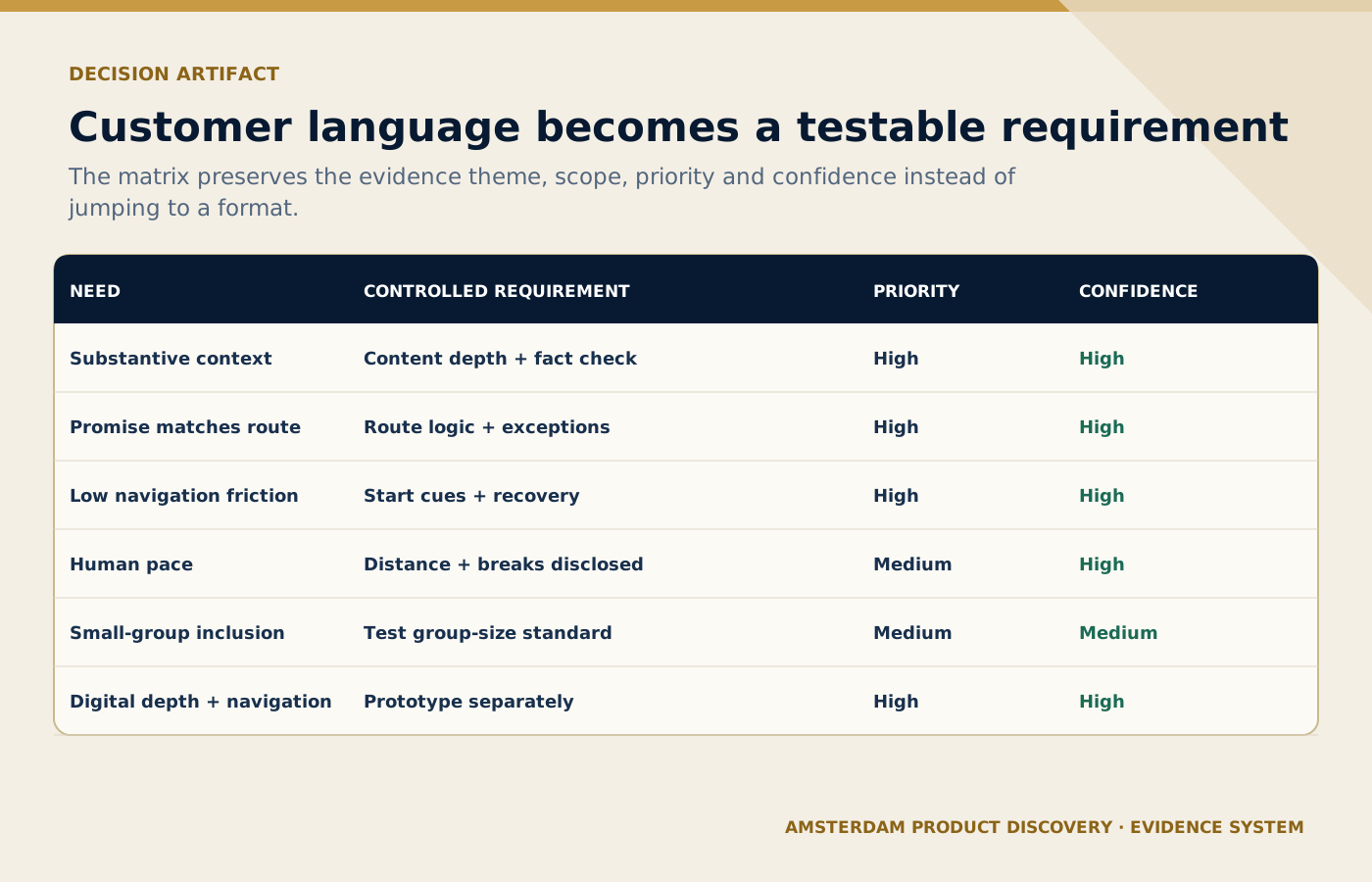
The matrix translates customer language into testable requirements while retaining scope, priority and evidence confidence.
On small screens, scroll the diagram horizontally to read its labels.
#Independent validation: where the coding held and where judgment mattered
Twelve observations were independently re-reviewed after the taxonomy and AI-assisted pass. Theme coding was confirmed across all 12. Two cases required sentiment discussion because comments about walking load were cautionary rather than fully negative; the final resolution retained Mixed. The exercise matters because classification agreement is not the same as truth. A stable code only means the research team is applying the same definition consistently.
The evidence pack preserves the validation decisions instead of replacing the first-pass coding. This creates an audit trail for Article 05 and later requirements work.
#What Article 04 changes in the hypotheses and assumptions
H01 moves to SUPPORTED_NEEDS_PRIMARY_VALIDATION: contextual storytelling, guide knowledge, local discovery and information depth recur in customer language. H02 also moves to SUPPORTED_NEEDS_PRIMARY_VALIDATION because small-group interaction is repeatedly valued; its price premium remains untested. H03 gains supporting review signals around less-obvious discovery but remains untested at route and resident level. H04 remains untested because this English-dominant public sample cannot identify an underserved language market. H05 and H06 remain untested.
A02, the assumption that relevant visitors can be recruited, remains open. Public reviews prove that usable customer-language evidence exists; they do not prove that this project can recruit visitors for interviews or concept tests. Its confidence therefore improves only to Medium and the recruitment pilot remains mandatory.
#Copy-ready AI prompts
ROLE: VOC research assistant.
TASK: Classify review observations using only the approved human coding taxonomy.
RULES: Do not invent a theme. Preserve review ID and source. Separate praise, pain point and JTBD. Sentiment is secondary. If no existing code fits, mark TAXONOMY_REVIEW instead of creating one.
OUTPUT: review_id, theme_codes, sentiment, JTBD, pain_point, confidence.
ROLE: Product research QA reviewer.
TASK: Independently validate a stratified sample of VOC classifications.
CHECK: theme definition, evidence fit, sentiment judgment, JTBD wording and whether the source supports the claim.
RULES: Do not see the first reviewer's rationale until after your own decision.
OUTPUT: agreement, disagreement, resolution needed, final approved code.ROLE: Tourism product manager.
TASK: Convert validated VOC themes into product requirements without choosing a product format.
RULES: Every requirement must cite one or more VOC theme codes. Separate MUST, SHOULD and INVESTIGATE. Do not infer willingness to pay or segment size from review frequency.
OUTPUT: requirement_id, customer_need, evidence_codes, requirement, priority, confidence, validation_test.#Limitations and confidence
Confidence is Medium for recurring guided-walking and food themes because multiple recent public reviews across several products show similar patterns. Confidence is Medium-to-Low for self-guided customer needs because much of that evidence comes from platform-level feedback dimensions rather than individual review narratives. No claim here establishes population prevalence, willingness to pay, language demand or segment size.
The sample is English-language, marketplace-heavy and exposed to review-selection and platform-ranking bias. Negative experiences may be underrepresented or overrepresented depending on reviewer behaviour. Host responses were not coded as customer evidence. Review counts and ratings remain popularity/quality proxies rather than booking data.
#Decision gate: is the VOC evidence strong enough to continue?
Yes—for deeper customer understanding, not for concept selection. The review screen identifies coherent customer jobs and converts them into traceable requirements. It also exposes unresolved questions that Article 05 must address: which segments prioritize context over coverage, who prefers autonomy versus human interaction, whether language creates genuine unmet need, and which customer groups accept the price/effort trade-offs implied by different formats.
Article 04 Gate: PROCEED TO SEGMENT & LANGUAGE RESEARCH. Article 05 is not written here. No winning product is selected.
#Sources and working artifacts
- VOC observations
- Human coding taxonomy
- Theme frequency
- Pareto pain-point table
- Jobs-to-Be-Done summary
- Importance × Performance
- VOC → Product Requirements Matrix
- Independent validation sample
- VOC source register
- Viator — Hello Amsterdam walking tour reviews
- Viator — Small-group Amsterdam walking-tour reviews
- Viator — Jordaan food-tour reviews
- VoiceMap — Amsterdam Introduction feedback
- VoiceMap — Pijp self-guided feedback
Connect this guide to your next step
Continue with related methods and the wider series.
- Series guideBuilding a Data-Driven Signature Tour.
Explore the complete series and its reading order.
- Related guideFinding the Amsterdam Tourism Market Gap
Part 03 of a 12-part Amsterdam tourism product-management case study: triangulating frozen competitive supply with destination demand, policy and feasibility signals through a transparent opportunity model.
- Related guideWho Should We Build It For? Source Markets, Segmentation, Language and Customer Jobs
Part 05 of a 12-part Amsterdam tourism product-management case study: source-market segmentation, language supply, connectivity and guide feasibility translated into Primary, Secondary and Test research segments.
Put this article into practice
- Retain the source and sampling context for each customer observation.
- Distinguish stated preferences, complaints and observed behaviour.
- Test themes against contradictory evidence and sampling limitations.
- Translate supported needs into research questions rather than promises.
Your next step
Carry the verified findings, assumptions and open questions into the next research stage.
Continue to Who Should We Build It For? Source Markets, Segmentation, Language and Customer Jobs