

- Who this helps
- Tourism product managers, destination marketers and guide-planning teams.
- What you can do
- Compare research segments using demand context, language supply and operating feasibility, then distinguish priority segments from tests.
Language is not a market by itself. The useful segment is the intersection of source market, trip context, customer job, language preference, booking behaviour and a delivery model that can actually operate in Amsterdam.
#The business decision: choose who to investigate before choosing what to build
Article 03 identified three opportunity areas worth investigating: context-rich guided walking, independent discovery and food plus neighbourhood culture. Article 04 then found a consistent set of customer jobs: understand Amsterdam quickly, make history and local life meaningful, discover things that are easy to miss alone, reduce navigation and planning friction, and receive enough value to justify the promise and price. None of that tells us which visitor should be the design centre.
Article 05 therefore asks a different question: which source-market and language combinations are sufficiently supported to become Primary, Secondary and Test segments? The answer cannot come from intuition such as “Amsterdam is international, so English is enough” or “German is the biggest market, so build in German.” Market size, Amsterdam affinity, language supply, connectivity, visitor jobs and operating feasibility can point in different directions.
The output is a segmentation decision for further research. It is not a target-market forecast, a media plan or a guarantee that a dedicated non-English product will convert.
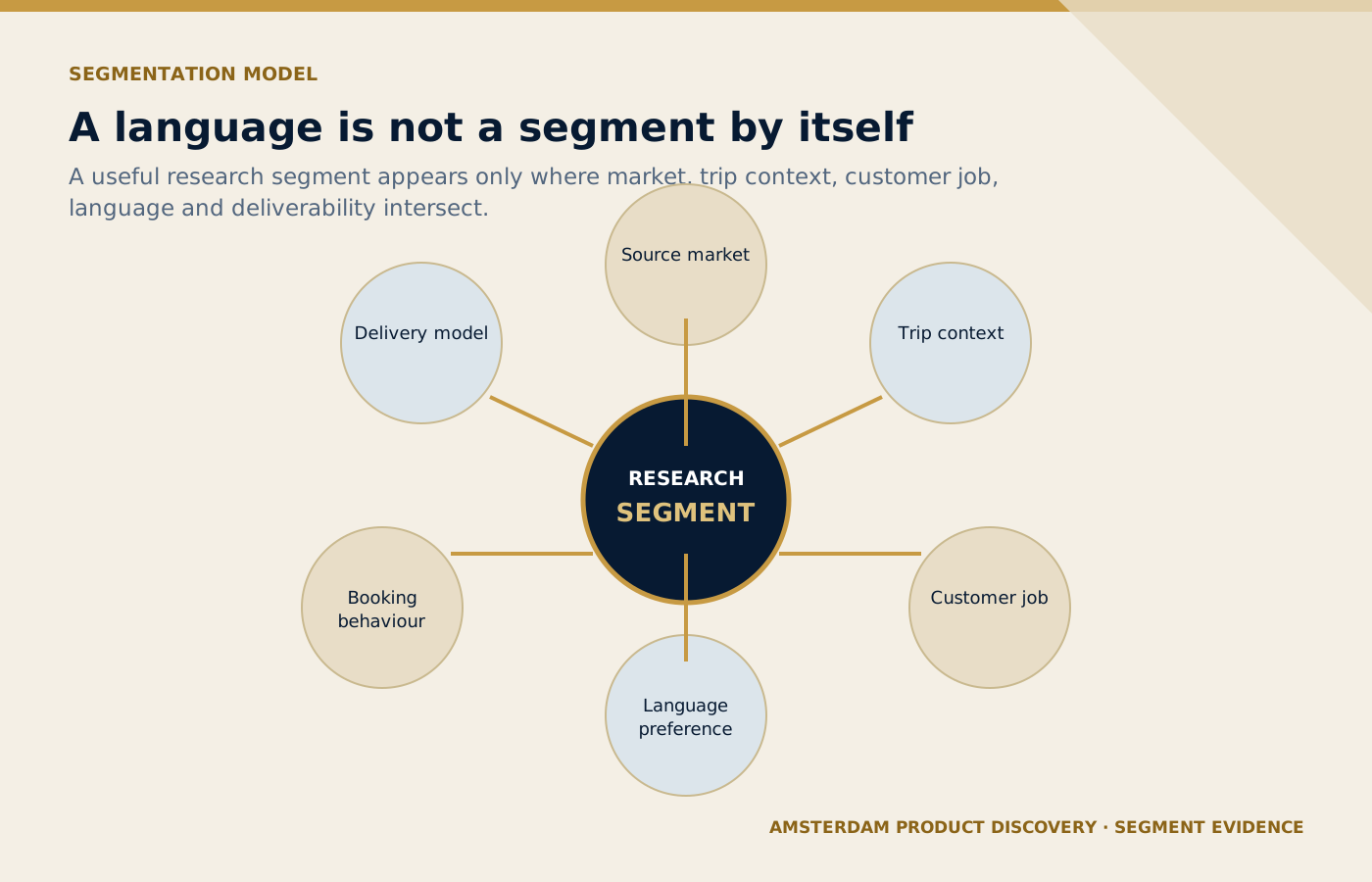
Language becomes useful only inside a research segment that also explains the trip, customer job and feasible delivery model.
On small screens, scroll the diagram horizontally to read its labels.
#Method: separate market size, language need and operating feasibility
The evidence comes from four controlled layers. First, the frozen Article 02 dataset supplies observed OTA language disclosure across 53 OTA listings inside the 84-FULL competitive sample. Second, Article 04 supplies the VOC jobs and a critical limitation: its governed review corpus is English-language. Third, official Amsterdam and NBTC research supplies destination scale, source-market size and behavioural context. Fourth, transport and guide evidence tests whether the visitor can reach Amsterdam easily and whether multilingual delivery is operationally plausible.
These layers are not interchangeable. A large source market does not prove demand for a tour in that language. An OTA listing that offers French audio does not prove live French guide capacity. A guide directory proves that multilingual professionals exist, not that they are available at the required date, price or product quality. An English review corpus can validate customer jobs but cannot establish that German or French visitors describe those jobs in the same way.
#Destination evidence and differences between source markets
Amsterdam O&S estimates that the city received about 10 million staying visitors and 14 million tourist day visitors in 2024. Among surveyed tourist day visitors, almost two thirds were domestic; foreign day visitors were more likely to combine multiple activities such as walking along canals, museums, shopping, the Red Light District and canal cruises. O&S Tourism MRA 2024–2025 and the Amsterdam day-visitor study therefore support a segmentation distinction between domestic urban visitors and international discovery visitors.
At national level, NBTC reports 21.3 million international guests in the Netherlands in 2024. Germany alone accounted for more than 7.5 million overnight visitors, around 35% of international staying visitors. Belgium represented 12%. The UK, US and French market profiles below provide further audience context, but their publication dates and underlying reference years must be checked separately; they are not combined here into one 2024 volume table. These national numbers are not Amsterdam arrivals or forecasts for this product. NBTC Germany, Belgium, United Kingdom, United States and France are kept as separate evidence rows in the Article 05 pack.
#Source market is not enough: trip behaviour changes the job
German visitors are the largest international market for the Netherlands, but they also show high repeat visitation: NBTC's inbound study reports about four overnight visits to the Netherlands over the previous five years on average. That makes a basic “Amsterdam highlights 101” proposition less obviously differentiated for the whole German market. The more interesting hypothesis is a repeat or short-break visitor who wants substantive context and less-obvious discovery without spending time researching it independently.
British visitors have a strong city-break pattern; more than one third of non-business UK trips to the Netherlands are city trips in NBTC's market research. US visitors show a different commercial behaviour: 71% of US staying visitors in the relevant NBTC survey subgroup had pre-booked attraction tickets. The subgroup comprises visitors who booked accommodation before arrival, excluding package trips (US sample: 110); it is not a percentage of all Americans or only of attraction-ticket buyers. See NBTC orientation and booking tables. That makes advance clarity, trust, itinerary promise and digital discoverability particularly important for an English-speaking long-haul segment. French visitors are smaller in absolute national volume, but Amsterdam affinity is strong: NBTC reports that 75% of French staying visitors in its inbound study visited Amsterdam, while France also shows relatively strong museum participation.
These differences are why Article 05 segments by job + trip context + source market + language, not nationality alone.
#Connectivity: a segment is stronger when access is structurally easy
Schiphol connected the Netherlands to 301 direct destinations in 2025, including 125 intercontinental destinations. The airport reported particularly heavy travel links with the United Kingdom and United States among its most popular country markets. Rail strengthens the near-market case: Eurostar connects Amsterdam directly with London and Paris, while NS International operates direct ICE service between Amsterdam and Berlin. Schiphol 2025 traffic, London, Paris and Berlin provide the connectivity evidence.
Connectivity is not scored as demand. It is a friction variable: markets with frequent direct access can support short breaks, repeat visitation and seasonal resilience more easily than markets that require complex itineraries.
#OTA language supply: English dominates disclosure, but the denominator is imperfect
The frozen Article 02 sample contains 53 OTA observations from GetYourGuide, Viator, Klook, Tiqets and Expedia. English is explicitly present in 29 of those observations. Spanish appears in eight, German and French in six each, and several products expose broad multilingual audio or interface options. Nineteen OTA observations did not display a language in the frozen collection.
This is a supply-disclosure metric, not market share. The language field can mix live-guide language, audio-guide language and a platform-displayed option, and “NOT_DISPLAYED” does not mean “not available.” The correct inference is modest: English is visibly common; non-English options exist; and the frozen sample gives enough variation to justify language testing, but not enough to declare a language gap.
#Review-language evidence: the strongest evidence is also the biggest bias
Article 04 coded 40 public review observations from English-language marketplace pages and 15 structured VoiceMap feedback observations from English-language pages. That is valuable because the repeated jobs are coherent: context, orientation, discovery, interaction, navigation and value. It is also the reason H04 cannot be validated yet. There is no governed German, French or Spanish review corpus in this project.
Accordingly, English has the highest VOC confidence because it is the language in which the current customer evidence was actually observed. German and French may share the same jobs, but that remains a hypothesis until native-language reviews or interviews are collected. Translation by AI would not solve this evidence gap; translating an English review into German creates German text, not German customer evidence.
#Operator and guide feasibility: multilingual delivery is plausible, not yet contracted
The Dutch National Guides Association's public Guidor directory exposes filters for English, German, French, Spanish, Italian, Arabic, Russian, Portuguese and other languages, with multilingual guides visibly listed across the main European languages. This establishes basic supply feasibility. It does not establish availability, day rates, training consistency, willingness to deliver a new route or the ability to scale multiple departures. Guidor's guides and languages directory is therefore treated as an operating-supply signal rather than a staffing plan.
Amsterdam's city-centre rules also constrain any live-guided option regardless of language. Groups may have no more than 15 participants, groups above four require an exemption in the regulated city-centre area, and rules restrict stopping, noise and routes around sex-worker windows. City of Amsterdam guided-tour rules mean that language expansion cannot be evaluated separately from group size, route geography and guide permitting.
#The segmentation model
The segment screen uses six directional dimensions: source-market demand, Amsterdam affinity, connectivity, customer-job fit, language-delivery feasibility and evidence confidence. Language whitespace is considered separately because a crowded language can still be commercially attractive, while a rare language can simply reflect low demand.
Scores are 1–5 research priorities, not probabilities. High confidence requires multiple independent evidence layers. Medium confidence means the market and operating logic are credible but primary customer evidence is missing. Low confidence means the segment should remain exploratory.
#Primary, Secondary and Test segments
| Priority | Segment | Core job | Why now | Critical gap |
|---|---|---|---|---|
| PRIMARY | English-speaking international cultural city-break visitor, especially UK/US and other English-comfortable visitors | Understand Amsterdam quickly, gain context and orient the rest of the stay | Strongest VOC evidence, high Amsterdam relevance, extensive connectivity, high guide feasibility | English is already well supplied; exact subsegment and willingness to pay remain untested |
| SECONDARY | German-speaking repeat or short-break explorer | Go beyond basic highlights with substantive local context and efficient discovery | Largest inbound Netherlands source market, strong repeat behaviour, high access and guide feasibility, less explicit frozen OTA language disclosure than English | No governed German VOC or product-conversion evidence |
| TEST | French-speaking cultural city-break visitor | Reduce planning effort and understand Amsterdam culture in a preferred language | Strong Amsterdam visit affinity, direct Paris connectivity, credible guide supply, cultural/museum orientation | Smaller market and no French VOC / willingness-to-pay evidence |
Scroll horizontally to read every column. Keyboard: focus the table, then use the arrow keys.
What to learn: Read each row across to connect Priority with Segment, Core job, Why now, Critical gap. Compare the rows to identify the relevant priority for your situation; use the accompanying section to interpret the result.
The Primary segment is not “all English speakers.” It is an early-trip, culture/discovery visitor who values context and orientation. The Secondary segment is not “all Germans.” It is a near-market visitor for whom basic landmark coverage may be insufficient. The Test segment is deliberately smaller because the evidence supports a research experiment, not an immediate dedicated French departure schedule.
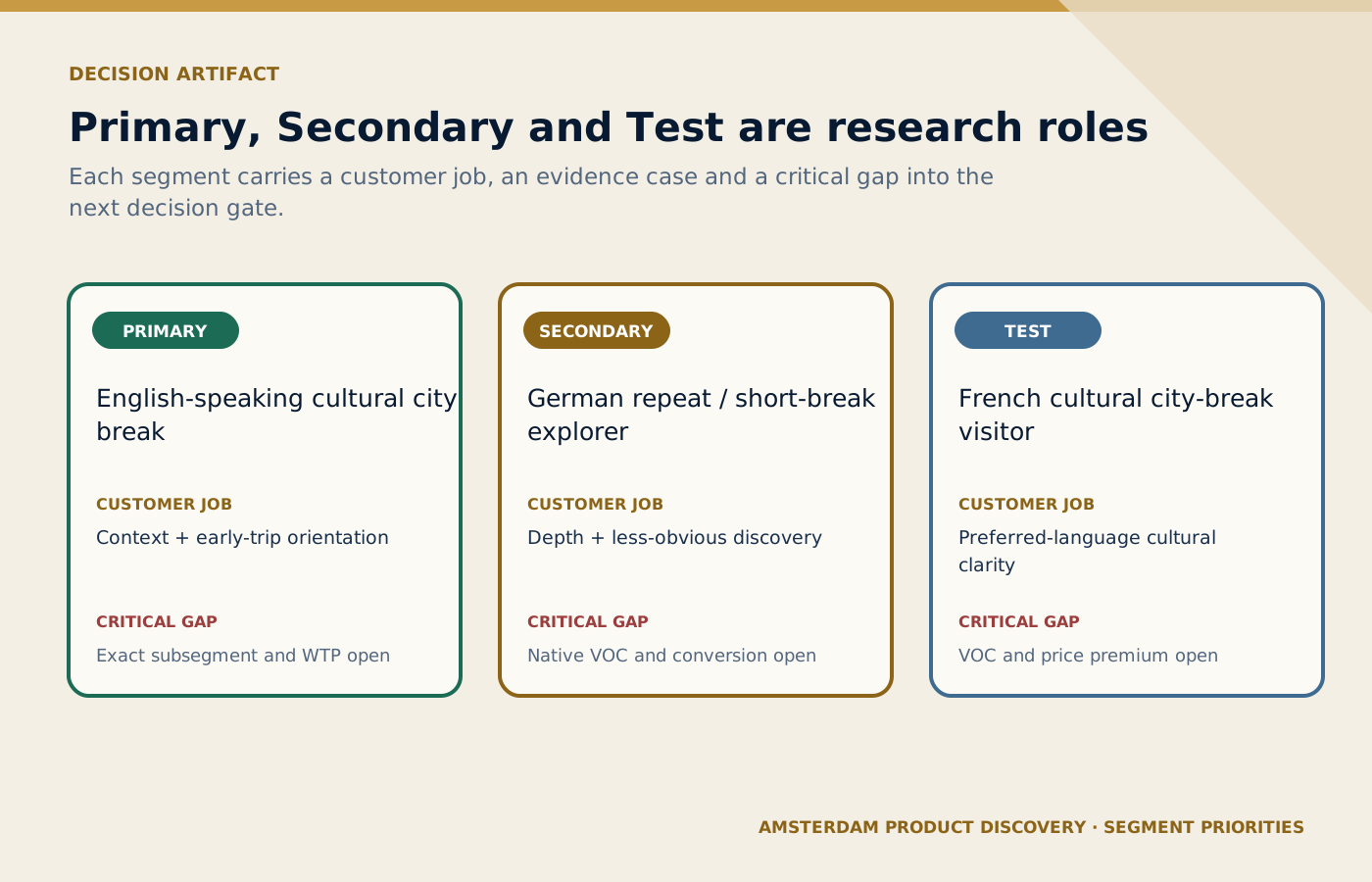
Primary, Secondary and Test describe the next research role of each segment rather than a final commercial schedule.
On small screens, scroll the diagram horizontally to read its labels.
#Language Opportunity Matrix
The Language Opportunity Matrix deliberately rewards both addressable demand and feasibility, while penalising unsupported whitespace claims. English scores highest overall because demand, connectivity, VOC evidence and guide feasibility are strongest, even though language whitespace is weak. German follows because source-market demand and operating feasibility are very strong but direct German VOC is missing. French remains a test because Amsterdam affinity and connectivity are strong while the evidence base is thinner.
| Language | Demand | Amsterdam fit | Connectivity | OTA whitespace | Guide feasibility | VOC directness | Role |
|---|---|---|---|---|---|---|---|
| English | 5 | 5 | 5 | 1 | 5 | 5 | PRIMARY |
| German | 5 | 4 | 5 | 3 | 5 | 1 | SECONDARY |
| French | 3 | 5 | 5 | 3 | 4 | 1 | TEST |
| Dutch | 5 | 2 | 5 | 3 | 5 | 1 | MONITOR |
| Spanish / Italian | 2 | 3 | 4 | 2 | 4 | 1 | MONITOR |
| Arabic | 1 | 2 | 4 | 3 | 2 | 1 | RESEARCH ONLY |
Scroll horizontally to read every column. Keyboard: focus the table, then use the arrow keys.
What to learn: Read each row across to connect Language with Demand, Amsterdam fit, Connectivity, OTA whitespace, Guide feasibility, VOC directness, Role. Compare the rows to identify the relevant language for your situation; use the accompanying section to interpret the result.
The matrix should not be read as “English is the winning product language.” English is the best research control because the current VOC is strongest there. German is the most defensible non-English secondary test. French is a disciplined test market. Other languages remain monitor/research-only until source-market and native-language evidence improves.
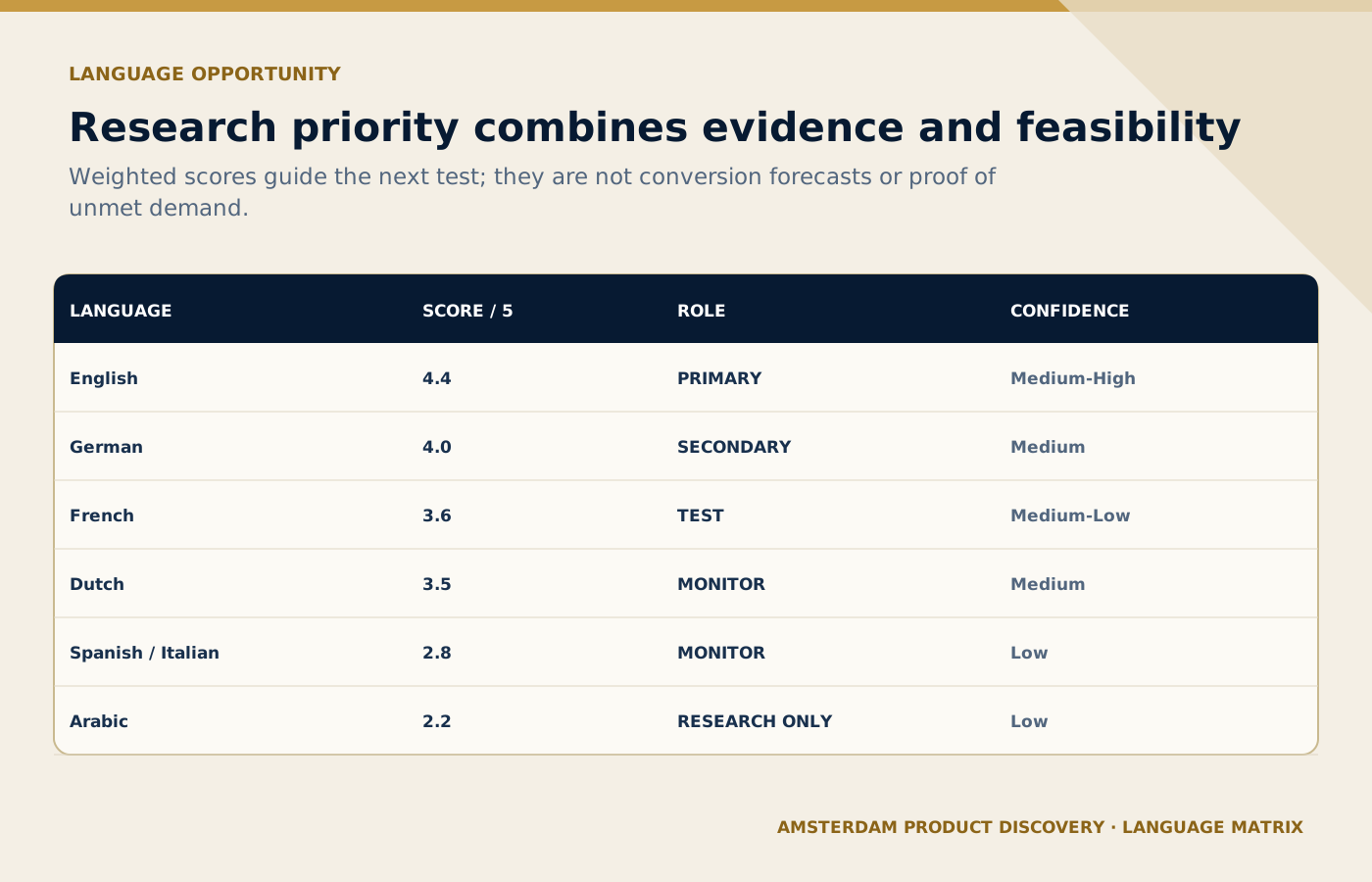
The weighted screen combines demand, Amsterdam fit, connectivity, public supply, guide feasibility and direct customer evidence.
On small screens, scroll the diagram horizontally to read its labels.
#Customer jobs by segment: the need may be shared, but the emphasis changes
Across all three priority segments, Article 04's core jobs remain stable: understand the city, discover meaningful places, reduce planning friction, and receive trustworthy delivery. What changes is the likely emphasis. The English long-haul/UK city-break segment needs strong pre-book clarity and first-day orientation. The German near-market segment may place more value on depth, contemporary context and less-obvious discovery because repeat familiarity is higher. The French test segment should examine whether native-language interpretation reduces cognitive effort and increases perceived cultural depth relative to English.
Those are hypotheses, not stereotypes. Article 05 uses market behaviour to design tests; it does not assign personality traits to nationalities.
#What should be tested before a language-specific departure exists?
For English, test the segment boundary: first visit versus repeat, early-trip versus late-trip, guided versus self-guided preference, and price sensitivity for richer interpretation. For German, collect native-language VOC and run paired concept tests: English delivery versus German delivery with identical content depth. For French, first test comprehension, comfort and booking intent before building a dedicated schedule. In every case, measure whether language changes conversion intent, trust, comprehension, perceived depth and willingness to pay rather than merely asking “which language do you prefer?”
A strong experiment would recruit visitors from each segment, expose them to the same proposition and content sample, then vary delivery language. That separates a language effect from a concept effect.
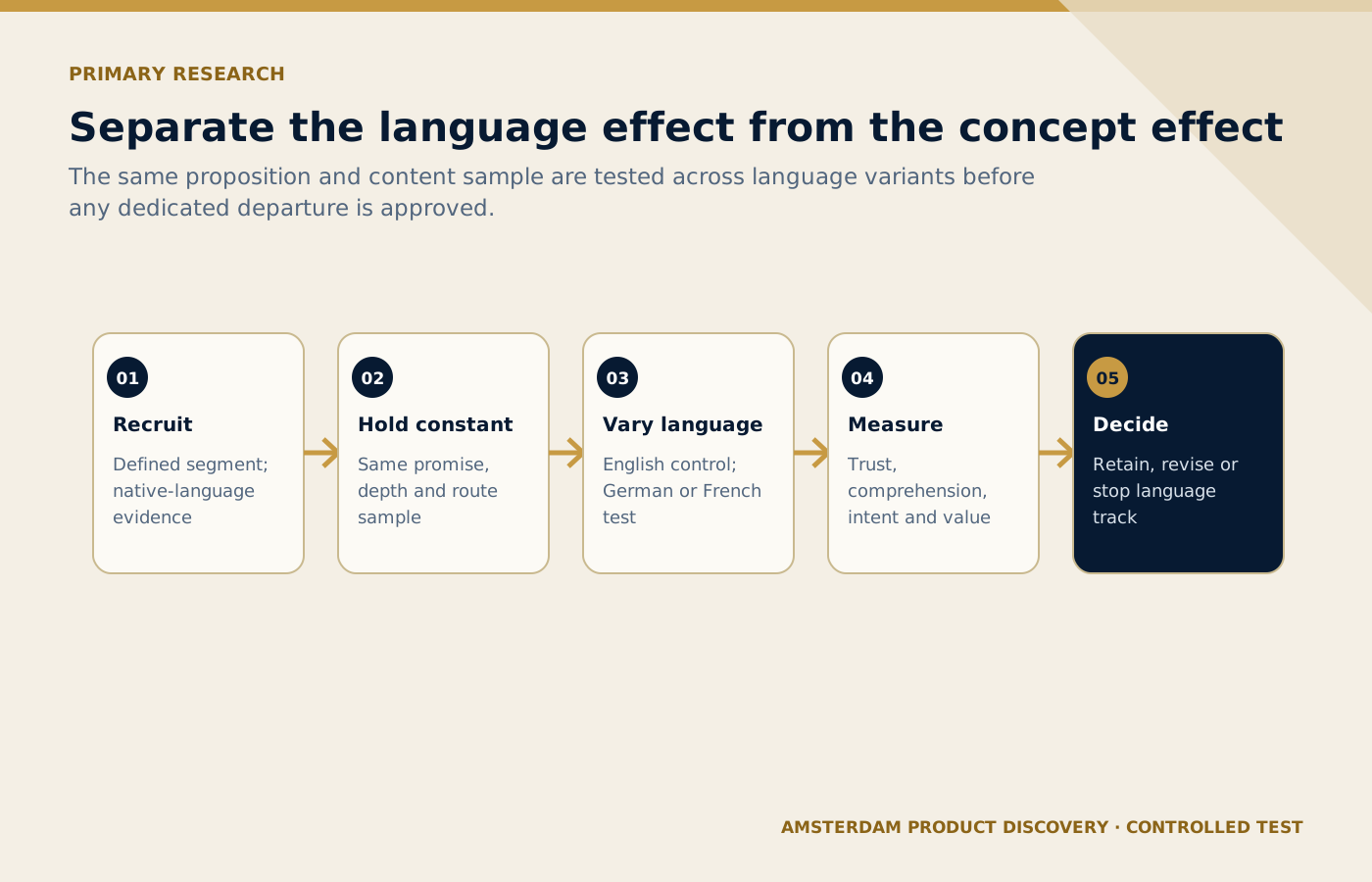
Holding the concept constant separates a genuine language effect from a response to different content or product design.
On small screens, scroll the diagram horizontally to read its labels.
#Hypothesis and assumption update
H04 moves from UNTESTED to PARTIAL_SIGNAL_NEEDS_PRIMARY_VALIDATION. There is now a credible reason to test German and French language opportunities: both are meaningful source markets, Amsterdam is highly accessible, multilingual guide supply exists and explicit non-English OTA disclosure is lower than English in the frozen sample. But there is still no non-English governed VOC, booking conversion, price-premium evidence or controlled language preference test. The hypothesis is therefore not validated.
A03 gains operating evidence because a multilingual professional guide pool is visible and Amsterdam's guide rules are known. Its status becomes OPEN_OUTREACH_REQUIRED: availability, commercial terms, quality control and willingness to participate still require direct operator/guide outreach.
#Copy-ready AI prompts
ROLE: Tourism segmentation analyst.
TASK: Score candidate visitor segments using only the approved Article 05 evidence table.
DIMENSIONS: source-market demand, Amsterdam affinity, connectivity, customer-job fit, language-delivery feasibility, evidence confidence.
RULES: Keep observed facts separate from derived scores. Do not infer language preference from nationality. Do not use market size as proof of unmet demand.
OUTPUT: segment, evidence_for, evidence_against, score_by_dimension, confidence, next_test.
ROLE: Multilingual VOC research assistant.
TASK: Code German or French visitor reviews using the existing Article 04 taxonomy.
RULES: Preserve the original-language text and source; add an English analyst translation in a separate field. Do not translate first and then treat the translation as the source. Flag concepts that do not fit the taxonomy for human review.
OUTPUT: review_id, original_language, original_text, analyst_translation, theme_codes, JTBD, sentiment_context, confidence.#Limitations and confidence
Confidence is Medium-High that English-speaking international discovery visitors are an appropriate Primary research segment because demand, connectivity, operating feasibility and VOC evidence converge. Confidence is Medium for the German Secondary segment because source-market and feasibility evidence are strong but native-language VOC is absent. Confidence is Medium-Low for the French Test segment because Amsterdam affinity is credible but the direct customer evidence is thinner.
The most important limitation is that national inbound volume is not Amsterdam product demand. The official sources use different years and methodologies, and the Article 02 OTA sample is purposive. Language availability is inconsistently disclosed and may refer to audio rather than live delivery. The guide directory proves professional supply exists but not commercial capacity. Article 04 reviews were English-language and cannot validate a non-English value premium.
#Decision Gate 2
The project can now define disciplined research segments, but it cannot honestly claim that a non-English language opportunity is validated. English is a robust control and Primary segment language; German is the strongest Secondary test; French merits a bounded Test segment. The commercial value of dedicated German or French delivery remains unknown.
Decision Gate 2: UNCERTAIN. Proceed to Article 06 only with the segment priorities above treated as research inputs, not fixed target markets. Article 06 must test where these visitors can be served responsibly and operationally; Article 05 does not select a route, product format or final language schedule.
#Sources and working artifacts
- Source-market evidence
- Connectivity evidence
- Frozen OTA language supply
- Review-language evidence
- Guide and operating feasibility
- Primary / Secondary / Test segments
- Language Opportunity Matrix
- Evidence classification
- Amsterdam O&S — Tourism MRA 2024–2025
- Amsterdam O&S — Tourist day visitors
- NBTC — Germany
- NBTC — Belgium
- NBTC — United Kingdom
- NBTC — United States
- NBTC — France
- Guidor — guides and languages
- City of Amsterdam — guided-tour rules
Connect this guide to your next step
Continue with related methods and the wider series.
- Series guideBuilding a Data-Driven Signature Tour.
Explore the complete series and its reading order.
- Related guideFinding the Amsterdam Tourism Market Gap
Part 03 of a 12-part Amsterdam tourism product-management case study: triangulating frozen competitive supply with destination demand, policy and feasibility signals through a transparent opportunity model.
- Related guideWhen Should the Tour Run? Demand, Weather, Seasonality and the Amsterdam Operating Calendar
Part 10 of a 12-part Amsterdam tourism product-management case study: demand context, historical climate, live-weather controls, event pressure and a rolling operating calendar for Amsterdam Layers.
Put this article into practice
- Define the segment’s trip context, customer job and language need.
- Check language requirements against actual delivery capability.
- Record booking behaviour and evidence gaps for each segment.
- Select a segment only after testing feasibility and demand evidence.
Your next step
Carry the verified findings, assumptions and open questions into the next research stage.
Continue to Where Should the Experience Happen? Attraction Intelligence, Geography and Destination Fit