

- Who this helps
- Destination planners, product managers and operations schedulers.
- What you can do
- Build a rolling calendar that separates historical context from live conditions and defines when operating plans need review.
#A calendar is an operating hypothesis, not a promise about the weather
Article 09 established that Amsterdam Layers can move toward a controlled pilot only with legal, accessibility, safety and destination-responsibility controls. Article 10 now asks a deceptively simple question: when should the tour actually run?
The answer cannot be “summer” or “weekends.” The approved concept is a live, small-group contextual walk, normally Plantage→Oosterpark, 110–135 minutes, maximum eight guests. Its commercial model is still conditional, its default route is weather exposed, and the same month can contain a quiet Tuesday, a citywide festival, a transport disruption and a severe-weather warning. A useful calendar therefore needs several clocks at once: historical demand, forecast demand, historical climate, actual weather forecast, daylight, known events, attraction availability and the product’s own booking economics.
This article builds that operating system without pretending that a 30-year climate average predicts the weather on a specific departure or that Amsterdam's visitor forecast predicts how many people will buy Amsterdam Layers.
#First separate three evidence types that are often mixed together
Historical climate describes what conditions have typically looked like over a long period. KNMI's current Schiphol normals use 1991–2020 averages. They are appropriate for staffing, route-design and seasonal contingency planning; they are not a forecast for 15 October 2026. KNMI climate normals.
Weather forecast is the short-horizon operational input. The duty manager must check the current KNMI forecast and warnings before each departure. A calendar may say August is usually mild, but a specific August departure can still be cancelled for a severe warning. KNMI weather warnings.
Demand forecast is different again. Amsterdam O&S recorded 23.7 million tourist overnight stays in 2025 and forecasts 2026 through scenarios: the low scenario is roughly stable while the middle/high scenarios reach up to 25.1 million overnight stays. By 2028, the scenario range is 25.0–29.4 million. O&S explicitly describes this as a forecast based on assumptions and uncertainty. It is evidence that Amsterdam remains a large visitor economy; it is not a booking forecast for this tour. Amsterdam O&S visitor forecast.
#Demand context: enough visitors exist, but product demand still has to be earned
Official city evidence shows the scale. In 2024 Amsterdam had nearly 10 million staying visitors, who stayed an average 2.36 nights and generated nearly 23 million overnight stays. Amsterdam O&S — tourism in figures. CBS also publishes Amsterdam hotel guests and overnight stays monthly, with 2025 final and 2026 currently provisional. CBS monthly Amsterdam hotel statistics.
But Article 10 refuses to turn hotel nights into tour bookings. The monthly/weekday analysis therefore labels month bands as planning classifications and weekday priorities as tests. There is no governed Amsterdam Layers booking history yet, and no official dataset answers whether this exact product converts better on Friday than Tuesday.
That means Article 11 must collect departure-level searches, bookings, conversion, lead time, cancellations and load factor by weekday. Until then, Friday–Sunday are useful test cells, not facts.
#Seasonality Model: combine demand context with operating friction
The Seasonality Model covers all twelve months using KNMI climate normals, a derived mid-month daylight estimate, a historical-demand planning band and a 1–5 weather-operability score. The score is intentionally operational: it penalises short daylight, frequent wet days and less comfortable temperature ranges. It does not claim to predict sales.
| Period | Operating pattern | Main constraint |
|---|---|---|
| Jan–Feb | Lower-demand / controlled winter testing | Short daylight, cold, rain and economics at low loads |
| Mar–Jun | Strongest general operating window | Growing crowds and live weather still require checks |
| Jul–Aug | High visitor opportunity, but not automatic GREEN | Crowd pressure, heat and substantial rain exposure |
| Sep–Oct | Strong shoulder operation | ADE and shorter daylight increase volatility |
| Nov–Dec | Selective winter operation | Darkness, wet weather, holidays and attraction availability |
Scroll horizontally to read every column. Keyboard: focus the table, then use the arrow keys.
What to learn: Read each row across to connect Period with Operating pattern, Main constraint. Compare the rows to identify the relevant period for your situation; use the accompanying section to interpret the result.
The climate evidence shows why “summer = dry” would be a weak rule. At Schiphol, the 1991–2020 normal precipitation is approximately 39.6 mm in April, but 98.6 mm in August. August is warm, yet it is also the wettest month in this monthly-normal set. December has only about 58 sunshine hours and around 14 days with at least 1 mm of precipitation. Those are planning facts, not departure-day forecasts.
#Daylight changes the product clock
The Netherlands' daylight envelope is substantial: official government guidance notes roughly 08:45–16:30 around the shortest days and about 05:20–22:00 around the longest. The project converts that into a derived mid-month daylight estimate for calendar planning, ranging from roughly 7.5–8 hours in December/January to more than 16 hours in June. Rijksoverheid daylight/clock context.
Short-day months therefore shift the default product toward 11:00–14:00 rather than simply accepting a dark finish. This is customer-experience control as much as safety: landmarks, surfaces, storytelling cues and orientation are all easier to deliver when the route is visible.
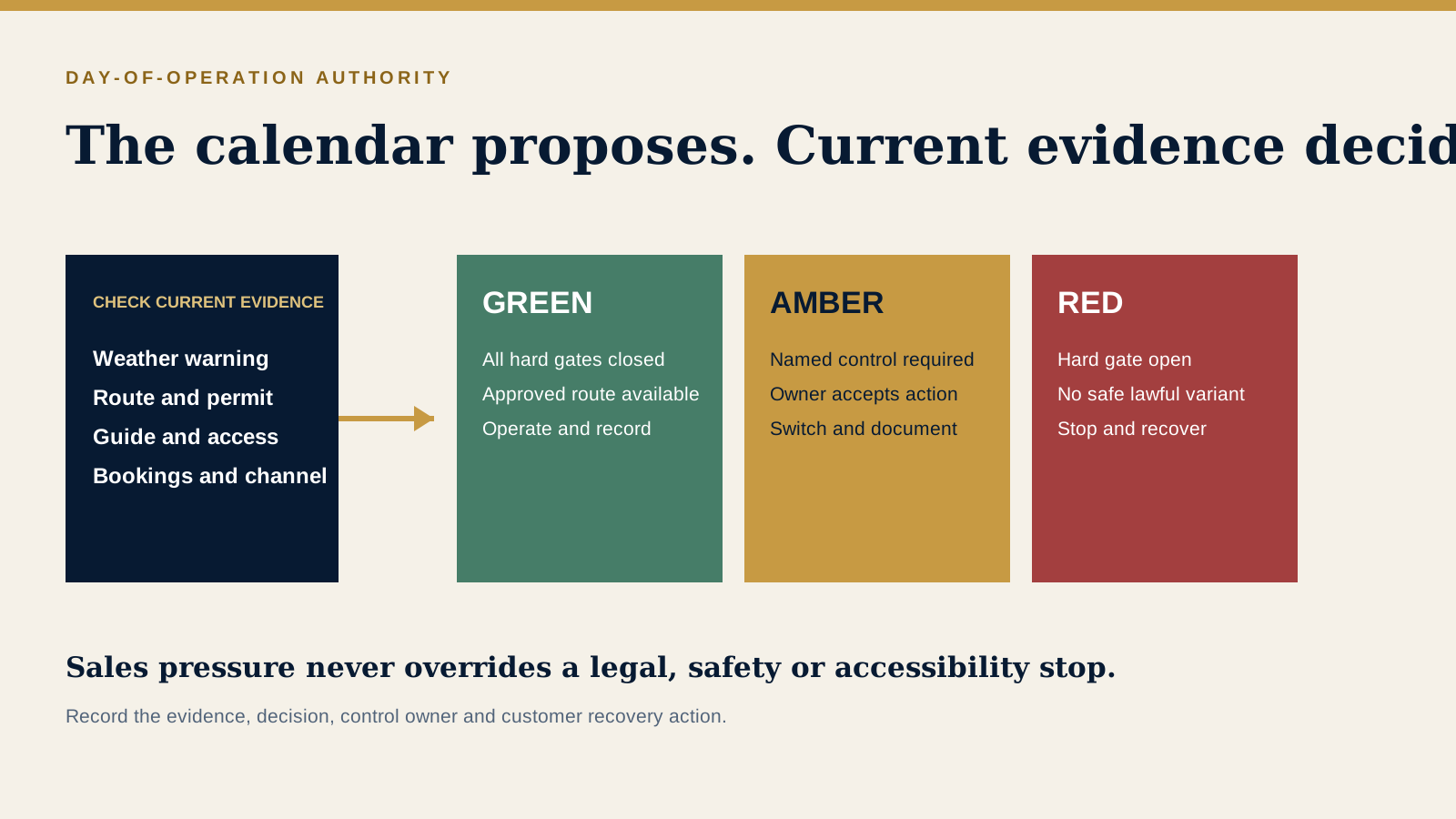
GREEN permits the approved operation, AMBER requires an owned control and RED stops the normal departure.
On small screens, scroll the diagram horizontally to read its labels.
#Green / Amber / Red: the calendar must be overridable
Monthly planning never overrides live weather, permit or safety conditions.
The Green/Amber/Red operating logic is the actual day-of-operation authority. Monthly colour is only the baseline.
GREEN means there is no relevant KNMI warning, the selected route is open, required permits are valid, crowd/event conditions are manageable and the guide can deliver an approved route.
AMBER means the service can normally continue only after an explicit control: route switch, earlier start, rain variant, crowd variant, customer warning or accessibility adjustment. KNMI code yellow is an AMBER trigger, not an automatic invitation to carry on unchanged.
RED means the normal departure does not operate. Examples include relevant KNMI orange/red warnings or clearly unsafe field conditions, missing required Centre exemption, an official closure/security perimeter with no approved route around it, no qualified guide, or a departure that fails the approved commercial minimum without an explicitly funded research-pilot exception.
This last point matters. Article 08 found a six-guest direct break-even under its current assumptions, seven for B2B and eight for OTA. Article 10 cannot make winter look “operationally ready” by scheduling departures that the commercial gate says should not run.
#Events are demand opportunities and operating disruptions at the same time
Amsterdam Dance Event 2026 runs 21–25 October. It can bring demand into the city while simultaneously increasing transport, crowd and supplier pressure. ADE official FAQ. Article 10 therefore marks those dates AMBER by default and authorises the peak-crowd route where conditions justify it.
Amsterdam Light Festival Edition 15 runs from 26 November 2026 to 17 January 2027. The festival itself says hundreds of thousands visited the preceding edition. Amsterdam Light Festival. That can strengthen winter destination interest, but it also concentrates activity in dark-hour central corridors. It is not evidence that Amsterdam Layers should become a light-festival tour.
King's Day 2027 is Tuesday 27 April. The City has already confirmed the date; detailed operating information will follow. City of Amsterdam — King's Day 2027. Because King's Day is one of the city's busiest public-space days and transport patterns materially change, the normal Amsterdam Layers product is marked RED for 27 April unless a separate event-day operating plan is researched and approved. That is a stop rule, not lost revenue.
#Attraction availability belongs in the calendar even when attractions are optional
Amsterdam Layers is intentionally venue-light, but its resilience variants use indoor anchors. The Hortus normally publishes daily operating hours around 10:00–17:00 and has known holiday closures including Christmas Day and New Year's Day. Eye can support the Noord rain/accessibility architecture, but its exhibitions and special closures must be checked live. These are optional modules: their closure should trigger a route/module change, not destroy the core product.
The operating rule is therefore simple: no optional attraction is allowed to become a hidden single point of failure.
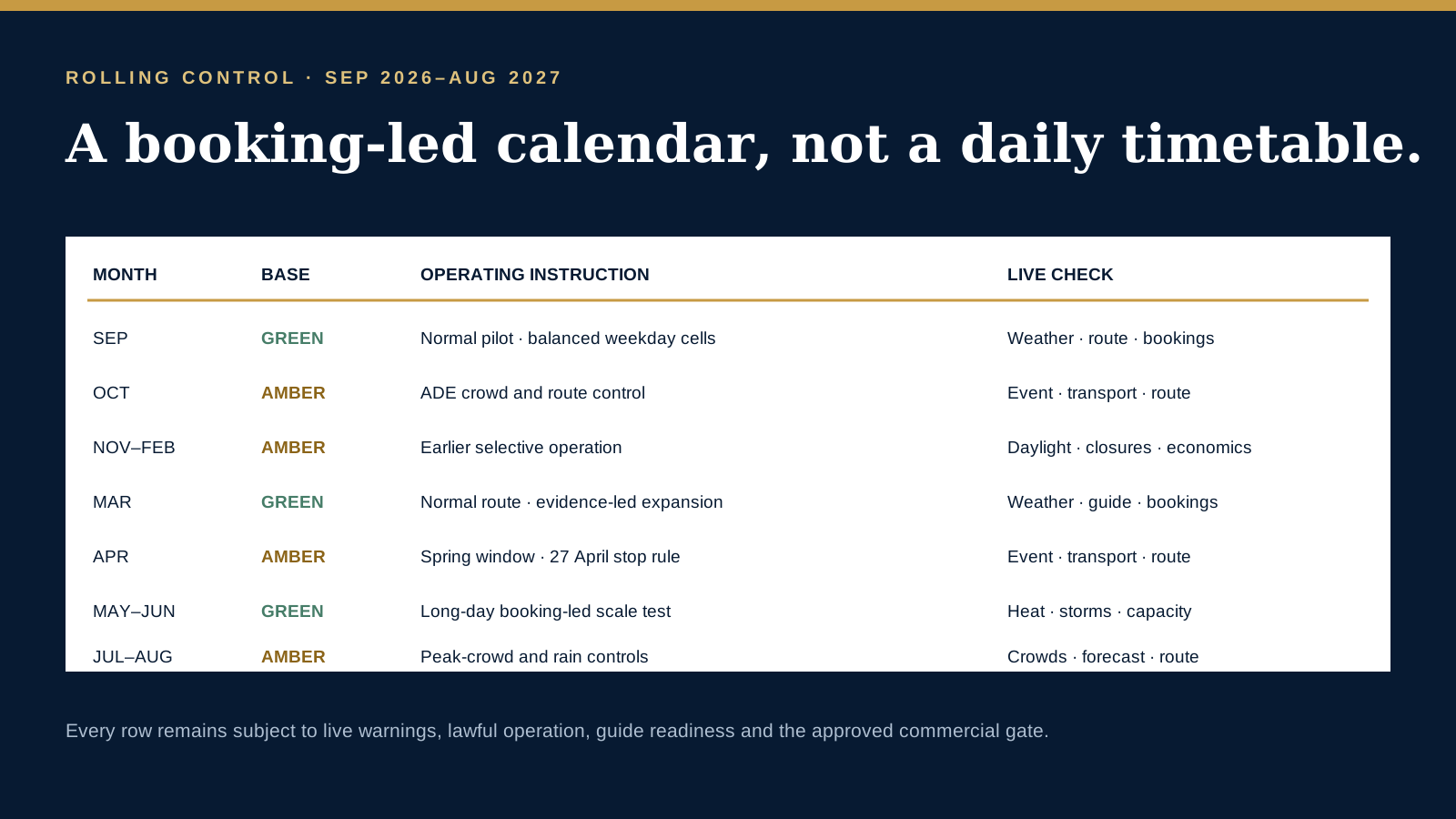
The rolling calendar connects each seasonal baseline to a practical instruction while keeping live checks and commercial permission visible.
On small screens, scroll the diagram horizontally to read its labels.
#The 12-month operating calendar: September 2026 to August 2027
The annual calendar is booking-led and condition-aware, not a fixed daily timetable.
The rolling 12-month operating calendar starts with the first full month after this research checkpoint. It is a management calendar, not a fixed departure timetable.
| Month | Base state | Operating instruction |
|---|---|---|
| Sep 2026 | GREEN | Normal Plantage pilot; test weekday cells. |
| Oct | AMBER | ADE 21–25 Oct; route/crowd check. |
| Nov | AMBER | Earlier starts; Light Festival begins 26 Nov. |
| Dec | AMBER | Short-day/rain logic; holiday attraction checks. |
| Jan 2027 | AMBER | Selective winter operation; Light Festival to 17 Jan. |
| Feb | AMBER | Controlled lower-demand economics test. |
| Mar | GREEN | Normal route; expand only from observed bookings. |
| Apr | AMBER | Strong spring month; normal product RED on 27 Apr. |
| May | GREEN | Strong daylight/climate window; booking-led scale test. |
| Jun | GREEN | Long daylight; live heat/thunderstorm check. |
| Jul | AMBER | Peak-crowd timing/route controls. |
| Aug | AMBER | Warm but wet climate normal; forecast dominates. |
Scroll horizontally to read every column. Keyboard: focus the table, then use the arrow keys.
What to learn: Read each row across to connect Month with Base state, Operating instruction. Compare the rows to identify the relevant month for your situation; use the accompanying section to interpret the result.
There is deliberately no row saying “run daily.” The Article 08 economics are not yet validated, and Article 11 has not measured weekday conversion. Frequency remains booking-led until the pilot creates evidence.
#Alternative-product trigger matrix: resilience without feature creep
The trigger matrix maps operational conditions to the five Article 06 route architectures rather than inventing new products every time conditions change.
Rain can activate Oosterdok→Noord. Peak crowd can activate Oud-West→Westerpark. A confirmed accessibility need can activate the candidate Oosterdok→Eye architecture only after the field-audit condition is satisfied. Construction can activate Museumplein→De Pijp. Short daylight can compress timing while preserving the same core story architecture.
Some triggers correctly produce no product. Severe weather, missing permit, no guide or exceptional King's Day operations can require cancellation. A calendar is responsible only if “do not operate” remains a real outcome.
#Weekday analysis: design an experiment, not a myth
Tourism teams often inherit rules such as “Saturday is strongest” without knowing whether the rule comes from bookings, intuition or another destination. This project has no Amsterdam Layers weekday series yet. The weekday plan therefore assigns Monday–Thursday as control/test cells and Friday–Sunday as priority test cells, but all seven remain hypotheses.
Article 11 should use a balanced pilot design and record, by offered departure: impressions or landing-page sessions, bookings, conversion, lead time, source channel, guests, cancellation/no-show, contribution, weather state and route variant. Only then should frequency be increased or a weekday removed.
#What the calendar can and cannot tell management
It can tell management that Amsterdam has year-round destination demand, that climate friction changes materially by month, that daylight constrains winter timing, that major events can simultaneously increase demand and operational risk, and that five pre-approved route architectures provide resilience.
It cannot tell management next February's weather, exact 2027 event disruption, the number of guests who will book a Tuesday departure, or whether a €55 price will convert. Those inputs remain live forecasts or pilot evidence.
#Decision Gate 5
CONDITIONAL.
Amsterdam Layers now has a defensible year-round operating architecture: historical climate is separated from live weather, demand forecasts are separated from product bookings, month/daypart logic is explicit, major known events are incorporated, five route variants have triggers, and RED conditions can stop a departure.
It is not yet OPERATIONALLY READY because four controls remain outside this article: the accompanied accessibility/route field audit from Article 09, the real supplier/commercial inputs and willingness-to-pay validation from Article 08, live KNMI/event/attraction checks for every departure, and actual weekday/load-factor evidence from the Article 11 pilot.
The next step is therefore not another calendar model. It is a controlled MVP and operations pilot that tests whether these rules work under real bookings and real Amsterdam conditions.
#Human + AI control prompts
These prompts support structured review. They do not replace live KNMI warnings, official event information, commercial approval or the duty manager’s decision.
#Review one proposed operating day
When to use it
Assess whether the proposed Amsterdam Layers departure should be GREEN, controlled AMBER or RED.
Required inputs
[Paste the current date, departure time, route, bookings, channel, guide status, permit status, live KNMI warning, event conditions, attraction status and accessibility requirements.]
Complete prompt
ROLE
Act as a tourism operations control reviewer.

DECISION/TASK
Assess whether the proposed Amsterdam Layers departure should be GREEN, controlled AMBER or RED.

INPUT
[Paste the current date, departure time, route, bookings, channel, guide status, permit status, live KNMI warning, event conditions, attraction status and accessibility requirements.]

METHOD
Separate historical climate from live weather. Check legal, safety, commercial and accessibility hard gates before considering demand opportunity. Name each missing input.

CONSTRAINTS
Use only supplied current evidence. Do not infer weather, permits, closures, bookings or customer needs.

OUTPUT
Return the state, reasons, required controls, owner, deadline and evidence that must be recorded.
Expected output
Return the state, reasons, required controls, owner, deadline and evidence that must be recorded.
Human verification
Check every finding against the supplied records and original sources. Verify calculations, assumptions and missing evidence. The accountable human owner approves any operational decision or publication.
#Review the rolling calendar with pilot evidence
When to use it
Review whether any month, weekday, daypart or route rule should change after the latest controlled pilot cycle.
Required inputs
[Paste offered departures, sessions, bookings, conversion, guests, lead time, cancellation, contribution, weather state, route variant, incidents and guest feedback.]
Complete prompt
ROLE
Act as a tourism product and operations analyst.

DECISION/TASK
Review whether any month, weekday, daypart or route rule should change after the latest controlled pilot cycle.

INPUT
[Paste offered departures, sessions, bookings, conversion, guests, lead time, cancellation, contribution, weather state, route variant, incidents and guest feedback.]

METHOD
Compare like-for-like cells. Keep destination demand, product demand, climate, live weather and operational exceptions separate. Preserve sample size and uncertainty.

CONSTRAINTS
Do not describe a test result as a seasonal fact. Do not change a hard legal or safety gate based on sales pressure.

OUTPUT
Return observed signals, unresolved gaps, proposed calendar change, decision owner and the next controlled test.
Expected output
Return observed signals, unresolved gaps, proposed calendar change, decision owner and the next controlled test.
Human verification
Check every finding against the supplied records and original sources. Verify calculations, assumptions and missing evidence. The accountable human owner approves any operational decision or publication.
Decision Gate 5: CONDITIONAL — CALENDAR CONTROLLED, PILOT EVIDENCE REQUIRED.
#Research artifacts
- Seasonality Model
- Monthly / Weekday Analysis
- Green / Amber / Red Operating Logic
- 12-Month Operating Calendar
- Alternative-Product Trigger Matrix
- Official Source Register
#Official sources
- KNMI climate normals — Schiphol
- KNMI current weather warnings
- Amsterdam O&S visitor forecast 2026–2028
- Amsterdam O&S tourism figures
- CBS Amsterdam hotel statistics
- Government daylight and clock context
- Amsterdam Dance Event
- Amsterdam Light Festival
- City of Amsterdam — King’s Day 2027
Connect this guide to your next step
Continue with related methods and the wider series.
- Series guideBuilding a Data-Driven Signature Tour.
Explore the complete series and its reading order.
- Related guideWho Should We Build It For? Source Markets, Segmentation, Language and Customer Jobs
Part 05 of a 12-part Amsterdam tourism product-management case study: source-market segmentation, language supply, connectivity and guide feasibility translated into Primary, Secondary and Test research segments.
- Related guideFinding the Amsterdam Tourism Market Gap
Part 03 of a 12-part Amsterdam tourism product-management case study: triangulating frozen competitive supply with destination demand, policy and feasibility signals through a transparent opportunity model.
Put this article into practice
- Check each operating date against supplied demand and constraint evidence.
- Confirm staffing, supplier and route availability for that date.
- Record the operating decision, dependencies and approving owner.
- Update the calendar when pilot evidence changes an assumption.
Your next step
Carry the verified findings, assumptions and open questions into the next research stage.
Continue to From Spreadsheet to Street: MVP, Pilot Launch and Operational Readiness