

- Who this helps
- Tourism product owners, operations leaders and responsible-tourism teams.
- What you can do
- Connect verified requirements, product risks and accessibility controls to measurable responsibility commitments and review decisions.
#Responsible operation is a product requirement, not a marketing paragraph
Article 08 left Amsterdam Layers commercially conditional. Article 09 asks a different question: if demand and economics improve, should this experience be operated in its current form, and under what controls? The working product remains the Article 07 concept: an English-first, live, small-group contextual walk, normally using the Plantage→Oosterpark corridor, 110–135 minutes, maximum eight guests, venue-light and dependent on a qualified guide rather than mandatory admissions.
That design looks operationally light. Legally and socially, it is not control-free. The route begins in Amsterdam Centre, public space is shared with residents, cyclists and other visitors, the customer buys a dated service, accessibility varies street by street, and the value proposition includes cultural interpretation in neighbourhoods with living communities and sensitive histories. “It is only a walking tour” is therefore the wrong risk model.
This article uses current City of Amsterdam, Dutch government/RVO and Netherlands Institute for Human Rights sources. Legal rules are separated from project controls and voluntary standards. Where the law is conditional on business structure, staffing or scale, the article says so rather than converting a conditional duty into a universal one.
VERIFIED RULE ≠ CONDITIONAL REQUIREMENT ≠ PROJECT CONTROL ≠ PILOT METRIC. The downloadable registers retain that distinction so a voluntary launch guardrail is never presented as legislation and a policy ambition is never presented as measured product impact.
#The first hard gate: Amsterdam guided-tour rules
The approved eight-person capacity creates a concrete regulatory requirement. The City of Amsterdam states that guided tours in the Centre may contain no more than 15 participants and that an exemption is required for groups of more than four people. Tours may operate between 08:00 and 22:00; they must not pass sex workers’ windows, recruit participants in public places, use amplification or shouting, consume alcohol/drugs during the tour, block busy canal bridges or business entrances, or combine with another tour group. The guide must also instruct participants to respect residents and businesses. The current exemption costs €212.30 and the City says processing takes about six weeks. City of Amsterdam — guided-tour rules.
For Amsterdam Layers, this is not an abstract compliance note. The normal route begins around Waterlooplein/Plantage, within Centrum, and the pilot cap is eight. A valid guide-specific exemption therefore becomes a pre-departure control whenever the route enters the regulated Centre with five or more participants. The product must also hold an approved stopping map and conduct standard so that storytelling does not create obstruction.
One previous industry assumption also needs correction. Amsterdam’s current Dutch guidance says land-based city tours no longer pay the municipal entertainment tax (vermakelijkhedenretributie) from 1 January 2023. The tax remains relevant to paid water entertainment and events, but not to this ordinary land-based walking product. City of Amsterdam — Centre tour rules and VMR.
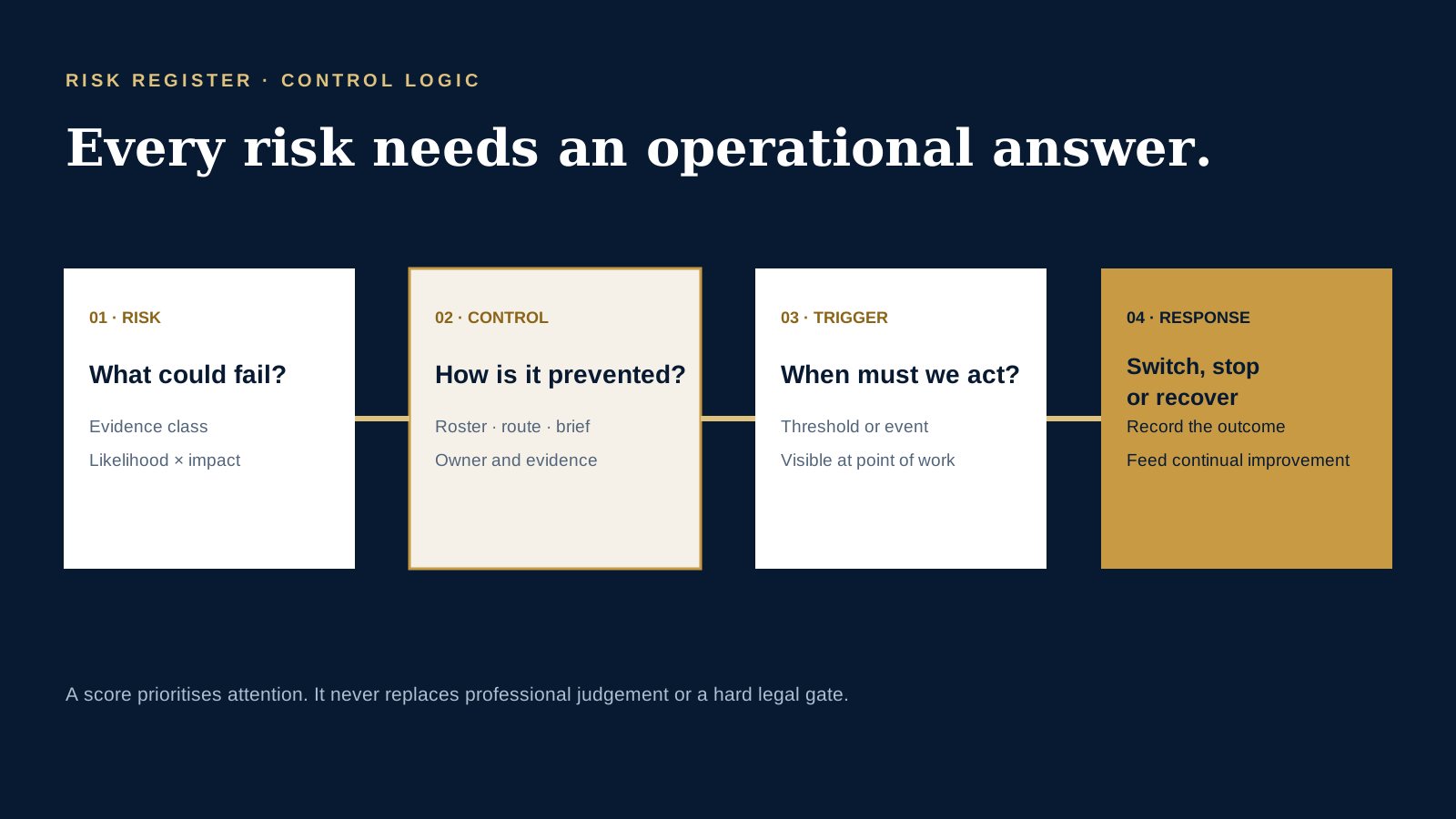
A score prioritises attention; the operating control still needs an owner, a trigger and an executable response.
On small screens, scroll the diagram horizontally to read its labels.
#Risk Register: what can actually stop or damage the service?
Every material risk needs a control, trigger and operational response.
The Article 09 Risk Register scores fifteen operational, regulatory, destination, accessibility, consumer, privacy, supplier and sustainability risks. Likelihood and impact use a 1–5 scale. The purpose is not to create a dramatic heat map; it is to identify the controls that must exist before a paid pilot.
The highest-consequence risks are permit failure, conduct breaches, resident nuisance, an accessibility promise that cannot be delivered, sensitive-history misinterpretation, misleading consumer information and a serious safety incident. Several of these are low-frequency but high-impact. That is why a simple “average risk score” would be misleading.
The design already reduces some exposure. The eight-person ceiling is below the municipal maximum of fifteen. The route architecture avoids mandatory admissions. Moving interpretation reduces obstruction. Article 06 already created rain, peak-crowd, accessibility and disruption variants. But those design choices only become controls when they are operationalised through a roster check, route check, briefing, incident log and authority to switch or cancel.
#Compliance Checklist: law, conditional law and project policy
The Compliance Checklist distinguishes verified legal requirements, conditional legal requirements, project controls and not-applicable rules. This prevents two opposite errors: ignoring a real duty, or presenting a voluntary best practice as if Dutch law explicitly required it.
| Control area | Current Article 09 position |
|---|---|
| Centrum guided-tour exemption | Required before launch for the eight-person default operating model. |
| Tour conduct / prohibited areas / hours | Hard operating controls. |
| Land entertainment tax | Not applicable currently to the walking product; recheck annually. |
| Consumer/online information | Required before direct sales. |
| GDPR | Required if customer personal data are collected or stored. |
| EAA e-commerce requirements | Conditional on enterprise size/scope; design to the standard regardless. |
| Business liability insurance | Not generally mandatory, but Article 09 makes appropriate cover a project launch condition. |
| RI&E | Required if the operating company employs staff; employment model still needs confirmation. |
Scroll horizontally to read every column. Keyboard: focus the table, then use the arrow keys.
What to learn: Read each row across to connect Control area with Current Article 09 position. Compare the rows to identify the relevant control area for your situation; use the accompanying section to interpret the result.
#Consumer sales: clarity before conversion
Dutch online-sales rules require clear, correct and understandable information about the business, the service and the order process before the customer buys, followed by confirmation after purchase. The page must make the trader identity and contact details clear and cannot rely on misleading commercial practices. Business.gov.nl — online sales.
This translates directly into product copy. The booking page must state the real duration range, walking nature, approximate physical effort, language, meeting point, route-flex possibility, what is and is not included, accessibility limitations known at the time of sale, and the cancellation/no-show rule. “Accessible Amsterdam experience” or “hidden local Amsterdam” cannot be used as loose promotional shorthand if the physical journey or evidence does not support the claim.
Business.gov.nl lists services hired for a specific date among cases where the statutory 14-day cooling-off period does not apply. Article 09 therefore does not assume that every dated tour booking has a 14-day withdrawal right. It also does not use that exception as permission for an unfair cancellation policy. The exact direct-booking implementation and the 2026 online-cancellation-button rules should be checked by Dutch legal counsel before launch, with the applicable customer rights stated plainly. Business.gov.nl — cancellation period.
#Accessibility Review: do not confuse an accessible venue with an accessible journey
Article 06 correctly refused to advertise the candidate route as fully accessible. Article 09 keeps that restriction. Accessibility is a chain: discovery, booking, meeting point, surfaces, kerbs, crossings, pace, rest, toilets, transport recovery, communication and service recovery. One accessible museum or tram stop cannot validate the complete experience.
The Dutch equal-treatment framework is materially relevant to a tourism service. The Netherlands Institute for Human Rights explains that providers of goods and services must progressively improve general accessibility for people with disabilities or chronic illness, unless that creates a disproportionate burden, and that customers can request an effective adjustment where reasonable. Netherlands Institute for Human Rights — access with a disability.
The Accessibility Review therefore contains twelve controls. Before any “accessible” positioning, the project needs an accompanied field audit covering kerbs, paving, gradients, crossing timing, construction plates, cycle conflicts, reliable accessible toilets, rest frequency and route recovery. It also needs an adjustment-request process rather than a blanket “not suitable for wheelchairs” exclusion.
Digital accessibility has a separate rule set. Business.gov.nl states that e-commerce services covered by the European Accessibility Act must meet accessibility principles and provide accessible information, login/signing/payment flows and an accessibility statement. The Dutch regulator ACM describes the threshold as 10 or more employees, annual turnover above €2 million, or both. The service-provider microenterprise exemption must also be checked against the legal definition and applicable financial criteria; entity size and turnover alone should not be assumed from this research. See ACM guidance on accessible e-commerce. Business.gov.nl — EAA. Amsterdam Layers has no validated entity size yet, so the legal applicability is marked conditional—but the direct booking design should still be built to accessible standards rather than waiting to become large enough for accessibility to matter.
#Current route risk: the city changes underneath the product
Static route documents become stale. The City currently lists works around Sarphatistraat/Alexanderplein through September 2026, including street, path and tram-stop changes around the Plantage-to-Oosterpark operating area. City of Amsterdam — Sarphatistraat works. This does not invalidate the corridor, but it turns same-day route verification into a required operating control.
The guide therefore needs authority to activate the Article 06 disruption route without seeking commercial approval mid-service. A changed street, lift outage or unsafe crossing is not a reason to preserve the itinerary at all costs. The requirement is to preserve the customer job and safety standard, not every waypoint.
#Safety and liability
A professional walking experience is exposed to ordinary public-space hazards: bicycles, wet paving, kerbs, traffic, crowd compression, heat, rain and individual health events. Dutch guidance for self-employed professionals requires them to prevent danger to others and serious risks in their work. If the business employs staff, a formal Risk Assessment & Evaluation (RI&E) is required. Working conditions for self-employed professionals and RI&E guidance.
Business liability insurance is not generally compulsory for every Dutch entrepreneur, but Business.gov.nl notes that businesses can be liable for physical or property damage and that clients or suppliers may require cover. Business liability insurance. Article 09 therefore makes an appropriate AVB policy covering the actual guided-tour activity a project launch condition, while clearly labelling that as risk policy rather than a universal statutory requirement.
#Privacy: accessibility information can become sensitive operational data
The product should ask only for information necessary to deliver the service. Business.gov.nl’s GDPR guidance requires a lawful basis, data minimisation, security, transparent information and a justified retention period. Business.gov.nl — GDPR.
That matters especially when a guest voluntarily describes mobility, hearing, visual or other accessibility needs. The operational temptation is to write detailed medical notes “just in case.” Article 09 takes the opposite approach: ask what adjustment or assistance is needed, not for unnecessary diagnosis; restrict access to the operational team; define deletion timing; and never repurpose booking data for marketing without a lawful basis.
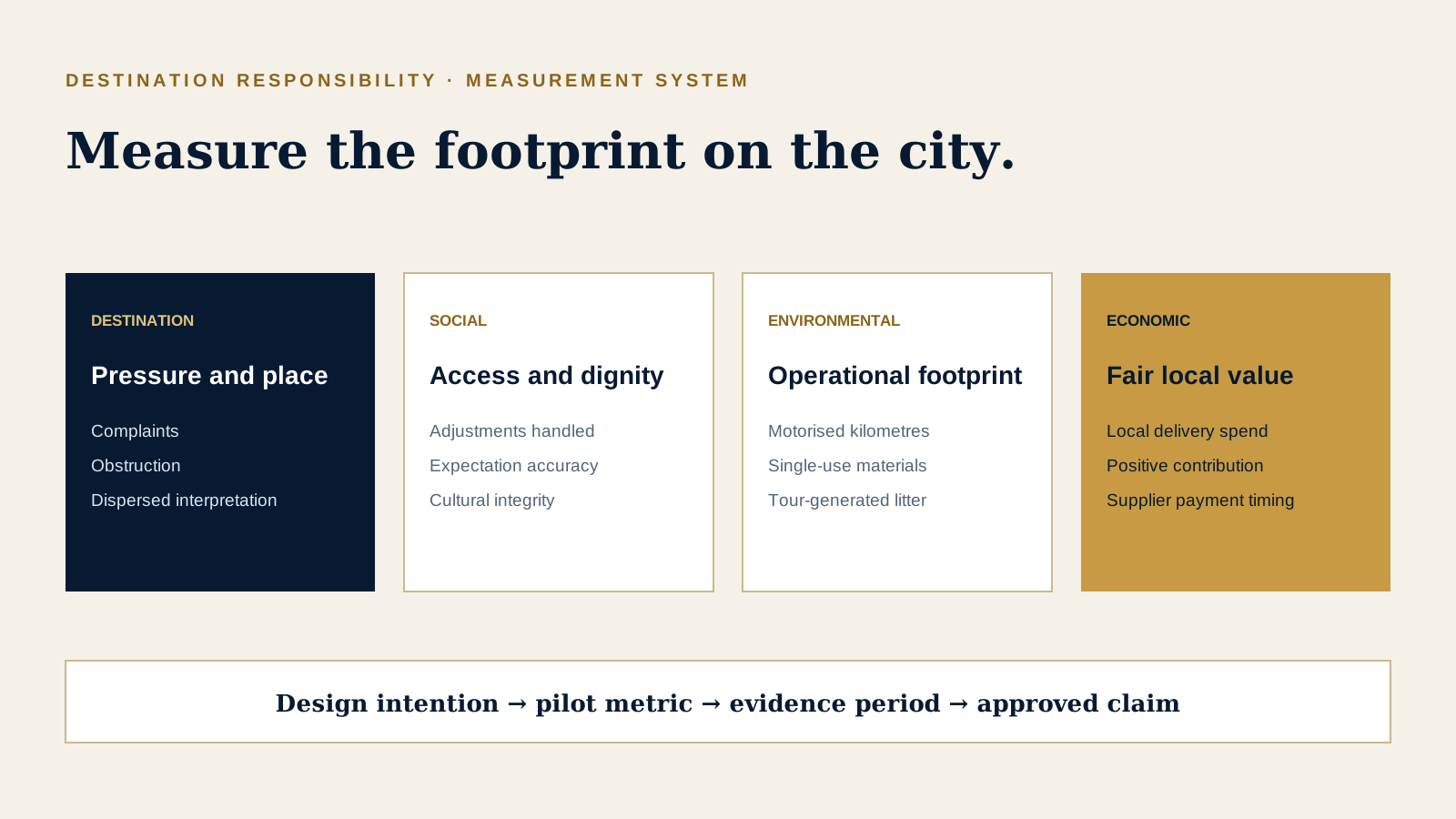
A responsible-tourism claim moves from design intention to publishable evidence only after its metric, period, source and owner are recorded.
On small screens, scroll the diagram horizontally to read its labels.
#Sustainability Scorecard: measure the footprint on the city, not the adjective
Walking is not treated as automatic proof of sustainability.
Amsterdam’s tourism policy says it wants entrepreneurship that attracts visitors while contributing positively to the city and residents, alongside visitor dispersal and nuisance reduction. The city’s wider spatial strategy promotes polycentric development and more walking, cycling and public transport. Its climate programme targets a 60% CO₂ reduction from 1990 levels by 2030 and 50% lower raw-material use, while the circular-economy policy targets 50% fewer new raw materials by 2030 compared with 2016. Tourism policy, Urban development, Sustainability and energy, and Circular economy.
Those goals do not allow Amsterdam Layers to call itself “sustainable” merely because guests walk. The Sustainability Scorecard uses fourteen measurable indicators across four pillars:
| Pillar | What Article 09 measures |
|---|---|
| Destination | Resident complaints, public-space obstruction and share of interpretation delivered outside the highest-pressure core. |
| Social | Accessibility requests handled, expectation accuracy and cultural-integrity complaints/corrections. |
| Environmental | Dedicated motorised operating transport, public-transport arrival prompts, single-use materials and tour-generated litter. |
| Economic | Local delivery spend, positive contribution, supplier payment timing and evidence behind public sustainability claims. |
Scroll horizontally to read every column. Keyboard: focus the table, then use the arrow keys.
What to learn: Read each row across to connect Pillar with What Article 09 measures. Compare the rows to identify the relevant pillar for your situation; use the accompanying section to interpret the result.
The default product already performs well structurally on some indicators: no private vehicle is required for normal operation, no physical giveaway is needed, and the route deliberately distributes interpretation eastward instead of concentrating every minute in the most pressured core. But those are design intentions until pilot logs measure what actually happens.
#Destination responsibility changes the route and the guide behaviour
The City’s tourism position is unusually clear: visitor activity should contribute positively to Amsterdam and the lives of residents, while nuisance and pressure are reduced. Its City Centre Approach similarly prioritises a centre where residents feel at home and overcrowding is reduced. City Centre Approach.
For Amsterdam Layers, destination fit therefore becomes observable behaviour: the group does not colonise doorways for storytelling; the guide does not perform residents as scenery; cultural or religious history is not reduced to shock value; the company records complaints rather than dismissing them as anti-tourist sentiment; and route variants are allowed to trade icon density for lower pressure.
This is also why the Sustainability Scorecard includes economics. A product that pays a professional guide poorly, delays supplier payment, or depends on persistent discounting is not automatically “responsible” because it is low-carbon. Destination, social, environmental and economic performance have to be considered together.
#What is verified, and what remains open?
Verified: the municipal guided-tour rules relevant to the eight-person design; the Centre exemption requirement; current exemption fee and lead time; the absence of land-based VMR; Dutch online-sales/GDPR frameworks; conditional EAA e-commerce duties; disability-accessibility principles; employer/self-employed safety frameworks; and Amsterdam’s current destination, mobility and circularity policy direction.
Designed but not field-validated: accessible route claims, rest/toilet reliability, route-surface quality, disruption bypasses, guide safety behaviours and measurable resident-impact thresholds.
Still externally dependent: the actual legal entity and staffing model, insurance wording/limits, final direct-booking terms, accessibility requests from real users, local stakeholder feedback, and pilot evidence for the sustainability metrics.
#Human + AI risk review
AI may help compare the registers, identify missing owners and test whether a public claim has supporting evidence. It must not invent legal advice, route conditions, accessibility performance or stakeholder consent. A qualified human owner verifies every applicable rule and operating decision.
#Audit the responsible-operation controls
When to use it
Test whether the proposed departure can operate within the supplied municipal, consumer, accessibility, privacy and safety controls.
Required inputs
[Paste the current route, roster, compliance checklist and risk-register rows.]
Complete prompt
ROLE
Act as a critical tourism risk and compliance reviewer.

DECISION/TASK
Test whether the proposed departure can operate within the supplied municipal, consumer, accessibility, privacy and safety controls.

INPUT
[Paste the current route, roster, compliance checklist and risk-register rows.]

METHOD
Separate verified rules, conditional requirements, project controls and pilot metrics. Identify missing evidence, owner, trigger and response.

CONSTRAINTS
Use only supplied sources and operating facts. Do not invent legal advice, permits, accessibility outcomes, insurance cover or route conditions.

OUTPUT
Return blockers, conditional approvals, evidence gaps, control conflicts and the qualified human review required.
Expected output
Return blockers, conditional approvals, evidence gaps, control conflicts and the qualified human review required.
Human verification
Check every finding against the supplied records and original sources. Verify calculations, assumptions and missing evidence. The accountable human owner approves any operational decision or publication.
#Challenge destination-responsibility claims
When to use it
Determine which proposed environmental, social, destination and economic claims can be published after the pilot.
Required inputs
[Paste the scorecard definitions, pilot observations, complaint log and claim register.]
Complete prompt
ROLE
Act as an evidence-led destination-responsibility reviewer.

DECISION/TASK
Determine which proposed environmental, social, destination and economic claims can be published after the pilot.

INPUT
[Paste the scorecard definitions, pilot observations, complaint log and claim register.]

METHOD
Map every claim to its metric, period, source, threshold and approving owner. Flag design intentions that have not yet been measured.

CONSTRAINTS
Do not equate walking with sustainability, absence of complaints with resident approval, or one accessible venue with an accessible journey.

OUTPUT
Return approved, qualified and rejected claims with reasons and required next evidence.
Expected output
Return approved, qualified and rejected claims with reasons and required next evidence.
Human verification
Check every finding against the supplied records and original sources. Verify calculations, assumptions and missing evidence. The accountable human owner approves any operational decision or publication.
#Article 09 operating decision
CONDITIONAL — CONTROLS REQUIRED
Amsterdam Layers is capable of responsible pilot operation only with controls. Article 09 does not grant launch approval. Before a paid pilot, the project must obtain the relevant guide exemption, complete the route/accessibility field audit, confirm insurance, implement consumer/privacy/accessibility booking controls, brief guides against the compliance checklist, and activate measurement of the sustainability KPIs from the first departure.
The concept does not need to be abandoned because of regulation or destination fit. It does need to reject the idea that a small walking product is naturally harmless, naturally accessible or naturally sustainable. Those claims must be demonstrated departure by departure.
#Download the Article 09 evidence pack
- Risk Register
- Compliance Checklist
- Accessibility Review
- Sustainability Scorecard
- Official Source Register
#Stop boundary
Article 09 ends with risk, regulation, accessibility and responsibility controls. It does not build the seasonal operating calendar. Article 10 remains closed.
#Sources and further reading
Primary standards, institutional guidance and professional references used to support this article.
- City of Amsterdam — rules and exemptions for guided tours in the city centre (checked 4 September 2026).
- City of Amsterdam — Centrum guided-tour rules and land VMR status (checked 4 September 2026).
- Business.gov.nl — rules for online sales and purchases (checked 4 September 2026).
- Business.gov.nl — cancellation period in case of a sale (checked 4 September 2026).
- Netherlands Institute for Human Rights — access with a disability (checked 4 September 2026).
- Business.gov.nl — European Accessibility Act rules (checked 4 September 2026).
- Business.gov.nl — Risk Assessment and Evaluation (checked 4 September 2026).
- Business.gov.nl — arrange business insurance (checked 4 September 2026).
- Business.gov.nl — GDPR and personal-data protection (checked 4 September 2026).
- City of Amsterdam — tourism policy (checked 4 September 2026).
- City of Amsterdam — valuable visitors economy (checked 4 September 2026).
Editorial note: Rules, fees, works and policy pages are time-sensitive. This article is an evidence-led product-control framework, not Dutch legal, accessibility or insurance advice. Applicability must be confirmed for the actual entity, route, staffing model and sales flow.
Connect this guide to your next step
Continue with related methods and the wider series.
- Series guideBuilding a Data-Driven Signature Tour.
Explore the complete series and its reading order.
- Related guideWhere Should the Experience Happen? Attraction Intelligence, Geography and Destination Fit
Part 06 of a 12-part Amsterdam tourism product-management case study: verified POI intelligence, destination-fit scoring and resilient route variants across crowd, rain, accessibility and disruption conditions.
- Related guideWho Should We Build It For? Source Markets, Segmentation, Language and Customer Jobs
Part 05 of a 12-part Amsterdam tourism product-management case study: source-market segmentation, language supply, connectivity and guide feasibility translated into Primary, Secondary and Test research segments.
Put this article into practice
- Distinguish verified rules from project controls and assumptions.
- Assign an owner, trigger and response to each material risk.
- Verify accessibility, privacy, safety and public-claim evidence.
- Record qualified human approval before authorizing operation.
Your next step
Carry the verified findings, assumptions and open questions into the next research stage.
Continue to When Should the Tour Run? Demand, Weather, Seasonality and the Amsterdam Operating Calendar