

- Who this helps
- Tourism product managers, pricing teams and commercial reviewers.
- What you can do
- Model channel economics, capacity and break-even with transparent assumptions and commercial guardrails.
#A popular tour can still be a bad business
Article 07 approved a product concept, not a commercial model. Amsterdam Layers — Context & Neighbourhood Discovery is a live, small-group, venue-light contextual walk, designed around Plantage→Oosterpark, delivered in English first, running roughly 110–135 minutes and capped at eight guests for the pilot. That capacity ceiling exists for experience quality and operating control. Article 08 therefore cannot “solve” weak economics simply by increasing the group to fifteen.
The business question is narrower and harder: can the approved service architecture make money at eight guests or fewer? To answer it honestly, I separate observed public facts from commercial assumptions. Current Amsterdam walking-tour listings provide market context, Stripe and GetYourGuide publish parts of the payment/distribution mechanics, and Dutch tax guidance provides a VAT baseline. But the guide tariff, final OTA commission, reseller net rate, cancellation history and visitor willingness to pay do not yet exist for this product. Those values are modelled as scenarios, not reported as facts.
FACT ≠ ASSUMPTION ≠ HYPOTHESIS ≠ SCENARIO. Every material input keeps its evidence class through the calculations and decision gate.
#Business decision
The decision is not “what price looks premium?” It is whether the product can produce a positive contribution after VAT, guide cost, channel cost, variable service cost and an allocation of fixed overhead while preserving the eight-guest service maximum. A viable model must also survive realistic channel and cost variation rather than working only in one optimistic spreadsheet cell.
The commercial model uses four capacity concepts that must not be confused:
| Capacity concept | Article 08 definition | Current result |
|---|---|---|
| Minimum viable departure | Lowest guest count at which the departure can be intentionally guaranteed under the preferred direct-led model without planned loss. | 6 guests at the €55 test midpoint under the base assumptions. |
| Break-even capacity | Guest count where contribution after allocated fixed cost reaches zero. | Direct 6 · B2B 7 · OTA 8. |
| Target capacity | Commercial operating target that creates some buffer while remaining inside the experience design. | 7 guests. |
| Maximum service capacity | Hard experience ceiling inherited from Article 07. | 8 guests. |
Scroll horizontally to read every column. Keyboard: focus the table, then use the arrow keys.
What to learn: Read each row across to connect Capacity concept with Article 08 definition, Current result. Compare the rows to identify the relevant capacity concept for your situation; use the accompanying section to interpret the result.
This distinction matters because “break-even at eight” is not the same as a healthy product. If an OTA departure only becomes positive at the last available seat, one cancellation can destroy the contribution.
#The cost model: fixed, variable and departure costs
The commercial assumption register is intentionally compact because the concept is venue-light. The largest cost is the professional guide. Guidor confirms that professional guides can be sourced and that individual tariffs are available on contact, but it does not publish a standard tariff for this exact product. I therefore use €200 per departure as a base planning assumption, with €160 and €240 sensitivity cases. It is not a supplier quote.
Another €15 per departure is reserved for route/disruption checking, local guide expense and simple backup materials. A €1.50 per-guest variable allowance covers communication, digital follow-up and small operating consumables. Monthly fixed overhead is modelled at €450, covering a placeholder for booking/software, insurance/admin/accounting, baseline content/marketing and contingency. At 24 departures per month, that is €18.75 allocated per departure. Every one of these non-public values is labelled ASSUMPTION in the downloadable model.
#Transparent unit-economics formulas
The unit-economics model exposes every step. Retail prices are VAT-inclusive planning prices. The model first calculates ex-VAT revenue, then applies percentage channel costs to that ex-VAT base; direct card processing is applied to the charged retail amount.
- Ex-VAT Revenue per Guest = Retail Price ÷ (1 + VAT Rate)
- Net Revenue per Guest = Ex-VAT Revenue − Distribution Cost − Per-Guest Discounts
- Contribution per Guest = Net Revenue per Guest − Variable Cost per Guest
- Departure Contribution = (Guests × Contribution per Guest) − Departure-Level Costs − Allocated Overhead
- Contribution Margin % = Departure Contribution ÷ Total Net Revenue
- Break-Even Guests = ceiling((Departure-Level Costs + Allocated Overhead) ÷ Contribution per Guest)
This is a planning convention, not tax advice. The operator and tax adviser must confirm the taxable base, recoverability of input VAT and contractual commission basis before launch.
The VAT baseline uses the Dutch general rate of 21%. The Belastingdienst states that the general 21% rate applies to goods and services that are not exempt or taxed at 9%/0%, while a specific exemption for excursions and guided tours applies only under restricted conditions such as qualifying public-law bodies, associations or foundations operating for science/general development and cost recovery. A commercial Amsterdam Layers operation should therefore model 21% until specialist tax advice confirms the exact structure. Belastingdienst VAT rates and tour/excursion exemption conditions.
#Three scenarios, not three forecasts
These cases are controlled planning scenarios. They show which combination of price, channel and occupancy deserves validation; they do not predict sales.
| Scenario | Commercial configuration | Decision use |
|---|---|---|
| Conservative | €45 retail · 6 guests · OTA-weighted mix · €240 guide cost | Tests whether weak pricing power and expensive supply destroy the model. |
| Base | €55 retail · 7 guests · direct-led mix · €200 guide cost | Working hypothesis for supplier quotes and willingness-to-pay research. |
| Strong | €59 retail · 8 guests · direct-led mix · €160 guide cost | Shows the upside boundary without exceeding the service cap. |
Scroll horizontally to read every column. Keyboard: focus the table, then use the arrow keys.
What to learn: Read each row across to connect Scenario with Commercial configuration, Decision use. Compare the rows to identify the relevant scenario for your situation; use the accompanying section to interpret the result.
The conservative case is expected to fail; that is useful. The fastest destroyer is the combination of rejected premium pricing and high OTA commission. The strongest controllable management lever is direct-channel share, followed by a verified guide rate and channel-specific departure guarantees.
#The price problem starts with the market, not the spreadsheet
The frozen Article 02 pack could not support a broad comparable walking-tour price because only twelve date-independent digital products cleared the strict price gate. Article 08 therefore uses fresh public market benchmarks only as context, not as a demand forecast. At the research date, selected 2–3 hour small-group walking products were publicly displayed around US$23–34 per person: Viator's Amsterdam Highlights Small-Group Walking Tour from US$23.22, Hello Amsterdam from US$33.84, GetYourGuide's Cultural Highlights tour from about US$30 and a French/English small-group walk from about US$33. Prices, availability and currencies can change. See Viator Amsterdam Highlights, Hello Amsterdam, GetYourGuide Cultural Highlights and the French/English small-group tour.
Amsterdam Layers is intentionally different: lower-pressure geography, deeper context, a strict eight-person cap, route resilience and explicit onward value. Those differences may justify a premium. But the market evidence does not prove visitors will pay €55. The €55 figure in this article is a test midpoint chosen to stress the economics, not a recommended launch price.
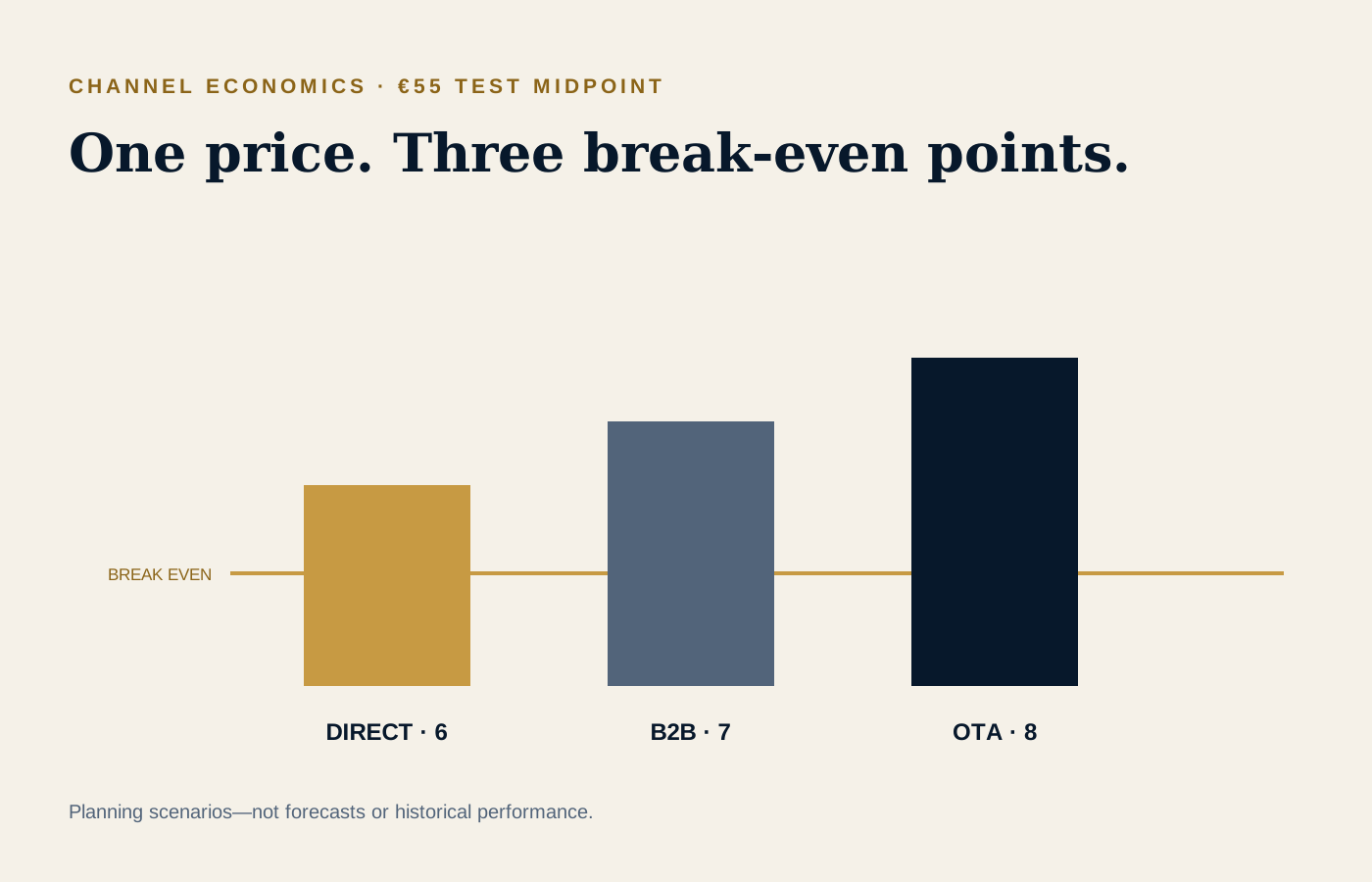
The same retail price produces materially different break-even thresholds by channel, making distribution mix a commercial control.
On small screens, scroll the diagram horizontally to read its labels.
#Direct economics
The same retail price produces very different break-even requirements by distribution channel.
Direct sales are the healthiest channel in the base model because the product retains the retail value and pays only payment-processing cost rather than marketplace commission. Stripe currently publishes standard Dutch online card pricing of 1.5% + €0.25 for standard EEA cards, 2.5% + €0.25 for UK cards and 3.15% + €0.25 for international cards. Because Article 05's Primary segment is international, I use 2.5% + €0.25 per transaction as a conservative planning blend, assuming an average booking contains two guests. Stripe Netherlands pricing.
At €55 retail and six guests, the base direct model produces approximately €264 of net revenue after VAT and payment fees. After €9 of guest-variable cost, €215 of departure cost and €18.75 fixed-cost allocation, the departure contributes only about €21. Seven guests improve that to about €63; eight guests to roughly €106. Direct can work, but the six-guest minimum is a floor, not an attractive target.
#OTA economics: distribution can consume the product
GetYourGuide publicly confirms that suppliers pay commission only on successful bookings and that the exact rate varies by country and is shared after signup. It also states that fulfilled bookings can be paid monthly at no extra charge or twice monthly with a surcharge. Because the exact Amsterdam supplier rate is unavailable publicly, the model uses a 25% commission scenario with 20% and 30% sensitivity. GetYourGuide supplier information.
At the same €55 price, the base OTA model is negative at six and seven guests and only narrowly positive at the eight-guest maximum after the fixed-cost allocation. That is a major commercial warning. An OTA should not become the channel that dictates whether the product can depart unless one of three things changes: the price is higher, the guide/departure cost is lower, or the commission is materially better than the assumption.
This creates a useful channel rule for the pilot: do not guarantee an OTA-heavy departure merely because bookings exist. Guarantee the departure only when combined bookings meet the contribution threshold. Commercial operations should control departures by contribution, not by vanity volume.
#B2B economics
No hotel, DMC, concierge or reseller agreement exists yet. I therefore model B2B at a 20% net discount to retail. At €55 and seven guests, the departure produces only about €10 after the allocated fixed cost; at eight guests, roughly €45. A B2B partner could still be attractive if it supplies predictable volume, lower acquisition cost, better advance booking and lower cancellation behaviour—but those benefits are hypotheses until a contract and booking history exist.
The economic lesson is that commission and discount are not marketing expenses hidden somewhere below gross profit. They materially determine whether an eight-person product is commercially possible.
#Distribution strategy for the controlled pilot
Start direct-led so the pilot retains customer contact, clearer cash timing and the strongest unit economics. Use content and partner referrals to create qualified discovery, then test one OTA allocation only after its exact commission, cancellation and payout terms are recorded. Hotel, concierge, DMC and reseller distribution should enter as controlled B2B experiments with written net rates, attribution and settlement rules. No channel receives unrestricted inventory: each receives a capacity allocation and a contribution floor.
#Markup, margin and contribution are not the same thing
The model reports both markup and contribution margin because tourism quotations often confuse them. Markup describes contribution relative to operating cost. Margin describes contribution relative to net revenue. A 25% markup is not a 25% margin. The downloadable channel economics table calculates both after VAT, channel cost, guest-variable cost, departure cost and allocated fixed overhead.
At the seven-guest target and €55 base price, direct contribution margin is about 21% of net revenue. B2B is only around 4%, while the 25%-commission OTA case remains negative. That distribution is more important than a single blended headline margin.
#Price sensitivity: where the model breaks
The sensitivity analysis tests €35, €39, €45, €49, €55, €59 and €65 at seven guests. At market-like prices around €35–39, the base model loses money even on direct distribution. Direct becomes positive around the mid-€40s; B2B requires roughly the mid-€50s; the 25%-commission OTA case does not become positive at seven guests until around the mid-€50s.
That does not mean the correct price is €65. It means the current cost/capacity/channel structure demands either a premium willingness to pay or better supply/channel economics. A spreadsheet cannot decide which. If real visitors reject the premium, the product must be revised rather than hiding the problem through larger groups.
#Guide-cost and commission sensitivity
The same sensitivity matrix varies guide cost from €160 to €240 and OTA commission from 20% to 30%. The pattern is simple: at a seven-guest target, small changes in guide cost or commission can move the departure across zero contribution.
This is why Article 07's supplier feasibility was necessary but not sufficient. “Guides exist” is an operating fact. “A guide can be contracted at a cost that fits this product” is a commercial fact that still requires a quote. Before any launch price is approved, the project should obtain at least three comparable guide quotations using the same scope: 110–135 minutes delivery, pre-departure route/disruption check, briefing/training expectation, cancellation terms, language, invoicing/VAT status and backup arrangements.
#Cancellation and no-show economics
A small-capacity product is unusually sensitive to cancellations because one guest represents 12.5% of maximum capacity. The model therefore separates cancellations from no-shows.
A cancellation outside the free-cancellation window normally removes revenue. Whether it also removes guide cost depends on the supplier cancellation terms. A late cancellation or no-show may retain revenue under some direct/channel policies, but Article 08 does not assume that revenue until the actual cancellation rules are configured. An operator/guide cancellation is more severe: it can trigger a full departure refund, rebooking support and reputational loss. The Article 07 backup-guide requirement is therefore also a unit-economics control.
The base planning scenario records an 8% cancellation rate and 3% no-show rate only for sensitivity. These are not observed Amsterdam Layers metrics. The first pilot dashboard must replace them with actual booking-level cohorts: booked guests, cancelled guests, cancellation lead time, no-shows, refunded revenue, retained revenue and supplier cancellation cost.
#Cash-flow timing
Profit and cash are not the same. Direct card bookings can provide working capital before the tour, but the settlement is not instantaneous. Stripe documents a seven-calendar-day initial settlement period for Netherlands accounts and a standard three-business-day settlement timing thereafter, subject to account/risk conditions and payout schedule. Stripe payout documentation.
GetYourGuide's supplier model pays fulfilled bookings through periodic pay runs, so an OTA booking can create a gap between the service date and cash receipt. B2B is even more contract-sensitive; the model uses a 30-day invoice assumption only as a placeholder. If guides require payment on or shortly after delivery while OTA/B2B cash arrives later, the product needs working capital even when the P&L is positive.
The channel economics table therefore treats payout timing, refund reserves and supplier payment terms as part of commercial feasibility—not finance administration after launch.
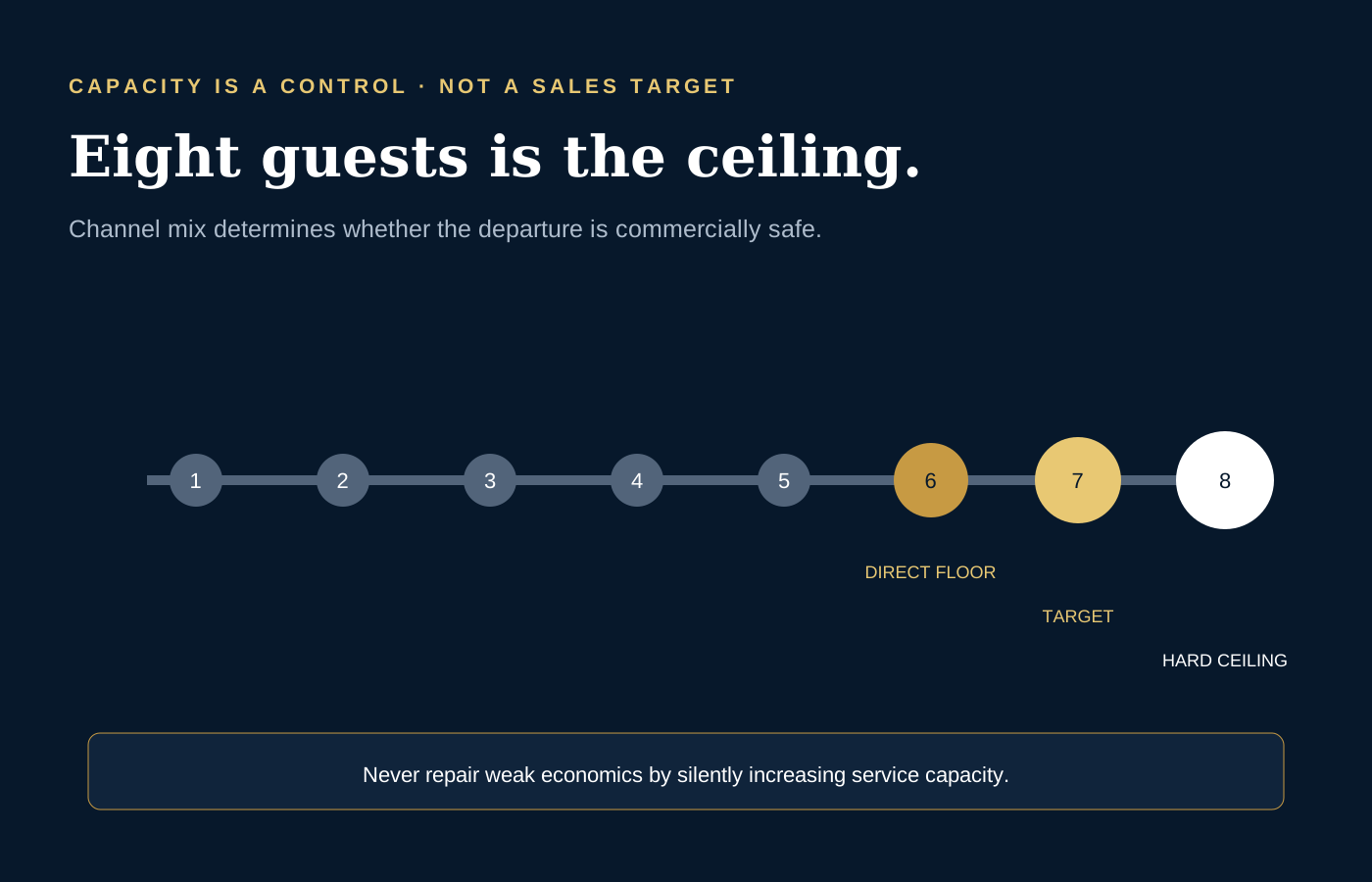
Commercial capacity stays inside the eight-guest service ceiling, with a seven-guest target and channel-specific departure rules.
On small screens, scroll the diagram horizontally to read its labels.
#Capacity rules for the pilot
Commercial capacity must remain inside the service-quality ceiling approved in Article 07.
The economics produce four operational rules:
- Minimum viable departure: 6 guests for the preferred direct-led base case at €55. A five-guest departure should not be routinely guaranteed under the current assumptions.
- Break-even capacity is channel-specific: 6 Direct, 7 B2B, 8 OTA at the base assumptions.
- Target capacity: 7 guests. This creates more buffer while remaining below the eight-person service ceiling.
- Maximum service capacity: 8 guests. Commercial pressure does not automatically authorize nine or ten guests; that would reopen Article 07's experience and H02 logic.
For mixed-channel departures, the booking system should calculate expected contribution from the actual booking mix. “Six guests booked” is not sufficient information if five came through a high-commission channel.
#How to research willingness to pay instead of guessing
The absence of real willingness-to-pay evidence is the largest reason Gate 4 cannot be VIABLE. Article 08 therefore publishes a WTP research plan rather than pretending that competitor prices reveal willingness to pay for this concept.
Van Westendorp can establish the psychologically acceptable range by asking when the offer feels too cheap, a bargain, expensive and too expensive. Gabor-Granger can test booking likelihood across randomized price points such as €39, €45, €49, €55, €59 and €65. A compact choice/conjoint test can show whether visitors trade price against group size, neighbourhood, guide format, duration and language. A non-transactional landing-page intent test can add behavioural evidence without taking fake bookings. Finally, paid pilot departures provide the evidence that surveys cannot: actual booking, cancellation, attendance, review and contribution behaviour.
Primary English research should come first because Article 05 made it the controlled prototype segment. German and French price testing should follow only with native-language concept wording; translated English willingness-to-pay data should not be treated as equivalent.
#Human + AI commercial analysis
AI can accelerate scenario comparison, formula checking and anomaly detection, but it cannot supply missing prices, contracts, bookings or approval. The analyst provides governed inputs and the product owner approves every interpretation.
#Challenge the unit-economics model
When to use it
Test whether the proposed product remains contribution-positive within its approved eight-guest capacity.
Required inputs
[Paste the assumption register and unit-economics rows.]
Complete prompt
ROLE
Act as a critical tourism unit-economics reviewer.

DECISION/TASK
Test whether the proposed product remains contribution-positive within its approved eight-guest capacity.

INPUT
[Paste the assumption register and unit-economics rows.]

METHOD
Recalculate VAT-exclusive revenue, channel cost, variable cost, departure cost, allocated overhead, contribution and break-even guests.

CONSTRAINTS
Use only supplied inputs. Keep OBSERVED, DERIVED, ASSUMPTION and HYPOTHESIS separate. Do not invent bookings, contracts, commissions or demand.

OUTPUT
Return formula checks, exceptions, sensitivity risks, missing evidence and the human approval required.
Expected output
Return formula checks, exceptions, sensitivity risks, missing evidence and the human approval required.
Human verification
Check every finding against the supplied records and original sources. Verify calculations, assumptions and missing evidence. The accountable human owner approves any operational decision or publication.
#Stress-test channel concentration
When to use it
Identify which direct, OTA, hotel/referral and B2B mixes remain commercially credible.
Required inputs
[Paste verified channel terms and the scenario model.]
Complete prompt
ROLE
Act as a tourism distribution-risk analyst.

DECISION/TASK
Identify which direct, OTA, hotel/referral and B2B mixes remain commercially credible.

INPUT
[Paste verified channel terms and the scenario model.]

METHOD
Compare net revenue, cash timing, cancellation exposure, customer ownership and operating complexity by channel mix.

CONSTRAINTS
Treat unpublished commission and referral terms as assumptions. Do not convert listing visibility into demand.

OUTPUT
Return viable mixes, failure triggers, evidence gaps and proposed pilot guardrails for human approval.
Expected output
Return viable mixes, failure triggers, evidence gaps and proposed pilot guardrails for human approval.
Human verification
Check every finding against the supplied records and original sources. Verify calculations, assumptions and missing evidence. The accountable human owner approves any operational decision or publication.
#What must be true for the commercial model to pass
H05 originally asked whether the concept can reach target margin without unsafe group size or extractive terms. Article 08 can now narrow that hypothesis, but not close it. The model says the concept is conditionally capable of positive contribution inside the eight-guest cap, especially through direct sales. It also says the economics are fragile if the product depends heavily on OTA commission, if guide costs are at the top of the sensitivity range, or if visitors will not accept a meaningful premium over mainstream walking-tour prices.
Before Gate 4 can become VIABLE, the project needs three real inputs: (1) a guide quote, (2) actual distribution terms, and (3) primary willingness-to-pay evidence. Those inputs must be rerun through the same model without changing the eight-guest maximum simply to make the spreadsheet work.
#Proposed pilot guardrails
These are management proposals to test, not established industry standards. The controlled register defines a six-guest direct minimum, a seven-guest target, an eight-guest hard service ceiling, no guaranteed departure with negative expected contribution, no discount below the channel-specific price floor, and escalation whenever assumed channel or supplier terms differ from verified terms.
Download the commercial guardrails and break-even scenarios.
#Evidence summary
#What we know
- The Article 07 service ceiling is eight guests.
- Current official Dutch VAT guidance supports a conservative 21% planning baseline unless specialist advice establishes another treatment.
- Stripe publishes Dutch card fees and settlement timing; GetYourGuide confirms commission applies to fulfilled bookings but does not publish the exact Amsterdam rate before signup.
#What remains assumed
- €55 VAT-inclusive test price, €200 guide cost, €15 departure support, €1.50 guest-variable cost, €450 monthly overhead and 24 departures.
- Twenty-five percent OTA commission and twenty percent B2B discount scenarios.
#What the pilot must validate
- Willingness to pay, paid channel mix, cancellations, attendance, actual guide and partner terms, and realized contribution.
#Commercial risks
- Premium-price rejection, supplier-cost escalation, high-commission concentration, cancellation leakage and insufficient working capital.
#Required next evidence
- Three comparable guide quotations, signed channel terms, controlled willingness-to-pay research and a rerun of the same formulas with verified inputs.
#Decision Gate 4
REVISE
The concept is not commercially rejected. A direct-led version can generate positive contribution at six to eight guests under the base assumptions, and the venue-light design keeps variable supplier cost low. But the current model does not justify a final price or channel strategy. The €55 midpoint is a hypothesis, public competitors are commonly displayed materially below it, the guide fee remains an assumed €200 rather than a quote, and OTA-heavy economics are too fragile at the eight-person ceiling.
The revision is therefore commercial, not conceptual: obtain guide quotes; test €39–€65 willingness to pay; secure actual OTA/B2B terms; define channel-specific departure guarantees; and rerun the model. If the real data cannot produce a healthy contribution at eight guests or fewer, the correct response is to redesign cost/channel architecture—or stop—not to dilute the experience by adding capacity.
Article 09 remains closed. Risk and destination-responsibility validation should start only after the Article 08 commercial revisions have an evidence-backed configuration to test.
Next gate: Article 09 — Risk & Destination Responsibility.
#Sources and further reading
Primary standards, institutional guidance and professional references used to support this article.
- Belastingdienst — VAT rates (checked 4 September 2026).
- Belastingdienst — exemption conditions for lectures, excursions and guided tours (checked 4 September 2026).
- Stripe Netherlands — pricing (checked 4 September 2026).
- Stripe — payout timing (checked 4 September 2026).
- GetYourGuide — supplier costs, commission disclosure and payment cadence (checked 4 September 2026).
- GetYourGuide — publicly displayed Amsterdam walking-tour listings (checked 4 September 2026).
- Viator — Amsterdam Highlights small-group walking tour (checked 4 September 2026).
Editorial note: Public prices are time-sensitive listing observations, not realized selling prices or demand. Guide cost, product demand, commission and B2B terms remain assumptions until verified.
Connect this guide to your next step
Continue with related methods and the wider series.
- Series guideBuilding a Data-Driven Signature Tour.
Explore the complete series and its reading order.
- Related guideAfter the First Guests: Product Analytics, Continuous Improvement and the Scale Decision
Part 12 of a 12-part Amsterdam tourism product-management case study: a governed post-pilot measurement architecture, frozen performance review, improvement controls and an evidence-valid product decision.
- Related guideAmsterdam Tourism Product Research Plan
Part 01 of a 12-part Amsterdam tourism product-management case study: framing the destination decision, hypotheses, research design, data provenance, sampling and ethics before deciding what to build.
Put this article into practice
- Trace every cost and price input to its source and date.
- Use consistent units, capacity and participant assumptions.
- Recalculate contribution and break-even under the stated scenarios.
- Record commercial risks and obtain approval before committing.
Your next step
Carry the verified findings, assumptions and open questions into the next research stage.
Continue to Can We Operate It Responsibly? Regulation, Accessibility, Sustainability and Product Risk