
- Who this helps
- DMC managers, tour operators, hotel operations leaders, MICE teams and transport coordinators.
- What you can do
- Level eligible preparation work, evaluate the DMC case study, use three AI prompts and protect guest service.
Educational disclosure: All tourism scenarios, operational figures, staffing assumptions and calculated improvements in this article are fictional examples created for teaching. They are not measured outcomes from a real operator.
Article summary: Discover how Heijunka, the Lean approach to leveling production volume and mix, can help tourism teams prepare for demand peaks, stabilize workflows and protect guest-facing service. Includes an illustrative DMC case study, calculations, visual planning examples, practical controls and three reusable AI master prompts.
Educational disclosure: All tourism scenarios, operational figures, staffing assumptions and calculated improvements in this article are fictional examples created for teaching. They are not measured outcomes from a real operator.
1. Your team has enough capacity. So why is everyone overwhelmed?
It is 8:30 a.m. at a destination management company.
Three airport transfer groups need confirmation. Two excursion departures are approaching. A hotel requests a revised guest manifest, and a transport supplier is waiting for updated instructions.
The operations team is busy, but the problem is not necessarily the total number of tasks.
The problem may be when those tasks arrive, when they are released for processing, and how different types of work compete for the same resources.
At 8:00 a.m., the team may have spare capacity.
At 9:00 a.m., everyone may be overloaded.
By 11:00 a.m., the pressure has disappeared.
Adding employees for the entire morning might solve one bottleneck while creating unused capacity elsewhere.
Lean Management offers another way to investigate this pattern.
It is called Heijunka (平準化).
Heijunka is not about forcing every hour to look identical. It is about creating a more predictable operating rhythm wherever the work can safely be planned, prepared, sequenced or released differently.
For tourism businesses, the challenge is deciding which activities can be leveled and which must happen at a fixed time.
2. What is Heijunka?
Heijunka is a Japanese Lean Management concept commonly translated as production leveling or production smoothing.
In manufacturing, it aims to distribute production quantity and product mix more evenly across a defined planning period.
Instead of producing large batches of one product and then switching to another, a manufacturer may use smaller, mixed sequences aligned with demand.
The objective is a more stable operating system with fewer disruptive peaks and less unevenness.
The Lean Enterprise Institute identifies leveling quantity and type of production as central to Heijunka. Toyota also describes its role in managing production volume and the sequencing of different vehicle specifications.
Two dimensions of Heijunka
Volume leveling means smoothing the amount of work released into a process over time.
Mix leveling means balancing the different categories of work so that one difficult task type does not dominate an entire period.
In a tourism company, the equivalent categories might be:
- Airport transfer preparation
- Excursion manifest verification
- Hotel group arrival documentation
- Supplier confirmations
- Guest special-request validation
A schedule that releases 15 complex cases together may be much harder to manage than one that distributes those cases among simpler tasks.
However, the service sector introduces a critical limitation.
You cannot level a flight's actual arrival time, a guest's contractual pickup time or a conference's scheduled opening simply because your staffing chart looks better.
Instead, you level the eligible preparation work surrounding those events.
Watch the lesson: Heijunka explained with a DMC example
Heijunka Explained | The Japanese Method for Balancing Workloads (DMC Example)
3. Heijunka is not Yamazumi
These two Lean tools are related, but they answer different questions.
| Dimension | Yamazumi | Heijunka |
|---|---|---|
| Primary question | Who has how much work? | When and in what sequence should eligible work be released? |
| Main visual | Stacked workload columns | Time-based leveling board or schedule |
| Main concern | Workload imbalance | Demand variation and uneven work release |
| Tourism application | Compare coordinator workload | Schedule advance preparation across available periods |
| Key limitation | Does not automatically solve scheduling | Cannot move immovable guest commitments |
A Yamazumi chart may reveal that one coordinator has 68 minutes of work within a 60-minute window.
Heijunka may help determine whether some of that work could have been completed earlier, released in a different sequence or shared through a controlled preparation process.
The strongest improvement may use both tools together.
4. Understanding Muda, Mura and Muri
Mura — Unevenness
A team alternates between quiet periods and sudden workload spikes.
Muri — Overburden
People or systems are asked to perform more work than their safe, sustainable capacity allows.
Muda — Waste
The process contains activities that consume resources without delivering necessary value, such as avoidable rework or repeated data entry.
These concepts interact.
Uneven work release can create overburden. Overburden can contribute to mistakes. Mistakes may create rework, which adds further workload.
But managers should not assume every busy period represents waste. Some peaks are real and unavoidable.
The purpose of analysis is to distinguish preventable variation from genuine demand.
5. Case study: A DMC facing a morning preparation peak
Imagine a DMC coordinating airport transfers, excursions and hotel arrivals.
The company has two trained operations employees responsible for a defined category of pre-departure preparation tasks.
The morning preparation window runs from 8:00 a.m. until 11:00 a.m.
For teaching purposes, assume:
- Each preparation package requires six minutes of active work.
- Each employee provides 30 minutes of nominal processing capacity per half-hour.
- Combined nominal capacity is 60 minutes per half-hour.
- There are 44 preparation packages across six half-hour periods.
- The preparation packages have different deadlines, but some can be completed earlier because the required information is already available.
The initial release pattern is:
| Period | Packages released | Work minutes | Nominal capacity |
|---|---|---|---|
| 08:00–08:30 | 4 | 24 | 60 |
| 08:30–09:00 | 8 | 48 | 60 |
| 09:00–09:30 | 12 | 72 | 60 |
| 09:30–10:00 | 10 | 60 | 60 |
| 10:00–10:30 | 6 | 36 | 60 |
| 10:30–11:00 | 4 | 24 | 60 |
| Total | 44 | 264 | 360 |
The 9:00–9:30 period contains 72 minutes of assigned work against 60 minutes of nominal capacity.
That is a 12-minute capacity deficit for the period, before considering interruptions, breaks or variation in actual processing times.
Across the entire morning, the team has 360 minutes of nominal capacity and only 264 minutes of assigned preparation work.
Average nominal utilization is:
264 ÷ 360 × 100 = 73.3%
The average suggests sufficient capacity.
The peak period tells a different story.
What is actually going wrong?
The problem is not necessarily insufficient total staffing.
It may be that the company releases work according to when someone notices it, rather than according to a controlled preparation plan.
Some work is unnecessarily delayed until the departure becomes urgent.
Other tasks arrive in large batches from different departments.
The team spends the morning reacting to the release pattern instead of following a stable preparation sequence.
This is a candidate for Heijunka analysis.
6. Designing a safer future state
Suppose the team reviews the 44 packages and confirms that several preparation packages can be safely reassigned across available time windows: four from 9:00 a.m. to 8:00 a.m., two from 9:30 a.m. to 10:00 a.m., and two from 9:30 a.m. to 10:30 a.m.
The relevant information is already verified, and the preparation remains valid until departure.
A revised illustrative release schedule could be:
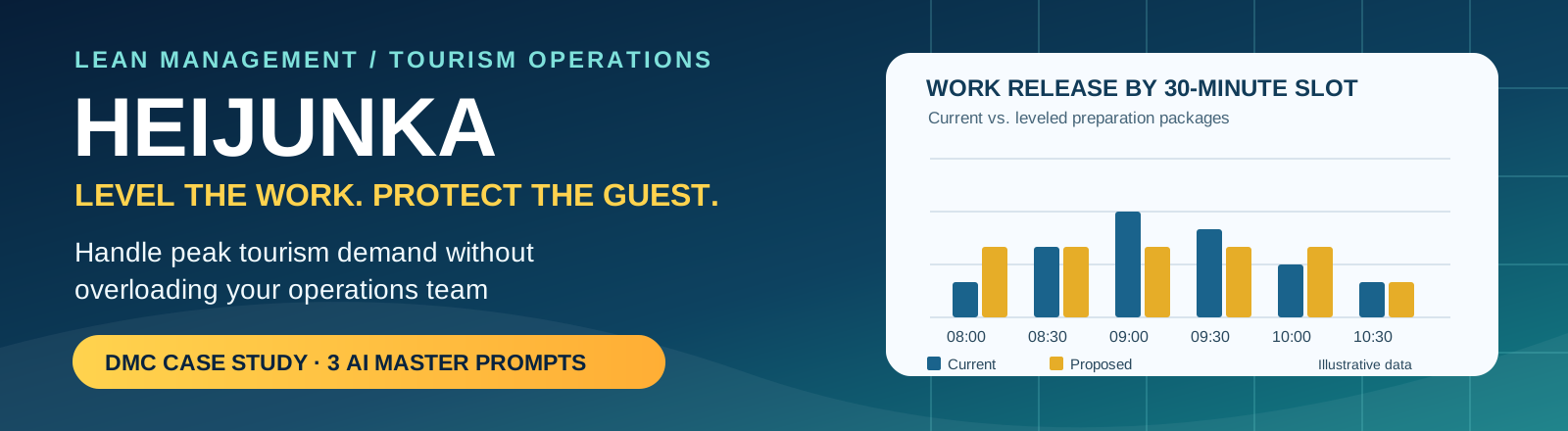
| Period | Current release | Proposed release |
|---|---|---|
| 08:00–08:30 | 4 | 8 |
| 08:30–09:00 | 8 | 8 |
| 09:00–09:30 | 12 | 8 |
| 09:30–10:00 | 10 | 8 |
| 10:00–10:30 | 6 | 8 |
| 10:30–11:00 | 4 | 4 |
| Total | 44 | 44 |
The total workload does not change.
Only the timing of eligible preparation work changes.
Under the proposed release pattern, the highest half-hour workload becomes:
8 packages × 6 minutes = 48 minutes
The maximum planned workload falls from 72 to 48 minutes per half-hour.
This represents a reduction of:
(72 − 48) ÷ 72 × 100 = 33.3% in peak released workload
It is not a 33.3% reduction in total labor hours, payroll expense or customer demand.
The team still performs 264 minutes of preparation work.
The potential benefit is a less concentrated workload and more available capacity during the original peak.
Important feasibility conditions
- The reassigned packages can genuinely be prepared in their proposed time windows.
- Guest and supplier information is available and sufficiently reliable.
- Earlier preparation does not create unacceptable stale-data risk.
- All packages still meet their individual deadlines.
- Staff have the necessary skills and access rights.
- Earlier work does not displace more urgent commitments.
- A controlled revalidation step is retained when circumstances change.
If these conditions fail, the schedule must be redesigned.
A visually balanced chart is not proof of a feasible operating plan.
7. Visualizing the workload
Figure 1 — Current versus proposed preparation releases
Use a grouped vertical column chart with six time periods on the horizontal axis and package counts on the vertical axis.
Current state: 4, 8, 12, 10, 6, 4.
Proposed state: 8, 8, 8, 8, 8, 4.
The chart should show that the proposed plan reduces the highest release concentration without changing total work.
Figure 2 — Capacity comparison
Use vertical columns for the current and proposed peak workload, measured in minutes.
Current peak: 72 minutes.
Proposed peak: 48 minutes.
Add a horizontal reference line at 60 minutes of nominal half-hour capacity.
Nominal half-hour capacity: 60 minutes.
Figure 3 — Cumulative preparation workload
Use a cumulative line chart to show that the proposed schedule completes eligible work earlier while both plans finish the same total of 44 packages.
This is a different analytical purpose from the first two figures. A line chart is more appropriate here because it shows cumulative progress across time.
| By end of | Current cumulative | Proposed cumulative |
|---|---|---|
| 08:30 | 4 | 8 |
| 09:00 | 12 | 16 |
| 09:30 | 24 | 24 |
| 10:00 | 34 | 32 |
| 10:30 | 40 | 40 |
| 11:00 | 44 | 44 |
8. How to build a Heijunka box for tourism operations
A traditional Heijunka box is a visual planning system that organizes work by type and fixed time interval.
In manufacturing, cards can represent production instructions issued at regular intervals.
A tourism adaptation might use rows for work categories and columns for half-hour preparation periods.
Example: Tourism operations leveling board
| Work category | 08:00 | 08:30 | 09:00 | 09:30 |
|---|---|---|---|---|
| Transfer preparation | 2 | 2 | 2 | 2 |
| Excursion manifests | 2 | 2 | 2 | 2 |
| Hotel group documentation | 1 | 1 | 1 | 1 |
| Supplier validation | 1 | 1 | 1 | 1 |
This is a conceptual planning board, not the complete 44-package case-study schedule.
Each card should contain a reference ID, deadline, responsible role, work category, readiness status and escalation condition.
Avoid displaying unnecessary guest personal information on a shared board.
The difference between planning and dispatch
Advance preparation: Tasks that may be scheduled earlier when information and authorization are available.
Deadline-controlled work: Tasks that must be completed within a defined window.
Real-time response: Activities such as responding to a flight disruption or guest emergency.
Only the first category is a straightforward candidate for advance leveling.
The second requires careful deadline-based planning.
The third requires reserved response capacity rather than artificial smoothing.
9. Volume leveling versus mix leveling
A DMC may process the same number of preparation packages every half-hour and still experience uneven workload.
Why?
Because not all packages require the same amount of work.
For example:
| Package type | Illustrative standard time |
|---|---|
| Standard transfer confirmation | 4 minutes |
| Excursion manifest verification | 6 minutes |
| Complex group movement review | 12 minutes |
A period containing six standard confirmations requires approximately 24 minutes.
A period containing six complex group reviews requires approximately 72 minutes.
The number of packages is identical, but the labor content is very different.
This is why a mature Heijunka approach should consider work content and mix, not simply task counts.
Managers can estimate weighted workload as:
Planned work minutes = Σ (package quantity × validated standard processing time)
The standard times must be established from representative observations and updated when the process changes.
10. What about unpredictable flight arrivals?
A flight may arrive late, early or at a different terminal.
A tour may encounter traffic disruption.
A conference speaker may miss a connection.
These are genuine operational uncertainties.
Heijunka cannot remove them.
The objective is to reduce avoidable preparation peaks so that teams retain enough flexibility to respond when unexpected events occur.
- Reserving explicit response capacity for disruptions.
- Separating confirmed tasks from tasks waiting for external information.
- Establishing clear deadlines for supplier confirmations.
- Using flight-status monitoring with a human escalation owner.
- Revalidating documents when guest or transport information changes.
- Escalating predicted overload before it becomes a missed service commitment.
A perfectly flat utilization chart can be dangerous if it leaves no capacity for variation.
11. Hotel application: Group check-in preparation
Consider a hotel expecting three groups during the afternoon.
The arrival times are fixed by the guests' travel arrangements.
The hotel should not ask everyone to arrive earlier merely to improve the staff utilization chart.
Instead, it can investigate which preparatory activities are eligible for earlier completion.
Examples include room-block verification, welcome-material preparation, approved billing checks and group coordinator communication.
The front desk can use a visual board to track preparation readiness.
The board should separate:
- Ready and verified
- Awaiting information
- Requires revalidation
- Escalation required
Room assignment and personal data must remain within authorized hotel systems.
The hotel should also preserve appropriate arrival-time staffing and guest-service capacity.
The goal is to reduce last-minute preparation pressure, not move work so early that information becomes unreliable.
12. MICE application: Conference registration and supplier readiness
A conference may have a fixed opening time, a scheduled keynote and several simultaneous supplier activities.
These cannot all be shifted.
But eligible preparatory work may include badge printing, approved attendee-list reconciliation, equipment testing, signage preparation and supplier confirmation.
A leveling plan can distribute preparation over earlier periods while preserving final validation gates.
For example, badges might be prepared before the event, but an updated attendee list could require controlled corrections.
The event manager must decide what can be finalized, what remains provisional and what must be checked immediately before use.
This distinction is essential in applying manufacturing concepts to service operations.
13. Calculating whether Heijunka creates financial value
In the fictional DMC example, total preparation time remains 264 minutes.
Therefore:
Direct labor minutes saved = 0
It would be misleading to claim an 18-minute or 24-minute labor saving simply because the peak was reduced.
The potential financial benefits, if measured, may come from fewer overtime events, reduced avoidable rework, fewer missed deadlines or more reliable service delivery.
For example, assume a pilot later documents a reduction of 20 overtime minutes per operating day, with 20 comparable operating days per month.
20 × 20 = 400 overtime minutes.
400 ÷ 60 = 6.67 hours.
At an illustrative incremental overtime cost of €15 per hour:
6.67 × €15 = approximately €100 per month.
This would be an estimated avoided incremental overtime cost only if the overtime reduction were actually observed, attributable and reflected in paid hours.
It is not a result demonstrated by the case study.
Never convert theoretical capacity into claimed financial savings without evidence.
14. Seven-day Heijunka pilot
Day 1 — Define the service boundary
Choose one repeatable workflow, such as pre-departure preparation for airport transfers. Record guest commitments, operational deadlines and non-negotiable safety controls.
Day 2 — Collect task data
Capture arrival times, release times, processing times, readiness conditions, rework, interruptions and actual completion deadlines. Use representative observations rather than estimates alone.
Day 3 — Visualize the current state
Create vertical workload charts by time interval. Separate genuine demand spikes from internally created batching and delayed work release.
Day 4 — Design a future-state sequence
Identify tasks eligible for earlier preparation. Create a leveling board and validate capacity, task dependencies, skills and deadlines.
Day 5 — Conduct a controlled pilot
Test the new release schedule on a limited, low-risk workflow. Keep the previous process available as a fallback.
Day 6 — Review results
Compare peak workload, late completion, rework, overtime, escalations and guest-service outcomes.
Day 7 — Decide
Adopt, revise or reject the proposed change based on evidence. Update standard work only after the process owner approves the results.
15. KPIs to measure
| KPI | Why it matters |
|---|---|
| Peak workload minutes per interval | Shows concentrated work |
| Workload variation between intervals | Measures unevenness |
| On-time preparation completion | Protects deadlines |
| Rework rate | Detects premature or incorrect preparation |
| Overtime minutes | Tracks possible financial impact |
| Escalations and service failures | Protects guest outcomes |
| Response-capacity availability | Checks resilience during disruption |
A successful pilot should not be judged solely by flatter workload columns.
It must also preserve or improve the quality and reliability of service.
16. Using AI to support Heijunka
AI can help structure task data, calculate workload by interval, identify potential release alternatives and explain operational trade-offs.
It can also generate draft charts, suggest a pilot design and flag missing assumptions.
However, AI cannot determine from a spreadsheet alone whether a guest manifest is safe to finalize early, whether a supplier agreement permits a change or whether staff are trained to perform a task.
Those decisions require authorized operational review.
The following prompts are designed to support analysis, not automatically implement operational changes.
AI Master Prompt 1 — Diagnose and level a tourism workflow
ROLE
Act as a Lean Management specialist with experience in destination management companies, hotel operations, tourism logistics and service workflow design.

OBJECTIVE
Evaluate a tourism workflow for opportunities to level eligible work volume and work mix using Heijunka.

INPUTS
I will provide:
1. Workflow description and service commitments
2. Task categories and volumes
3. Arrival times, release times and deadlines
4. Measured processing times
5. Staff availability, skills and capacity
6. Dependencies and information-readiness conditions
7. Required quality, privacy and safety controls

ANALYSIS REQUIREMENTS
1. Validate the completeness of the supplied data.
2. Separate fixed-time guest commitments from flexible preparation tasks.
3. Identify internally created batching and uneven release patterns.
4. Calculate total work minutes and workload by time interval.
5. Compare peak workload with validated capacity.
6. Analyze both task volume and task mix.
7. Propose a feasible future-state release schedule.
8. Preserve all deadlines, dependencies and mandatory checks.
9. Calculate current and proposed peak workload.
10. Clearly distinguish workload redistribution from actual labor savings.
11. Identify risks from stale information, premature preparation and insufficient response capacity.
12. Recommend operational safeguards and escalation thresholds.

REQUIRED OUTPUT
A. Executive summary
B. Data quality and assumptions table
C. Current-state interval workload table
D. Proposed future-state workload table
E. Vertical column chart specifications
F. Current versus proposed calculations
G. Deadline and dependency validation
H. Risks and mitigations
I. Seven-day pilot plan
J. KPIs and approval checklist

RULES
Never invent measured data.
Label all hypothetical examples.
Do not move fixed guest commitments without authorization.
Do not remove essential safety or quality checks.
Do not claim payroll savings from workload redistribution alone.
Ask for missing critical inputs before recommending implementation.
AI Master Prompt 2 — Build a tourism Heijunka box
ROLE
Act as a Lean visual-management designer and tourism operations planner.

OBJECTIVE
Design a Heijunka-style leveling board for eligible tourism preparation work.

WORKFLOW DETAILS
Organization type: [DMC / hotel / tour operator / MICE]
Planning horizon: [enter]
Time interval: [enter]
Work categories: [enter]
Task volumes: [enter]
Processing times: [enter]
Staffing and skills: [enter]
Task deadlines: [enter]
Information-readiness conditions: [enter]
Escalation requirements: [enter]

TASK
1. Define the planning boundary.
2. Separate flexible, deadline-controlled and real-time work.
3. Create a matrix with work categories as rows and time intervals as columns.
4. Calculate planned work minutes in every interval.
5. Check each interval against available capacity.
6. Include task ownership and release-readiness status.
7. Highlight predicted overload and missed deadlines.
8. Provide a legend and simple operating instructions.
9. Define when the board must be updated.
10. Specify how exceptions and urgent tasks will be handled.

DELIVERABLES
A. Readable Heijunka box
B. Workload calculations
C. Vertical capacity comparison chart
D. Standard operating instructions
E. Escalation and revalidation rules
F. Daily management checklist

CONSTRAINTS
Use only authorized, de-identified operational data.
Do not expose guest names or personal information.
Do not assign tasks to unqualified employees.
Do not schedule preparation before required information exists.
Do not assume that equal task counts mean equal workload.
Clearly mark any unverified assumption.
AI Master Prompt 3 — Independently audit a Heijunka improvement proposal
ROLE
Act as an independent Lean operations auditor with expertise in tourism service quality, operational risk and workload management.

OBJECTIVE
Critically review a proposed Heijunka implementation and identify unsupported claims, unsafe assumptions or mathematical errors.

MATERIALS
I will provide:
1. Current-state workflow
2. Proposed future-state schedule
3. Workload calculations
4. Staffing and capacity assumptions
5. Service deadlines and guest commitments
6. Risk assessment
7. Proposed KPIs and financial benefits

AUDIT PROCEDURE
1. Recalculate every total, percentage and capacity figure.
2. Verify that current and proposed task totals reconcile.
3. Identify any work that has been hidden, omitted or double-counted.
4. Check whether tasks are genuinely eligible for earlier preparation.
5. Test information availability and task dependencies.
6. Verify that fixed guest commitments remain protected.
7. Assess staffing qualifications and response-capacity requirements.
8. Evaluate the risk of stale data and repeated validation.
9. Challenge any claimed labor savings or financial return.
10. Identify possible adverse effects on guests, suppliers and employees.
11. Recommend measurable pilot acceptance criteria.
12. Produce a go / revise / no-go recommendation.

OUTPUT FORMAT
A. Audit verdict
B. Verified calculations
C. Material assumptions
D. Critical operational risks
E. Unsupported claims
F. Required corrective actions
G. Pilot acceptance criteria
H. Final management decision checklist

AUDIT RULES
Be skeptical and evidence-based.
Never invent missing operational facts.
Distinguish observations from assumptions.
Treat guest safety, service deadlines and data protection as mandatory constraints.
A flatter chart is not sufficient evidence of improvement.
17. Common mistakes when implementing Heijunka
Mistake 1: Trying to flatten real guest demand. Actual flight arrivals and event schedules are constraints, not simply scheduling preferences.
Mistake 2: Measuring task counts without processing time. Ten complex tasks may require far more work than ten simple ones.
Mistake 3: Moving preparation too early. Information may change, creating rework or service risk.
Mistake 4: Planning at 100% capacity. A schedule without interruption or response capacity is fragile.
Mistake 5: Claiming savings that were never measured. Redistributed work is not automatically eliminated work.
Mistake 6: Treating AI output as an approved operating procedure. Human validation and management authorization remain necessary.
Mistake 7: Using a leveling board without daily management. A board is only useful when its information is accurate, current and acted upon.
18. Frequently asked questions
Is Heijunka suitable for service industries?
Yes, as an adaptation of the manufacturing concept, particularly where work can be prepared, sequenced or released within controlled time windows. It is less directly applicable to unpredictable, immediate guest-facing demand.
Is Heijunka the same as staff scheduling?
No. Staff scheduling determines who is available. Heijunka focuses on the volume, mix and timing of work released into a process. Both need to be coordinated.
Can Heijunka reduce staffing costs?
Possibly, if a measured implementation reduces actual overtime, rework or other costs. A smoother chart alone does not establish financial savings.
What is the difference between Heijunka and Kanban?
Heijunka concerns leveling the production or work-release pattern. Kanban is a signaling mechanism commonly used to control replenishment or workflow. A Heijunka box can use Kanban cards.
Can AI create a Heijunka schedule?
AI can propose a schedule from supplied constraints, but it must be checked against actual task dependencies, information availability, staffing capability and service commitments.
Does Heijunka eliminate demand peaks?
No. It can reduce avoidable variation in eligible work release, but it cannot eliminate all real-world demand variation.
Conclusion: Level the work you can control
Tourism operations will always face uncertainty.
Flights will be delayed. Guests will arrive in waves. Events will run against fixed schedules, and suppliers will occasionally fail.
Heijunka does not make those realities disappear.
What it offers is a disciplined way to ask:
Are we overloaded because customer demand is genuinely unavoidable—or because our own operating system releases too much work at once?
That question can reveal opportunities to prepare earlier, sequence work more intelligently and preserve capacity for the unexpected.
For tourism leaders, the objective is not simply a smoother schedule.
It is a more reliable service operation that protects guests, employees and essential controls.
References and further reading
- Lean Enterprise Institute — Heijunka
- Lean Enterprise Institute — Heijunka Box
- Toyota UK — Heijunka: Toyota Production System Guide
- Lean Management Institute — Heijunka
- Lean Enterprise Institute — 6 Guidelines for Moving Toward a Lean Value Stream
Editorial note: These sources support the underlying manufacturing concepts. The tourism applications, numerical examples, proposed pilot and AI prompts are original educational adaptations, not claims that the cited organizations tested this DMC scenario.
Continue Learning: Explore More Lean Management Lessons
Build on this Heijunka lesson with related educational resources from the Ahmed Quality Ops Knowledge Library.
1. Yamazumi — Balance the Workload
Learn how stacked workload charts reveal uneven assignments, overloaded roles and opportunities to rebalance operational tasks.
Read the related article · Watch the related video
2. Lean Thinking — Identify Waste
Understand how Lean principles help tourism teams recognize waste, reduce unnecessary activities and improve customer value.
Read the related article · Watch the related video
3. SIPOC — Understand the Entire Process
Identify suppliers, inputs, process steps, outputs and customers before redesigning a tourism workflow.
4. Process Mapping — Understand the Workflow Before Changing It
Learn why mapping a process helps expose dependencies, handoffs and operational weaknesses before introducing improvements.
5. Operational KPIs — Measure Improvement
Explore practical performance measures that help teams evaluate process reliability, operational variation and service outcomes.
6. Operational Excellence — Connect the Tools
Understand how Lean Management, process controls, improvement routines and management oversight fit into a broader tourism operating system.
Watch more educational videos: Ahmed Quality Ops on YouTube
Explore more practical lessons: Ahmed Quality Ops Knowledge Library