

- Who this helps
- Tourism operations managers, product teams, guides, sales teams and quality leads.
- What you can do
- Choose the relevant toolkit and structure tourism AI tasks around operating context, evidence and human review.
100+ Ready-to-Use AI Prompts, Templates, and Workflows for Modern Tourism Teams
Built for the real work behind tours, transfers, products, itineraries, quotations, guest journeys and quality systems. The playbook combines tourism operating experience with professional prompt design, responsible controls and copy-ready implementation.
#AI becomes useful when tourism expertise controls the prompt
Tourism professionals do not need a library of clever sentences. They need repeatable ways to prepare a guide, review a tour file, challenge an itinerary, organise a pickup plan, draft a proposal, respond to a complaint and improve a process without losing factual control.
The series uses one method across every department: define the real task, supply only approved context, show missing information, specify the output and keep human accountability visible. This makes the articles a connected operating playbook rather than ten unrelated collections.
It is the practice of translating tourism expertise, operational context, verified facts, output requirements and approval rules into a structured instruction for an AI system.
#The TRAVEL prompting framework
Every template in this playbook follows one memorable structure. The aim is not to make prompts longer for their own sake. It is to place the information, controls and approval points that a tourism professional needs in the right order.
state the professional perspective and the business decision to support.
include the destination, service type, timing, guest journey stage and confirmed constraints.
define the guest or client profile and provide only verified, permitted information.
require source labels, assumptions, uncertainty flags and a check against official or approved records.
specify the exact structure, priority order, tone, length and escalation path.
prohibit invention, protect data and identify who approves the final output.
In one sentence: a professional tourism prompt identifies the task, supplies the real operating context, defines the audience and approved inputs, demands a verifiable structure, explains exceptions and keeps privacy plus final authority with a human.
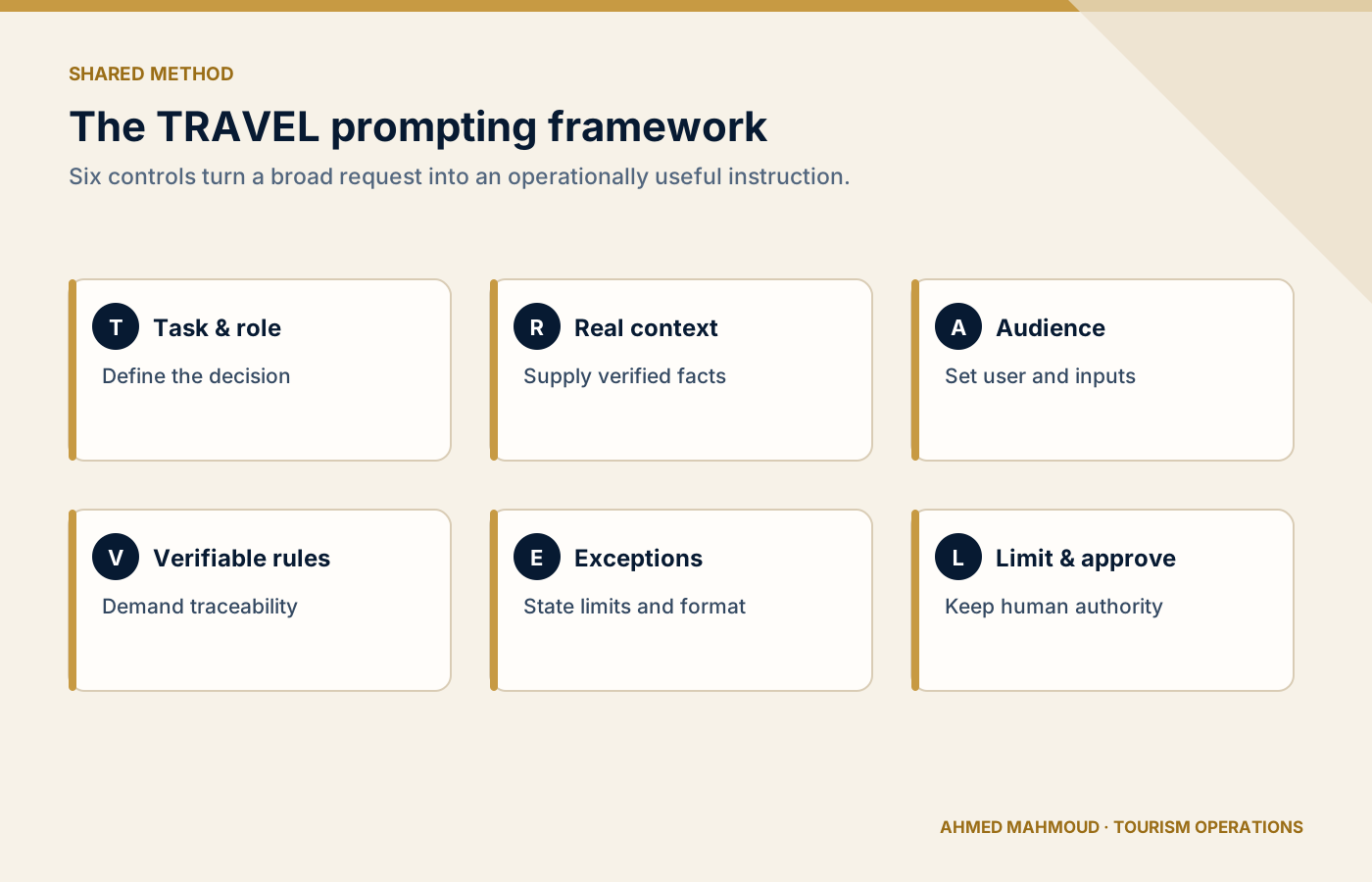
The six TRAVEL controls place context, evidence and human authority in a memorable order.
On small screens, scroll the diagram horizontally to read its labels.
#How to use the copy-ready prompts
Start from a specific tourism decision or communication, not from a general request to “make it professional”.
Use confirmed files, systems, official sources and current supplier information. Remove unnecessary personal data.
Replace every bracketed placeholder. Keep the limitations, missing-information stop and verification section.
Look for invented facts, hidden assumptions, false precision, cultural risks and decisions outside the employee’s authority.
Have the qualified owner review the result and record the approved prompt version when it becomes part of a workflow.
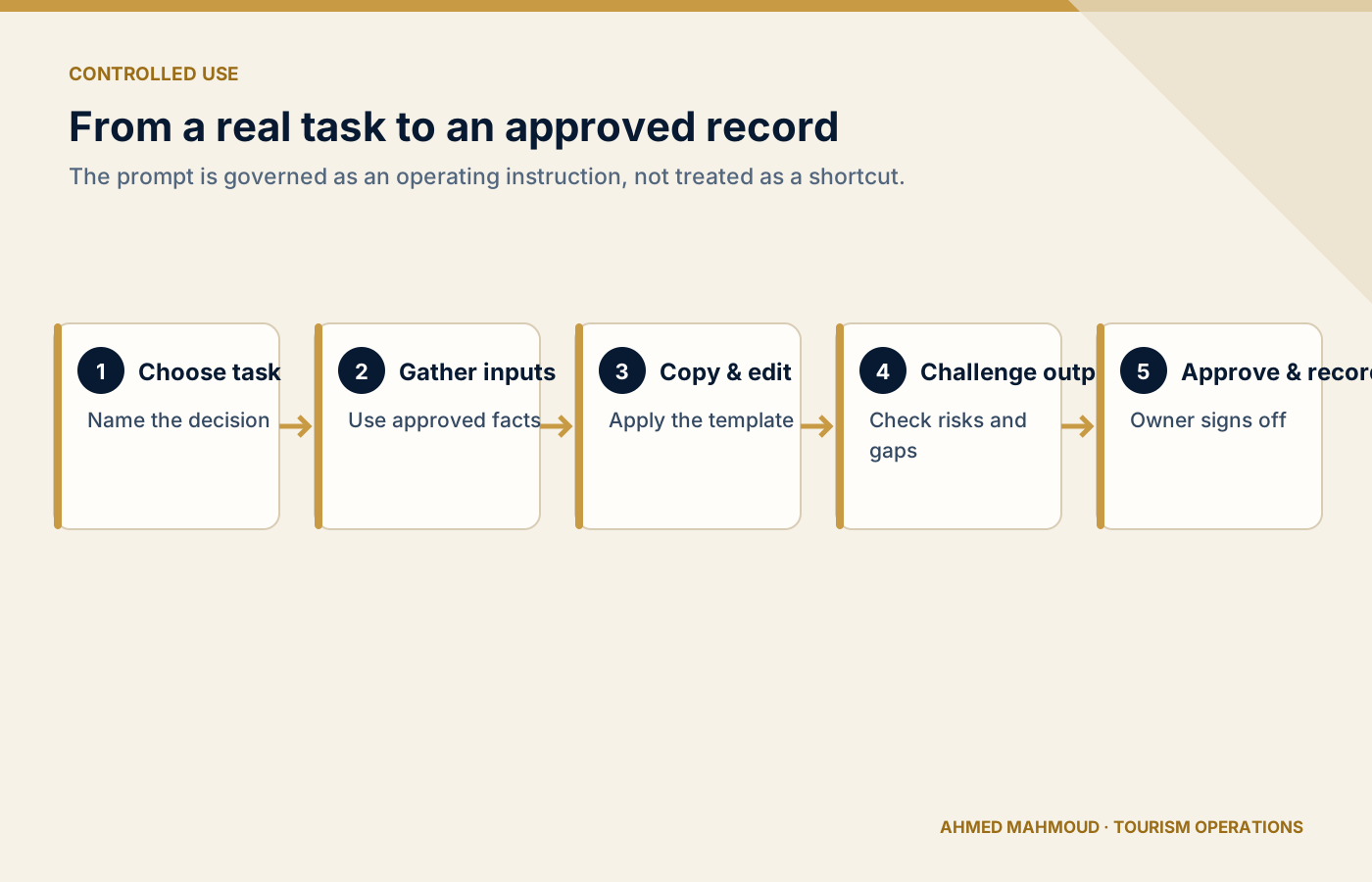
A controlled sequence keeps generated work attached to approved inputs and an accountable owner.
On small screens, scroll the diagram horizontally to read its labels.
#AI output is a draft until a tourism professional verifies it
Do not enter unnecessary guest data, passport information, payment details, confidential supplier rates or private contracts into an unapproved AI tool. Do not allow a model to confirm availability, change a service, promise compensation, approve a quotation or make a safety decision.
#Prompt-verification checklist
- The source of every dynamic fact is known and current.
- Missing inputs are visible and assigned to an owner.
- Confirmed facts are separated from assumptions and recommendations.
- Guest and commercial data are minimised.
- The output respects operational, safety and financial authority.
- A named human reviewer approves the final use.
#Ten connected Tourism AI Operations articles
Start with the framework, choose the toolkit closest to your role and finish with the governance guide. Each card shows the audience, operational focus and connected website resource.
#The Tourism Prompting Framework: How to Write Professional AI Prompts for Travel and Tourism
A Practical Guide to Roles, Context, Guest Profiles, Operational Data, Output Formats, and Verification Rules
Learn the TRAVEL prompting framework and use ten professional templates to create safer, clearer and more useful AI instructions for tourism work.
- For
- All tourism teams
- Templates
- 10 professional prompts
- Reading time
- 24–28 minutes
- Operational areas
- Prompt design · Context · Verification
#Front-Line Tourism AI Toolkit
Ready-to-Use AI Prompts for Tour Preparation, Destination Storytelling, Guest Engagement, Complaints, Multilingual Communication, and Service Excellence
Ten detailed AI prompt templates for tour preparation, storytelling, multilingual communication, delays, complaints, role-play and post-tour reporting.
- For
- Guides and guest-facing teams
- Templates
- 10 professional prompts
- Reading time
- 25–29 minutes
- Operational areas
- Guiding · Storytelling · Guest contact
#The DMC Operations AI Toolkit: 10 Ready-to-Use Prompts for Daily Tour Operations
Professional AI Templates for Dispatch, Guide Assignment, Supplier Coordination, Tour Monitoring, Delays, and Operational Reporting
Ten copy-ready prompts designed around real DMC tour files, assignments, supplier confirmations, movement plans, disruptions and handovers.
- For
- DMC operations teams
- Templates
- 10 professional prompts
- Reading time
- 27–31 minutes
- Operational areas
- Dispatch · Assignments · Suppliers
#Transport and Dispatch AI Toolkit
Ready-to-Use AI Templates for Hotel Pickup Planning, Vehicle Allocation, Driver Briefings, Route Risks, and Transport Reporting
Ten detailed prompts for hotel pickup sequencing, zone planning, vehicle checks, driver briefings, late vehicles, drop-offs and fleet reporting.
- For
- Dispatch and fleet teams
- Templates
- 10 professional prompts
- Reading time
- 27–31 minutes
- Operational areas
- Pickup · Routing · Fleet
#The Tourism Product Development AI Toolkit: 10 Prompts for Building Better Tours and Experiences
Professional AI Templates for Itinerary Design, Product Review, Market Adaptation, Seasonal Planning, and Experience Innovation
Ten professional prompts for tour concepts, product gaps, family, luxury and accessible adaptations, seasons, events, competitors and feasibility.
- For
- Product and destination teams
- Templates
- 10 professional prompts
- Reading time
- 27–31 minutes
- Operational areas
- Product · Market · Feasibility
#The Tourism Itinerary AI Toolkit: 10 Prompts for Realistic and Guest-Centred Travel Planning
Ready-to-Use AI Templates for Multi-Day Programs, Timing, Transfers, Meals, Attractions, Guest Preferences, and Operational Feasibility
Ten copy-ready AI prompts for one-day, multi-day, stopover, cruise, family, luxury, accessible and weather-resilient itineraries.
- For
- Itinerary planners and consultants
- Templates
- 10 professional prompts
- Reading time
- 27–31 minutes
- Operational areas
- Timing · Transfers · Accessibility
#Sales and Quotation AI Toolkit
Professional AI Templates for Tour Quotations, Sales Emails, Client Proposals, Follow-Ups, Objection Handling, and Partnership Development
Ten detailed prompts for tourism quotations, B2B proposals, discovery, follow-ups, objections, reactivation and commercial quality review.
- For
- Sales and quotation teams
- Templates
- 10 professional prompts
- Reading time
- 27–31 minutes
- Operational areas
- B2B proposals · Quotations · Follow-up
#The Guest Experience AI Toolkit: 10 Prompts for Communication, Complaints, and Service Recovery
Ready-to-Use AI Templates for Pre-Arrival Messages, Tour Updates, Guest Complaints, Review Analysis, and Post-Experience Follow-Up
Ten practical prompts covering pre-arrival communication, pickup reminders, delays, complaints, recovery, reviews and journey improvement.
- For
- Guest-experience and service teams
- Templates
- 10 professional prompts
- Reading time
- 26–30 minutes
- Operational areas
- Guest journey · Complaints · Recovery
#Quality and SOP AI Toolkit
Professional AI Templates for SOP Development, Root-Cause Analysis, Incident Reporting, Training, Audits, and Corrective Actions
Ten tourism-specific AI prompts for SOPs, process maps, Five Whys, fishbone analysis, incidents, CAPA, audits, training and quality reporting.
- For
- Quality, SOP and operations leaders
- Templates
- 10 professional prompts
- Reading time
- 28–32 minutes
- Operational areas
- SOP · Root cause · CAPA
#Responsible AI for Tourism: A Practical Governance Guide for Travel Companies
How to Protect Guest Data, Verify AI Outputs, Control Prompt Usage, Reduce Risk, and Maintain Human Accountability
A practical tourism governance guide with ten templates for risk, verification, privacy, cultural sensitivity, approvals, policies and AI reviews.
- For
- Managers, governance and training teams
- Templates
- 10 professional prompts
- Reading time
- 28–32 minutes
- Operational areas
- Privacy · Governance · Accountability
#Build an approved prompt library, not an uncontrolled folder
An operational prompt library should show its owner, department, permitted tool, approved version, data restrictions, test cases, final reviewer and next review date. High-impact prompts should have stronger access controls and evidence requirements than low-risk drafting aids.
| Control field | Purpose |
|---|---|
| Prompt owner | Accountable for content and review. |
| Risk tier | Determines testing and approval depth. |
| Approved tool | Prevents use in uncontrolled systems. |
| Data rules | Defines permitted and prohibited inputs. |
| Version and date | Keeps changes traceable. |
| Human approver | Names the final decision owner. |
Scroll horizontally to read every column. Keyboard: focus the table, then use the arrow keys.
What to learn: Read each row across to connect Control field with Purpose. Compare the rows to identify the relevant control field for your situation; use the accompanying section to interpret the result.
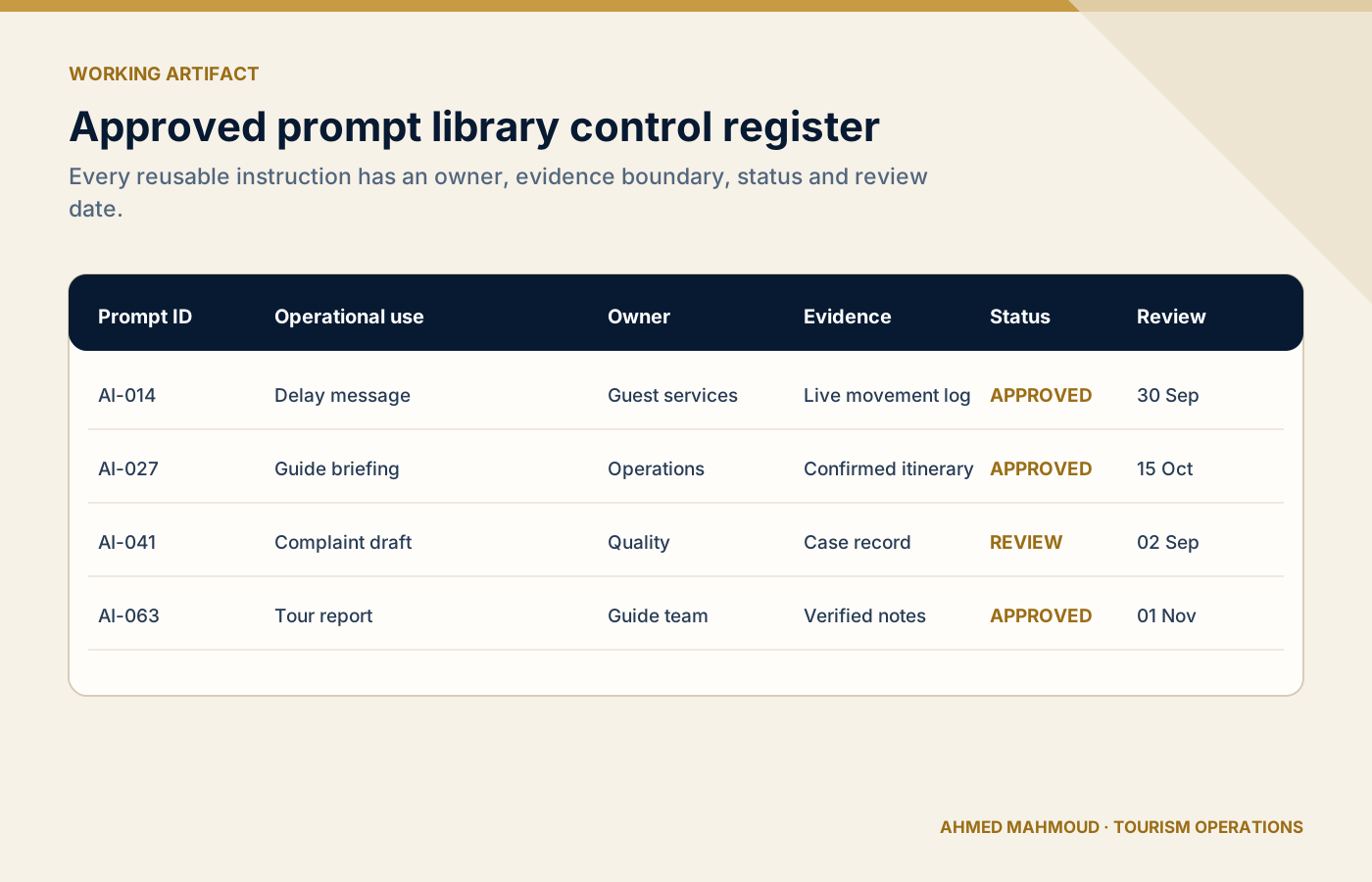
A governed library records ownership, evidence boundaries, approval status and review dates.
On small screens, scroll the diagram horizontally to read its labels.
#Projects and existing insights connected to the series
#Explore, download and improve the Playbook on GitHub
The website provides the polished reading experience. The public GitHub repository provides the complete source library, individual prompt files, structured data, release history and a transparent contribution workflow.
#Browse the repository
Review the full project structure, documentation, licences, version history and responsible-use controls.
Open the repository ↗#Download a release
Access packaged editions, release notes and source archives for controlled versions of the Playbook.
View current releases ↗#Contribute an idea
Suggest a tourism scenario, translation, verification improvement or responsible-AI safeguard through GitHub.
Suggest an improvement ↗Two connected experiences: use Ahmed Quality Ops for guided reading and professional context; use GitHub for files, versions, downloads and community participation.
#Using AI prompts in tourism operations
What is the Tourism AI Operations Playbook?
It is a ten-article professional learning series with 100 detailed copy-ready prompts, operating guidance, verification controls and connected tourism resources.
Who should use the playbook?
DMC teams, tour operators, guides, product managers, itinerary planners, sales teams, dispatchers, guest-experience teams, quality managers, trainers, students and travel-business owners.
Can the prompts be copied directly?
Yes. Every prompt has a copy button and editable placeholders. Users must replace placeholders with approved facts and complete human verification before operational use.
Does the playbook replace tourism expertise?
No. It is designed to make tourism expertise easier to apply consistently. Dynamic facts, safety, privacy, commercial commitments and live decisions remain human responsibilities.
How should a company create an approved prompt library?
Start with low-risk tasks, assign an owner, test realistic cases, document the approved version, restrict access, train users, record incidents and review the prompt whenever the process or risk changes.
#Begin with a framework you can teach across every tourism department
Article 1 explains the complete TRAVEL method, ten prompt-building templates and the quality controls behind the remaining toolkits.
Read the Tourism Prompting FrameworkConnect this guide to your next step
Continue with related methods and the wider series.
- Related guideThe DMC Operations AI Toolkit: 10 Ready-to-Use Prompts for Daily Tour Operations
DMC operations teams can use AI to organise files, identify gaps and structure briefs, but confirmations, assignments and disruption decisions must stay in approved systems.
- Related guideFront-Line Tourism AI Toolkit
Front-line teams can use AI to prepare, practise and communicate more consistently, while verified facts, empathy, safety and live decisions remain with the employee.
- Related guideThe Guest Experience AI Toolkit: 10 Prompts for Communication, Complaints, and Service Recovery
AI can support consistent guest communication and feedback analysis, while facts, privacy, empathy, recovery authority and accountability remain human responsibilities.
Put this article into practice
- Choose the relevant toolkit and structure tourism AI tasks around operating context, evidence and human review.
- The source of every dynamic fact is known and current.
- Missing inputs are visible and assigned to an owner.
- Confirmed facts are separated from assumptions and recommendations.
Your next step
Use this connected method when you are ready to specify the task, operating context, verified inputs, output requirements and human checks in a professional prompt.
Review The Tourism Prompting Framework: How to Write Professional AI Prompts for Travel and Tourism